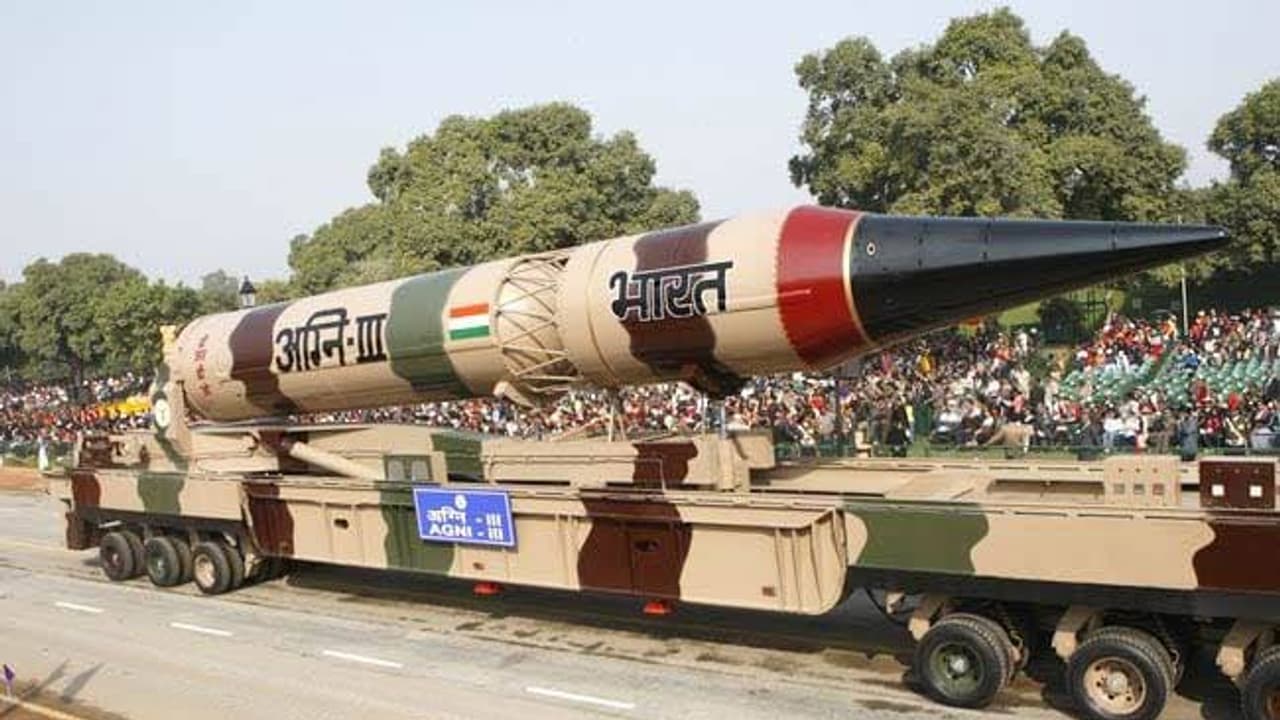
India on Friday successfully test-fired Intermediate Range Ballistic Missile (IRBM) Agni-3, with a strike range of 3,000-km, from the Integrated Test Range, Chandipur, Odisha.
New Delhi: India on Friday successfully test-fired Intermediate Range Ballistic Missile (IRBM) Agni-3, with a strike range of 3,000-km, from the Integrated Test Range, Chandipur, Odisha. Conducted by the Strategic Forces Command, the Agni-3 test-firing validated all operational and technical parameters.
With this test, the Agni series of missiles continues to strengthen India’s strategic capabilities.
The series includes Agni-1 with a range of 700 km, Agni-2 with a range of 2,000 km, Agni-3 with a range of 3,000 km, Agni-4 capable of striking targets up to 4,000 km, and Agni-5, which has the longest striking range of 5,000 km.
Internationally, the intermediate-range ballistic missiles (IRBMs) are classified as 5,000 km range.
Scroll to load tweet…
The Agni category missiles are solid propelled ballistic missiles, ranging from short range missiles to intermediate range missiles (700-5000kms) with road and rail mobility providing greater chances of survivability during an enemy attack.
This strengthens its scope of launching a counter/second strike.
This makes India one of the few countries in the world with the ability to potentially decapitate its enemy by preserving its arsenal in the first attack from the enemy.
China has about 600 nuclear warheads, while India has 180, according to the Stockholm International Peace Research Institute.
Just days ahead of Prime Minister Narendra Modi’s visit to China to participate in the Shanghai Cooperation Organisation (SCO) Summit last year, India successfully tested its Agni-5, an intermediate-range ballistic missile capable of carrying a nuclear warhead into China.