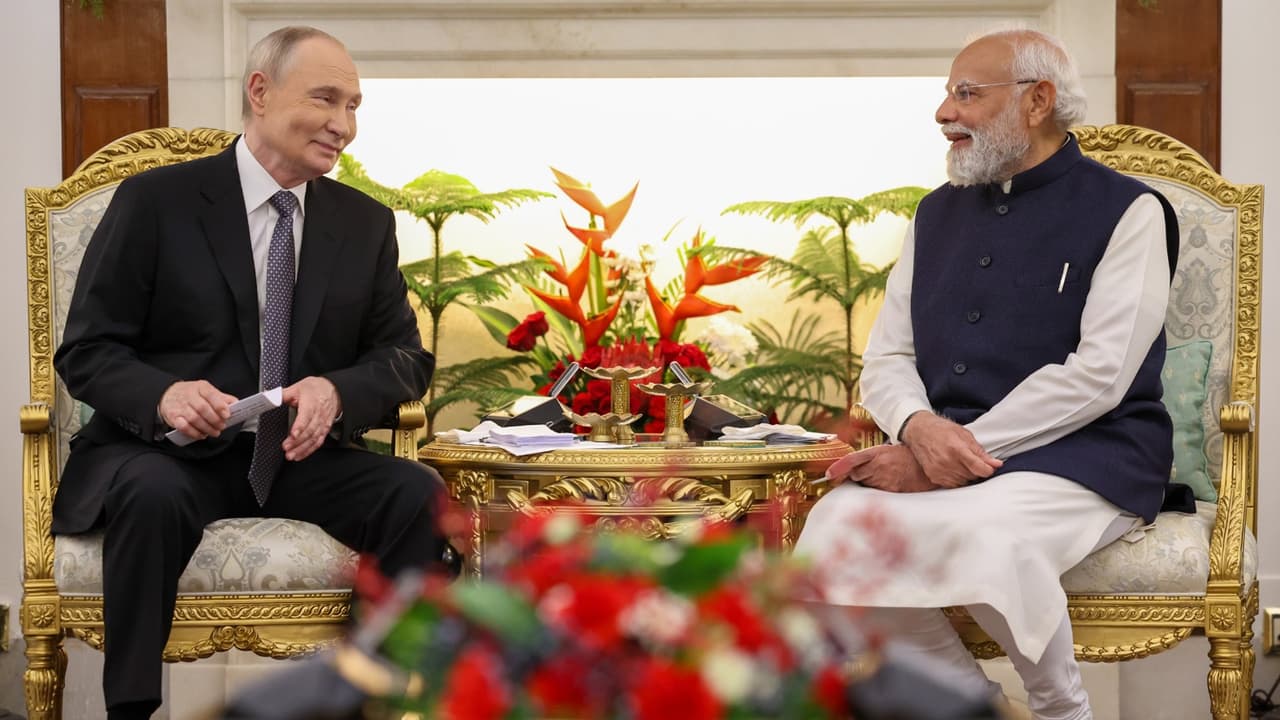
During the 23rd India–Russia Annual Summit, President Putin and PM Modi signed major agreements to boost trade to $100 billion, ensure energy security, and expand defence and nuclear cooperation.
India’s long-standing partnership with Russia received a fresh boost this week as President Vladimir Putin arrived in New Delhi for the 23rd India–Russia Annual Summit, his first official visit since the war in Ukraine began in 2022.
Over two days, December 4 and 5, both sides signed a series of long-term agreements covering trade, defence production, nuclear energy, and fertilisers. The message was clear: despite global volatility, New Delhi and Moscow want to modernise and broaden their economic and strategic ties.
Economists say the outcomes of this summit could reshape India’s supply chains, strengthen its export profile, and open new avenues for technology cooperation. But one big question looms: will these deals help India navigate growing tariff pressure from the US?
What India and Russia Agreed On
1. A Big Trade Push: $100 Billion by 2030
Prime Minister Narendra Modi and President Putin reaffirmed their plan to scale up bilateral trade, with both leaders adopting Program 2030, a detailed roadmap aimed at deeper economic collaboration.
The ambition is bold: raise India–Russia trade to $100 billion by the end of the decade.
Economist Sugandha Sachdeva says the meeting signals a “renewed push to widen strategic, economic and high-technology dimensions” of the partnership.
2. Energy Security: Russia Promises Uninterrupted Fuel
Putin assured India that Russian oil supplies, now a crucial part of India’s energy mix, will continue without disruption. Both sides highlighted that energy cooperation remains a “significant pillar” of their strategic relationship.
3. Defence Production Inside India
A major focus was on expanding joint manufacturing of spare parts and components for Russian-origin equipment used by India’s military.
This includes:
- deeper technology transfer
- Make-in-India joint ventures
- the possibility of exporting these components to friendly countries
The idea is to reduce long-term dependence on imported parts for legacy Russian systems.
4. Nuclear Energy: Talks on a Second Power Plant
India and Russia discussed building a second nuclear power plant equipped with Russian reactors. Despite shifting global geopolitics, nuclear cooperation between the two countries remains strong and steady.
5. Fertiliser Pact: A $1.2 Billion Urea Plant
Indian PSUs RCF, NFL and IPL signed an MoU with Russia’s Uralchem to set up a $1.2 billion greenfield urea plant. This could secure India’s long-term fertiliser needs, a crucial factor for the agriculture-heavy economy.
Can These Deals Offset US Tariff Pressure?
The timing of the summit is important. India is currently facing a steep 50% tariff on exports to the US, imposed by President Donald Trump as retaliation for India’s continued purchase of discounted Russian oil.
While the new agreements with Russia offer long-term gains, experts caution that they cannot fully counterbalance the importance of India–US trade ties.
What Experts Are Saying
Geojit Investments’ Chief Investment Strategist VK Vijayakumar says that although the agreements look promising, several challenges remain:
- the rupee-rouble trade mechanism is still not robust
- many Russian banks remain cut off from SWIFT
- financial transactions continue to be complicated
These issues, he warns, could slow progress toward the $100 billion trade goal.
Vijayakumar adds that India does have room to increase exports of pharmaceuticals, marine products, agricultural goods and textiles to Russia, but “Russia–India agreements can’t compensate for trade issues with the US.”
A stable and balanced India-US trade relationship, he says, is essential for keeping the rupee steady and managing the trade deficit.
A Partnership Moving Beyond Oil and Defence
While oil and defence have traditionally defined India–Russia ties, this summit shows a clear shift toward:
- advanced technology
- industrial partnerships
- nuclear energy
- agriculture and fertilisers
- expanding Indian exports