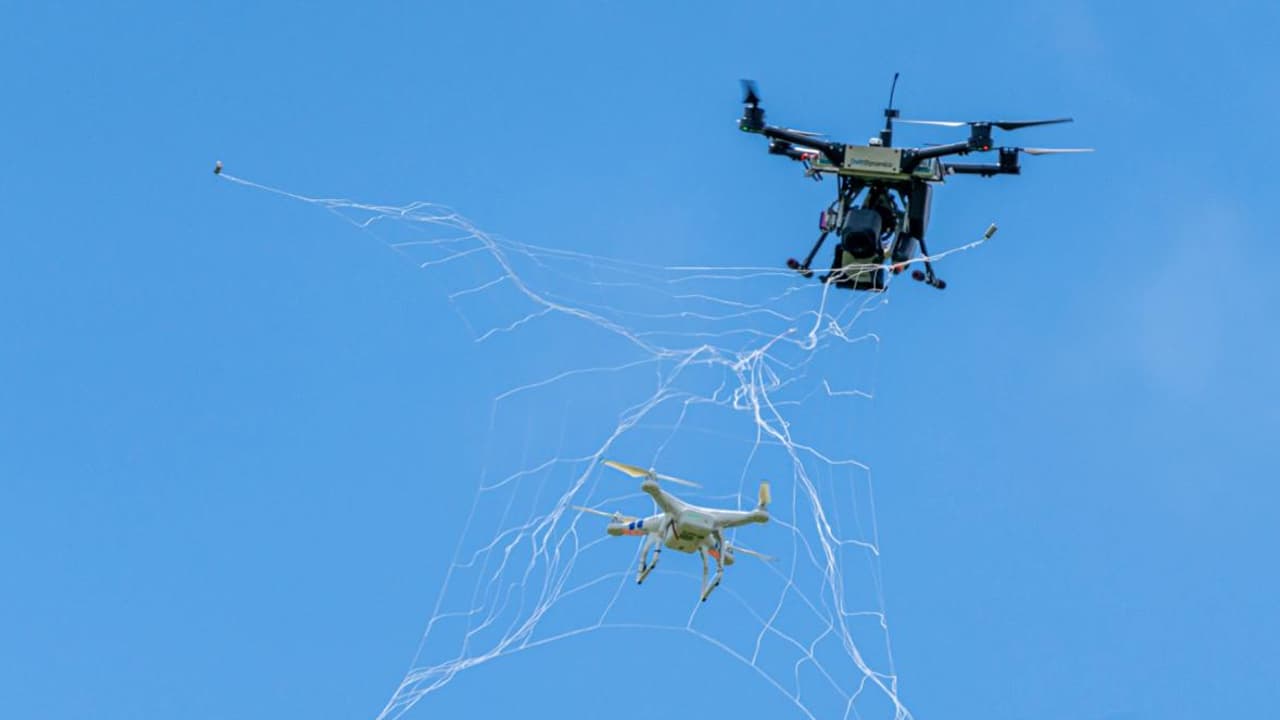
Defence Ministry has issued an RFI to procure a Drone Catcher System for Indian Army to counter low-RCS drones and swarm threats. The system will include an ESA-based 360-degree sensor, autonomous net-capture interceptor and Ground Control Station.
New Delhi: In a move aimed at countering the growing threat posed by low radar cross section (RCS) unmanned aerial systems (UAS), the defence ministry on Friday issued a Request for Information (RFI) for the procurement of a Drone Catcher System for the Indian Army.
While the ministry has not disclosed the number of systems planned for acquisition, the proposed solution will comprise primarily three key components — a drone sensor, a drone catcher, and a Ground Control Station (GCS).
The system is designed to detect, track, and neutralize low-RCS drones and UAS using a net-based interception mechanism.
According to the RFI, the system must be capable of operating independently or in conjunction with in-service air defence weapon systems and other counter-UAS (C-UAS) platforms. It should be deployable across diverse terrain conditions nationwide, including plains, deserts, and high-altitude areas.
Sources in the defence ministry said the requirement has been driven by the exponential rise in air threats from low-RCS drones and UAS, deployed either individually or in swarms. “The growing use of such platforms, including during Operation Sindoor, has underscored the need for a dedicated drone catcher capability,” a source said.
System Capabilities and Requirements
Drone Sensor
The drone sensor must be based on Electronically Scanned Array (ESA) technology or superior. It should be capable of scanning large volumes of airspace and provide 360-degree coverage to detect drone intrusions.
The sensors are required to perform simultaneous detection and tracking of at least 20 drones/UAS, detection, tracking, prioritization, and designation of hostile targets to the drone catcher via the GCS and minimum slant detection range of 4 km against a target with 0.01 sqm RCS.
Ground Control Station (GCS)
The GCS will act as the command node, relaying data from the drone sensor to the drone catcher through a secure data link. It will display telemetry information of hostile low-RCS drones/UAS, compute targeting solutions through an onboard microprocessor, and transmit actionable data to the drone catcher for interception.
The station will include a laptop or tablet-based interface for real-time monitoring and operational control.
Drone Catcher
The drone catcher must be fully autonomous in detecting and defeating aerial targets. Upon receiving target information from the GCS, it should acquire the designated target, intercept the hostile drone and neutralize it using a net-capture mechanism.
The system should be easy to operate and function either as a standalone unit or as part of an integrated Drone Catcher System.
Electronic Warfare Capabilities
In addition to physical interception, the system must include a jammer subsystem capable of electronic attack against hostile UAS. This should include RF denial, selective GNSS denial, GNSS deception, coverage across both standard and non-standard frequency bands.