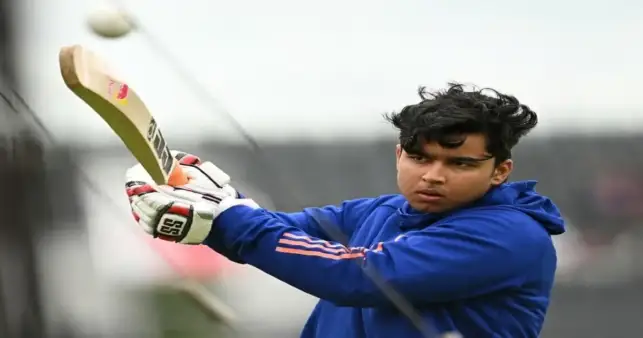
Vaibhav Sooryavanshi has already shown that the biggest stages do not easily overwhelm him. At 15, the left-handed batter has faced some of the most accomplished fast bowlers in world cricket and repeatedly responded with attacking strokes that appear beyond his years.
Jasprit Bumrah, Mitchell Starc, Pat Cummins and Kagiso Rabada have all featured among the high-profile bowlers he has encountered, while his international introduction also included a six against Jofra Archer. Yet an India-Pakistan contest at the Asian Games brings a different kind of pressure. For Sooryavanshi, the occasion represents another stage in his rapid development, one where the quality of the opposition is matched by the intensity surrounding the fixture.
The teenager’s rise has already been unusually rapid. His IPL performances announced him to a much wider audience, where his fearless strokeplay against established international bowlers became one of the defining aspects of his emergence. Rather than allowing the reputation of the opposition to dictate his approach, Sooryavanshi has generally attacked the ball with the same intent. That temperament was also evident during India’s Under-19 campaign, including the title-deciding match in which he produced one of his most significant performances. Even when the India-A triangular series did not unfold as smoothly for him, he responded when the stakes increased in the final. Those experiences matter because they have given him exposure to different forms of pressure before reaching this India-Pakistan encounter.
The challenge in Japan, however, is not simply about facing another set of bowlers. India-Pakistan cricket carries an intensity that can transform even routine moments into major talking points. For a teenager still at the beginning of his international career, that environment can test concentration, decision-making and the ability to remain connected to the immediate contest. Sooryavanshi’s attacking instincts are already well established, but international cricket also demands an understanding of when to absorb pressure, when to rotate the strike and when to attack. A high-profile game can therefore provide a different kind of education. Every delivery becomes part of a larger contest, and the ability to respond to setbacks can be as important as the spectacular shots that initially attract attention.
That developmental challenge is familiar to the Indian batting greats who became accustomed to India-Pakistan encounters at different stages of their careers. Sachin Tendulkar and Virat Kohli both experienced the extraordinary attention surrounding the rivalry, although their careers and circumstances were separated by generations. Tendulkar’s performances against Pakistan became an important part of his international story, particularly because he grew up playing in an era when bilateral and tournament encounters between the teams generated enormous attention. Kohli later experienced the same scrutiny, producing several memorable innings against Pakistan across formats and tournaments. Their careers demonstrate the scale of expectations that can accompany the fixture, but Sooryavanshi’s journey will necessarily be his own. At 15, he is still building the technical and mental foundations of a long international career.
For Sooryavanshi, the immediate task is therefore more straightforward than the enormous narrative surrounding the contest. He needs to read the conditions, assess the bowling attack and play the situation in front of him. His reputation for fearless batting can be an asset, but sustained success at the highest level requires more than aggression. The ability to adjust tempo, manage risk and recover from difficult passages is what eventually separates promising young players from established international performers. An India-Pakistan game can expose those qualities quickly because the pressure rarely remains confined to the scoreboard. A young batter must learn to distinguish the noise around the match from the information coming from the pitch.
The encounter also offers Sooryavanshi an opportunity to add another experience to a career that has moved remarkably quickly. He has already progressed from age-group cricket to the IPL and senior international cricket while facing bowlers whose names were familiar to him long before he shared the field with them. Now comes one of cricket’s most emotionally charged fixtures, where the attention surrounding the game can be as significant as the cricket itself. Whether he produces another spectacular innings or faces a difficult examination, the experience can contribute to his development. The larger lesson of India-Pakistan cricket, as generations of Indian batters have discovered, is that handling the occasion is part of handling the game. For Sooryavanshi, this pressure cooker is another chapter in learning how to turn extraordinary potential into sustained international cricket.