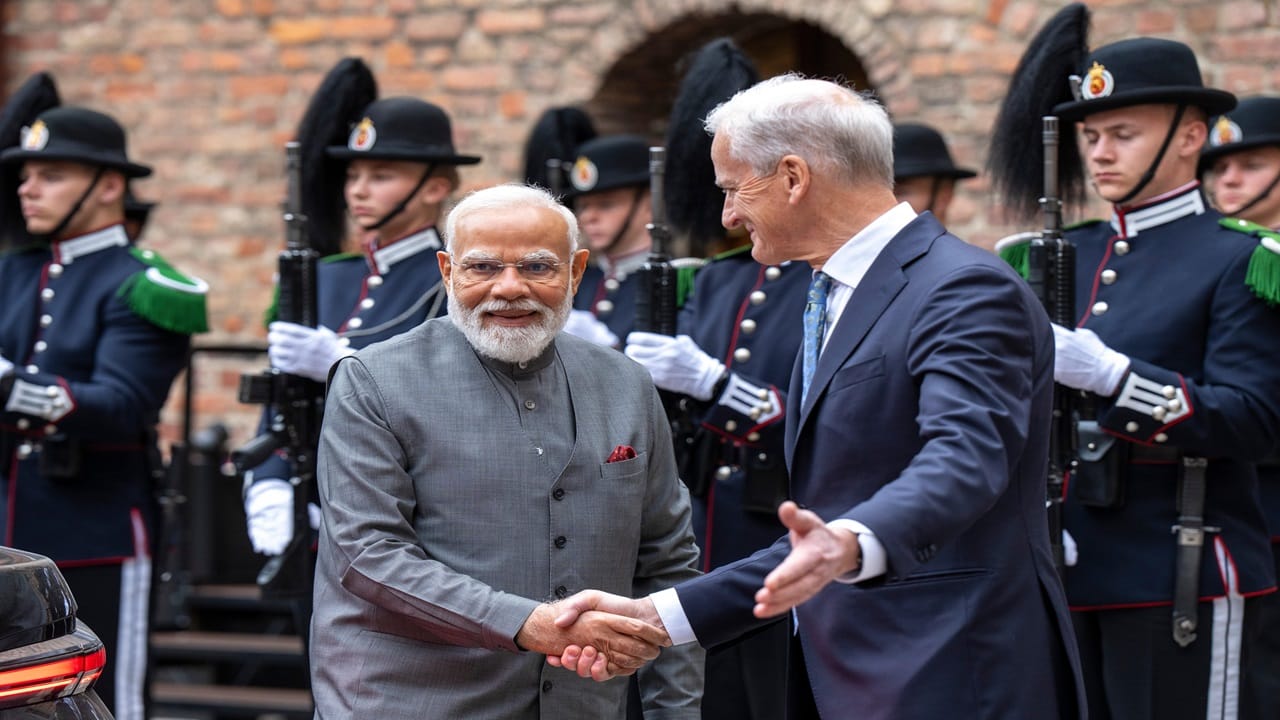
New Delhi: Prime Minister Narendra Modi, who is currently in Norway, will attend the India-Nordic summit on Tuesday. Among the countries that will attend the summit include Norway, Sweden, Finland, Iceland, and Denmark. The leaders are expected to discuss various issues during the summit.
While the first edition of India-Nordic Summit was held in Sweden’s capital of Stockholm in 2018, the second edition was held in Denmark’s capital of Copenhagen in 2022. Apart from PM Modi, his Norwegian counterpart Jonas Gahr Store, Danish counterpart Mette Frederiksen, Finnish counterpart Petteri Orpo, Icelandic counterpart Kristrún Frostadottir, and Swedish PM Ulf Kristersson will attend.
Among the issues to be discussed in the summit are climate change, trade, geopolitics and energy security. Stating on May 11, the Ministry of External Affairs said that the summit will “impart a more strategic dimension to India’s relationship with the Nordic countries, especially in technology and innovation, green transition and renewable energy, sustainability, blue economy, defence, space and the Arctic”. Notably, India’s exports to Nordic countries stood at $19bn in 2024.
Why India looking to strengthen its presence in the region?
Importantly, even if India do share any land or maritime border with Arctic countries, New Delhi has been engaged in the region since February 1920, after signing the Svalbard Treaty. Under the agreement, Norway has complete control over Svalbard. It also has the right to grant treaty access in various fields like hunting, fishing, commercial operations, industrial mining, among others in Svalbard.
One of the beneficiaries of this treaty, India provides access to carry out scientific studies in the region. New Delhi had sent a scientific expedition to do research in the Arctic region in 2007. A year later, it set up a research station named Himadri.
India deployed IndARC in 2014
India also deployed IndARC in 2014, which was the country’s first underwater moored observatory. Apart from carrying out scientific research, India is also looking to increase its strategic and economic footprint in the Arctic region, which is rich in hydrocarbons, natural gas, and minerals.
As per reports, New Delhi is looking to establish an India-Nordic Arctic mechanism, as all Nordic nations are members of the Arctic Council. In 2013, the council gave India the status of observer. In March 2022, India released its own Arctic policy. India seeks to strengthen “India’s scientific research and cooperation, climate and environmental protection, economic and human development, transportation and connectivity, governance and international cooperation, and national capacity building in the Arctic region,” the Ministry of Earth Sciences said in a statement earlier.