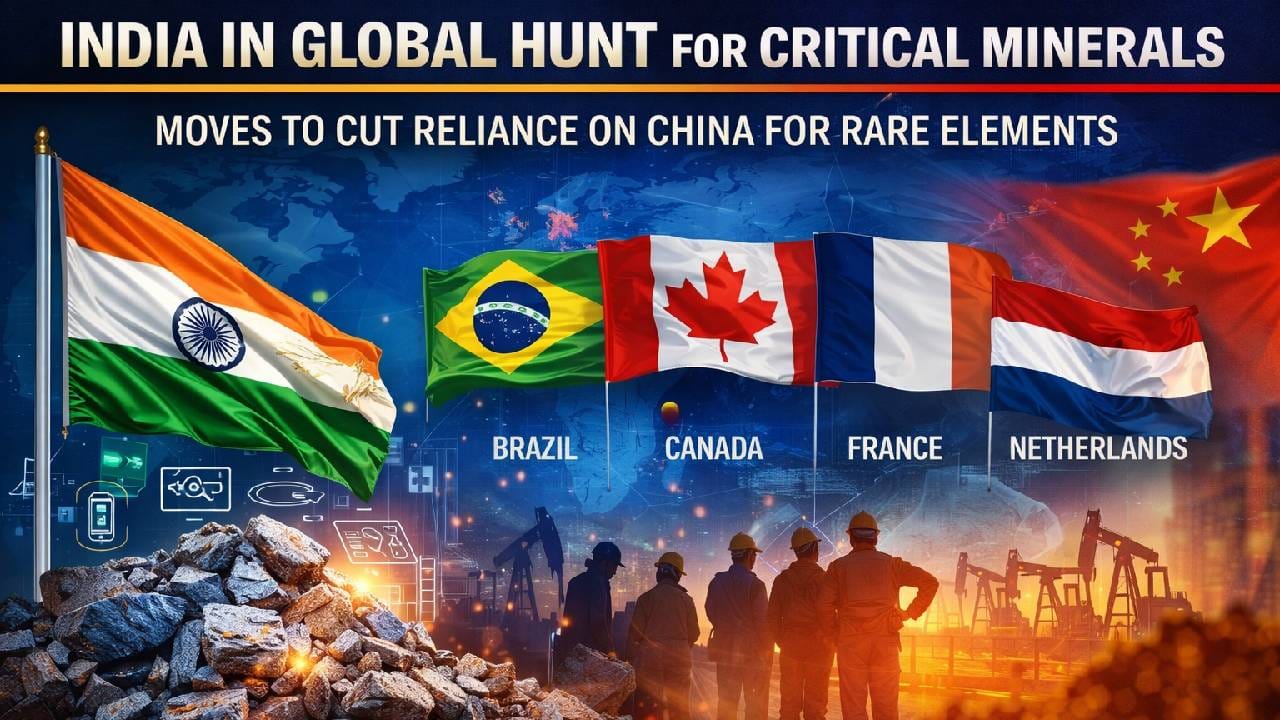
New Delhi: In a high-stakes bid to power its green energy future and insulate its supply chains from geopolitical friction, India has opened confidential negotiations with a quartet of global powers, comprising Brazil, Canada, France, and the Netherlands.
According to sources familiar with the matter, the Ministry of Mines is spearheading a massive diplomatic outreach to secure joint deals for the exploration, extraction, processing, and recycling of critical minerals, specifically targeting lithium and rare earth elements.
India isn’t just looking to buy minerals; it’s looking for a comprehensive technological marriage. New Delhi aims to replicate a landmark agreement signed with Germany in January. That pact goes beyond simple trade, covering joint acquisition of mineral assets in each other’s territories, collaborative ventures in third-party countries and the transfer of advanced mineral-processing and recycling technologies.
The primary catalyst for this global “scouting mission” is the need to decouple from China. Beijing currently exerts a near-total dominance over the global supply and processing of rare earths. As India accelerates its transition to electric vehicles and renewable energy to hit net-zero targets, mining experts warn that relying on an arch-rival for the “building blocks” of the new economy is a strategic vulnerability.
This sentiment was echoed at a recent G7 meeting in Washington, where global finance ministers brainstormed ways to dismantle China’s stranglehold on these essential raw materials.
Among the four nations, talks with Canada appear the most advanced. Sources indicate that a formal agreement is under “active consideration” and could be finalised during a high-level visit by Canadian officials in early March. The anticipated deal is expected to be a multi-sector powerhouse, covering critical minerals (Lithium and Rare Earths), Uranium for nuclear energy, artificial intelligence and general energy cooperation.
India is casting a wide net across the globe. The current negotiations follow successful pacts already inked with Argentina, Australia, and Japan. Furthermore, New Delhi is reportedly in the early stages of broader bilateral talks with Peru and Chile, two of the world’s most mineral-rich nations.
While the diplomatic momentum is high, the road from “deal” to “delivery” is long. Experts point out that the mining lifecycle is notoriously slow; exploration alone can take five to seven years, often with no guarantee of a viable find.
However, with 20 minerals officially designated as “critical” for national security and infrastructure since 2023, India is proving it is willing to play the long game to ensure its industrial engines never run out of fuel