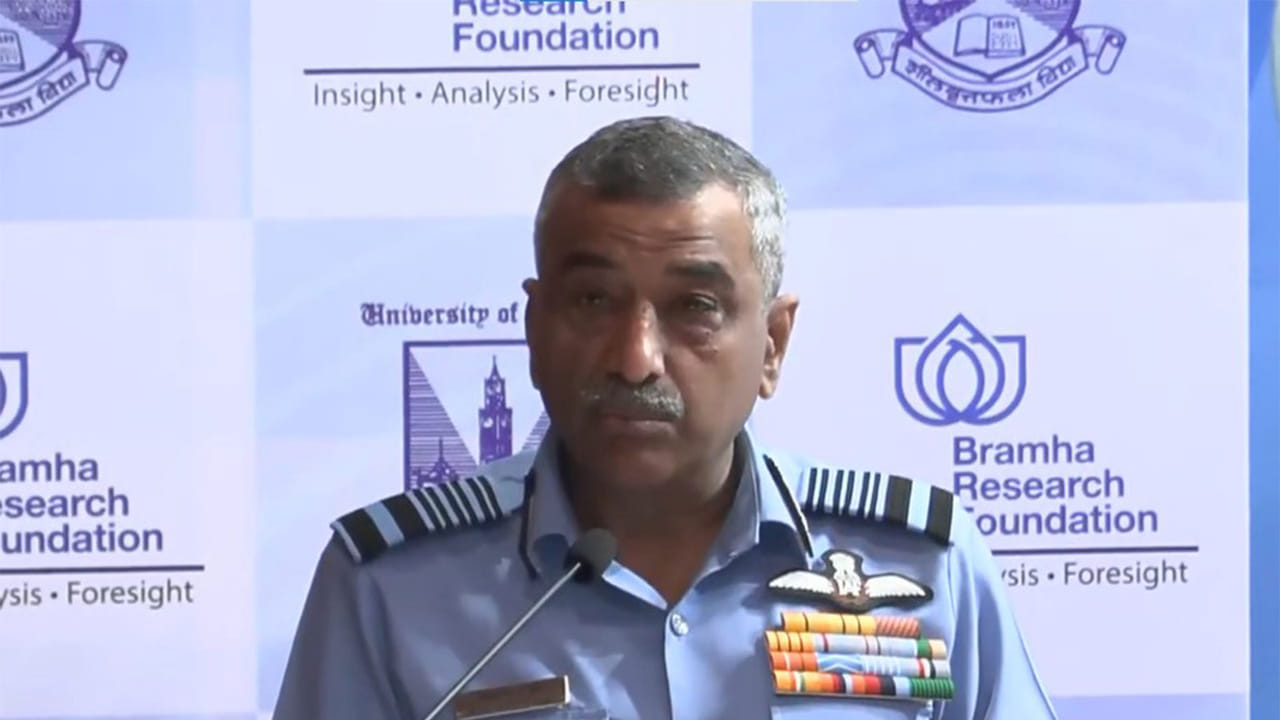
Air Chief Marshal Ashutosh Dixit states India now employs a ‘new normal’ in countering terror. Citing Operation Sindoor, he highlights the nation’s enhanced deterrence capabilities and emphasizes the youth’s critical role in a self-reliant India.
Mumbai (Maharashtra) [India], November 26 (ANI): Air Chief Marshal Ashutosh Dixit on Thursday said India had established a “new normal” in responding to terror attacks, citing Operation Sindoor as the country’s “befitting response” and asserting that the deterrence created since the 2008 Mumbai terror attacks should prevent such incidents from happening again.
Speaking on the 18th anniversary of the 26/11 Mumbai terror attacks, Dixit said India could not respond to the 2008 attack at the time, but had demonstrated its ability to retaliate against subsequent terror incidents. “It happened in 2008, and we could not give a response. But after that, whatever events like this have happened, we have been able to give a befitting response. The best response you have seen was in Operation Sindoor, which is still ongoing,” he said.
He added that India had established a new approach towards terrorism, referring to the Prime Minister’s stated position that “terror and talks will not go together, water and blood will not flow together, and the differentiation between a terrorist and his supporter will no longer be there”. “It’s a very great thing, and we are all prepared to do this. So, hopefully, the amount of deterrence which we have now created, such events should not happen at all,” Dixit said.
Role of Youth in Nation Building
The Air Chief Marshal was speaking at a guest lecture on the “Role of Youth in Nation Building”, hosted by the University of Mumbai in collaboration with the Bramha Research Foundation.
Recalling 26/11
Recalling the 26/11 attacks, Dixit said November 26 was a day no Indian could forget. He paid homage to the 166 people who lost their lives and remembered the police personnel, NSG commandos, security personnel and ordinary citizens who confronted the attackers with courage. “Today is 26th November. It is a day no Indian can forget. 18 years ago today, terrorists attacked the city. 166 innocent people lost their lives. Our police, our NSG commandos, our security personnel, and many ordinary citizens confronted the attackers with great courage. Several of them made the supreme sacrifice. I pay homage to every life we lost. And to every brave heart who laid down his life protecting Mumbai and the nation. I also remember their families who have carried that loss with quite dignity for 18 years,” he said.
Samvidhan Divas
He also noted that November 26 is observed as Samvidhan Divas, marking the adoption of the Constitution in 1949, and said the Constitution defined the nation that citizens serve. “Today is also Samvidhan Divas. On this day in 1949, we adopted our Constitution. The Constitution defines the nation we serve. Among the fundamental duties, it places on every citizen the duty to defend the country and render national service when called upon to do so. The events of 2008 (26/11 attacks) remind us that this nation must be protected by each and every one of us,” Dixit said.
Youth as Strategic Asset
Turning to the role of young people in nation building, he said interactions with young Indians strengthened his confidence in the country’s future. He highlighted India’s young demographic profile, noting that nearly 65 per cent of the population was below 35 years of age and the median age was around 29. Describing the youth as India’s greatest strategic asset, he said the “Amrit Peedhi” generation would play a crucial role in building a Viksit Bharat by 2047. Citing India’s achievements, he referred to Chandrayaan-3’s landing near the Moon’s south pole, Group Captain Shubhanshu Shukla’s journey to the International Space Station, the country’s startup ecosystem and its global leadership in digital payments through UPI. He also highlighted young women flying fighter aircraft and training at the National Defence Academy.
Nature of Warfare
Dixit emphasised that platforms and networks alone could not win wars, adding that people were the decisive factor. He urged students to learn from the Indian Air Force’s debriefing practice, which involves examining mistakes openly, taking responsibility and learning from every error. Speaking about the changing nature of warfare, he highlighted the growing importance of sensing, speed and unmanned systems. He said hypersonic missiles and drone swarms had compressed decision-making time, while drones had removed the traditional trade-off between precision and mass. Referring to Operation Sindoor, he said it was the first India-Pakistan conflict in which drones were employed on a large scale. India’s layered air defence and counter-drone systems kept the damage to a minimum, he said, crediting the air warriors and Indian technology. He also referred to Mission Sudarshan Chakra, a ten-year national mission announced by the Prime Minister to build a multi-layered shield over the country. He underlined the importance of space and cyberspace, warning that adversaries could target power grids, banks, railways and hospitals without crossing India’s borders.
Self-Reliance and Future Vision
Stressing self-reliance, Dixit said Operation Sindoor had reinforced the need for India to develop its own solutions for national security. The Indian Air Force was committed to fighting with Indian solutions, he said, adding that the country must move beyond Make in India and also focus on Think in India. He said national security was a collective responsibility, involving not only soldiers but also engineers protecting power grids, scientists in DRDO laboratories, startup founders developing counter-drone systems, doctors and teachers. Dixit also cautioned students against misinformation and threats in the cognitive domain, saying adversaries used fake news, doctored images, deepfakes and networks of bot accounts to target the minds of citizens. He urged them to verify information before forwarding it and rely on official sources. Sharing his vision for the Air Force through the word ‘VAYU’, he said it stood for Vigilance, Aatmanirbharta, Yukti and Unity of effort. He urged students to guard their minds against falsehood, build world-class skills, develop Indian solutions to Indian problems and work towards a common national purpose. Concluding his address, he said the finest tribute to those who lost their lives in the 26/11 attacks would be to build an India that was strong, self-reliant and united, so that no adversary dared to test it.