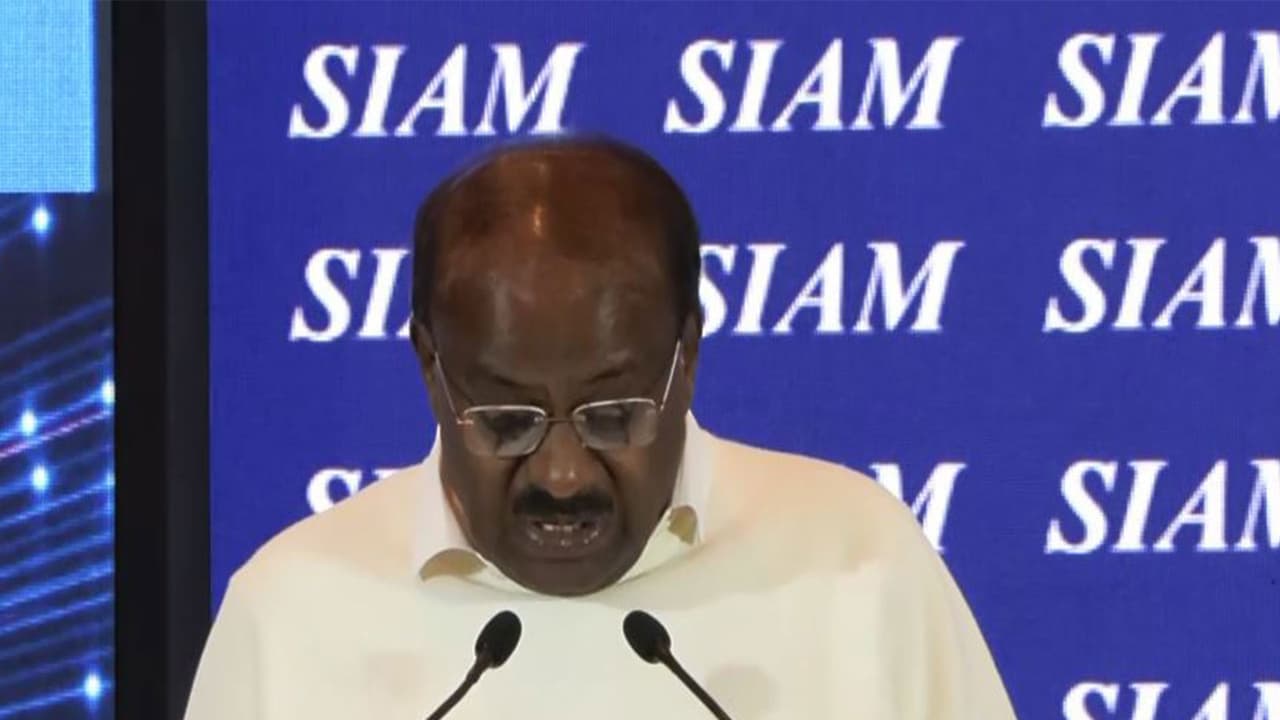
India is set to boost domestic manufacturing of rare earth permanent magnets for EVs with a Rs 7,280 crore scheme. The move, announced by Union Minister HD Kumaraswamy, aims to reduce imports and strengthen the clean mobility ecosystem.
India aims to focus on domestic manufacturing of sintered rare earth permanent magnets used in electric vehicles as part of a broader push to deepen its electric mobility, clean manufacturing ecosystem and reduce import dependence, Union Heavy Industries Minister HD Kumaraswamy said today.
Push for Self-Reliance in High-Tech Sectors
“This forward-looking initiative will promote indigenous manufacturing of sintered rare earth permanent magnets, which are critical components for electric vehicles, wind turbines, defence systems and aeronautics,” Kumaraswamy said while addressing the 5th Global Electric Mobility Summit 2026 organised by Society of Indian Automobile Manufacturers (SIAM). The minister said the Union Cabinet has approved the Rare Earth Permanent Magnets (REPM) scheme with an outlay of Rs 7,280 crore, describing it as a strategic intervention to reduce import dependence and strengthen domestic capabilities across high-technology sectors linked to clean energy and mobility.
Budgetary Support for Manufacturing
Referring to recent budget measures, he said capital goods used for critical minerals manufacturing have been granted exemption from basic customs duty to boost domestic manufacturing. The Budget has also announced the development of industrial corridors across Tamil Nadu, Kerala, Odisha and Andhra Pradesh to create integrated ecosystems for processing, component manufacturing and downstream applications.
India’s Electric Mobility Transition
Kumaraswamy said India’s electric mobility transition has moved decisively from intent to implementation, supported by policy alignment, budgetary measures and production-linked incentive schemes. He said electric mobility represents the convergence of national priorities such as cleaner growth, energy security, industrial transformation and self-reliance under the Make in India and Atmanirbhar Bharat initiatives.
Economic Growth and Climate Goals
India’s automotive industry is among the fastest growing globally and is valued at around USD 50 billion, he said, adding that the country is now the world’s fourth-largest economy with a gross domestic product of USD 4.18 trillion and is on course to become the third-largest. By 2030, India’s economy is projected to reach USD 7.3 trillion, reflecting growing confidence and capability.
The minister said India has set a national objective of achieving net-zero emissions by 2070 under the leadership of Prime Minister Narendra Modi, with electric mobility playing a central role in reducing transport-related emissions. Commercial vehicles, he said, contribute more than 40 per cent of transport-related pollution and therefore require special focus.
Rapid EV Market Growth
Over the past six years, India’s electric vehicle market has recorded a compound annual growth rate exceeding 60 per cent, Kumaraswamy said. In the 2024-25 financial year, electric vehicle registrations approached 2 million units, driven primarily by electric two-wheelers, while electric passenger vehicles crossed the milestone of 100,000 units. Electric buses and commercial fleets are also expanding steadily across cities and states, indicating a structural shift in public and shared transport.
Expanding Charging Infrastructure
To support adoption, the Ministry of Heavy Industries has approved Rs 2,000 crore under the PM E-Drive scheme for setting up more than 70,000 charging stations nationwide, he said.
Boosting Domestic Manufacturing and Competitiveness
On the manufacturing side, the government is implementing the Production Linked Incentive (PLI) scheme for automobiles and auto components with an outlay of Rs 25,938 crore to deepen domestic value addition and enhance global competitiveness.
Focus on Battery Manufacturing
Battery manufacturing, Kumaraswamy said, lies at the core of energy security and long-term competitiveness. The PLI scheme for Advanced Chemistry Cell batteries, with an outlay of Rs 18,000 crore, aims to establish 50 gigawatt-hours of domestic battery manufacturing capacity, reduce import dependence and position India as an emerging global manufacturing hub.
Vision for Global Leadership
Kumaraswamy cited NITI Aayog’s assessment that electric mobility is not only an environmental imperative but also a multi-billion-dollar economic opportunity, with potential to transform service delivery through connected vehicles, data-driven fleet management and new mobility models
“India’s vision is to move from adoption to leadership, from participation to influence and from scale to strategic depth,” he said, adding that collaboration among policymakers, industry and innovators would be key to building resilient industries and sustainable livelihoods. (ANI)
(Except for the headline, this story has not been edited by Asianet Newsable English staff and is published from a syndicated feed.)