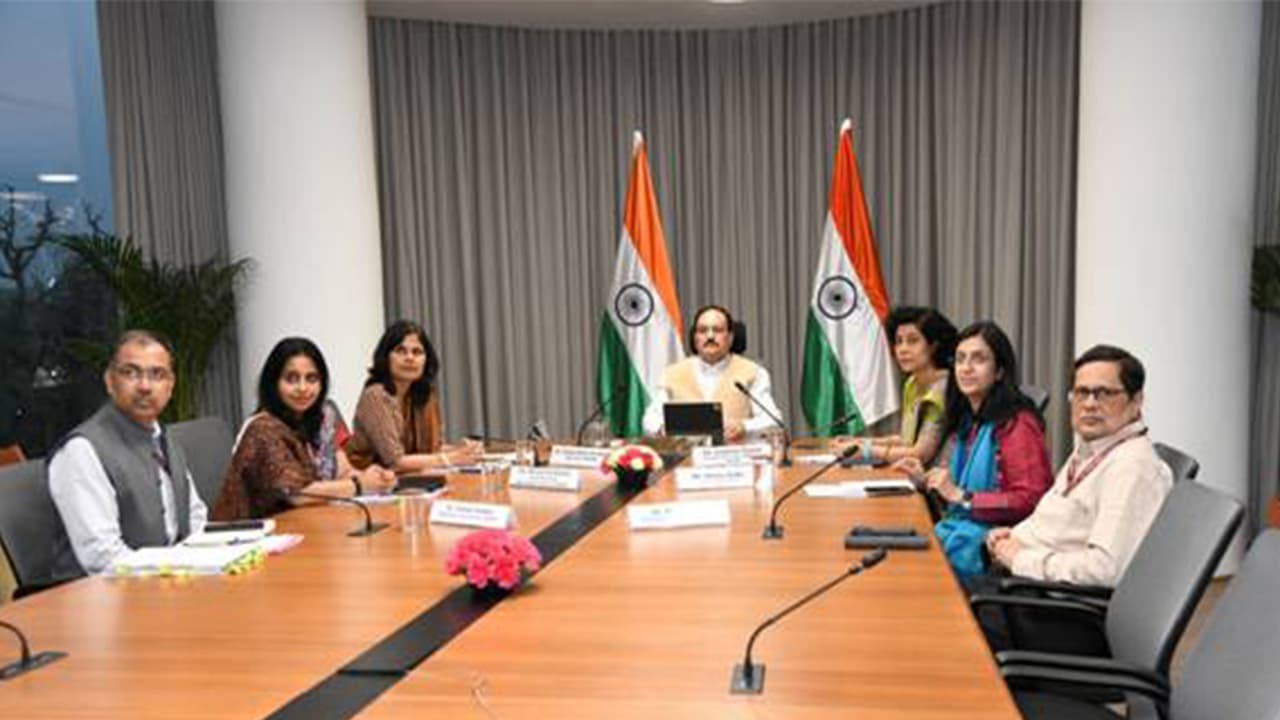
Union Health Minister JP Nadda addressed the WHO, highlighting India’s commitment to eliminate cervical cancer through prevention, screening, and a new nationwide HPV vaccination campaign targeting 12 million adolescent girls annually.
India’s Commitment to Eliminate Cervical Cancer
Union Minister for Health and Family Welfare Jagat Prakash Nadda virtually addressed a press briefing at the World Health Organisation headquarters today, underscoring India’s strong commitment to eliminate cervical cancer as a public health problem and strengthen global cooperation on pressing health challenges, the release said.
Addressing the gathering, the Union Health Minister emphasised that the health and dignity of women remain a core national priority for India and reiterated the country’s unwavering commitment to protecting women from preventable diseases such as cervical cancer.
Highlighting India’s comprehensive strategy to tackle the disease, he noted that cervical cancer continues to be a significant public health challenge globally and in India. The Government of India has therefore adopted a multi-pronged approach focused on prevention, screening, early detection, and timely treatment.
A cornerstone of India’s strategy has been the expansion of population-based screening programmes under the National Programme for Prevention and Control of Non-Communicable Diseases (NP-NCD), implemented as part of comprehensive primary healthcare services. Screening for cervical cancer using Visual Inspection with Acetic Acid (VIA) is now available at Ayushman Arogya Mandirs and various health facilities across the country for women between 30 and 65 years of age. Nadda informed that over 86 million women have already been screened for cervical cancer under the programme, reflecting India’s sustained commitment to early detection and prevention.
Nationwide HPV Vaccination Campaign Launched
The Union Health Minister also announced a major milestone in India’s fight against cervical cancer, the nationwide launch of the Human Papillomavirus (HPV) vaccination campaign. He informed that on February 28, the Prime Minister, Narendra Modi, inaugurated the national HPV vaccination campaign, targeting 12 million girls aged 14 years as a significant step toward safeguarding adolescent girls’ health and well-being.
Nadda highlighted that the initiative reflects the Government’s commitment to the vision of “Swasth Nari Sashakt Parivar” (Healthy Women, Empowered Families), ensuring prevention, protection, and equity at the core of women’s healthcare. The campaign is being implemented over 90 days and follows a single-dose schedule using the Gardasil Quadrivalent vaccine, in accordance with recommendations of the World Health Organisation and India’s National Technical Advisory Group on Immunisation (NTAGI). The vaccine is being provided free of cost at designated government health facilities.
Community-Centric and Digital Approach
Emphasising the community-centric nature of the initiative, Nadda stated that the HPV vaccination programme is voluntary, with parental consent serving as a cornerstone of the campaign, reflecting respect for community values and family autonomy.
The Union Minister also highlighted the role of digital technologies in ensuring transparency and efficiency in the campaign. Every vaccination event is recorded through the U-WIN digital immunization platform, enabling real-time monitoring and accountability, while vaccine stocks and cold-chain logistics are tracked through the Electronic Vaccine Intelligence Network (eVIN) system.
Nadda acknowledged the critical role played by India’s frontline health workers, who have been instrumental in reaching communities, building trust, and ensuring the successful implementation of the campaign.
Reaffirming Global Commitment
Reaffirming India’s global commitment, the Union Health Minister stated that India fully endorses and actively supports the WHO Global Strategy to accelerate the elimination of cervical cancer, including the 90-70-90 targets for 2030. He emphasized that a comprehensive approach integrating vaccination of adolescent girls, population-based screening of adult women, and timely access to quality treatment is essential to achieving elimination goals. Concluding his address, Nadda called for stronger global collaboration to eliminate cervical cancer as a public health problem.
WHO Commends India’s Efforts
Addressing the press briefing, Director-General of the World Health Organization, Dr.Tedros Adhanom Ghebreyesus, highlighted several pressing global health challenges, including obesity, HIV/AIDS, and cervical cancer, while emphasising the importance of sustained global cooperation and scientific innovation in addressing these public health issues.
Global Health Challenges and Targets
Speaking about the global fight against HIV/AIDS, Dr. Tedros noted that significant progress has been made in reducing the global burden of the disease. He also noted that the WHO has supported nine countries in the introduction and administration of HIV prevention interventions, strengthening global efforts to curb the epidemic.
Turning to cervical cancer, Dr. Tedros highlighted that International HPV Awareness Day, observed recently, serves as an important reminder of the global commitment to eliminate cervical cancer as a public health problem. He reiterated the importance of the WHO’s 90-70-90 global targets for 2030, which aim to ensure that 90 per cent of girls are vaccinated against HPV, 70 per cent of women are screened for cervical cancer, and 90 percent of women identified with cervical disease receive appropriate treatment.
The release stated that, Dr. Tedros congratulated the Indian leadership for its commitment in addressing cervical cancer through large-scale public health initiatives. He lauded the nationwide HPV vaccination campaign launched by Prime Minister Narendra Modi, describing it as the world’s largest free HPV vaccination drive. Commending the initiative, he noted that approximately 12 million adolescent girls will be vaccinated every year under the programme, marking a significant step toward protecting future generations from cervical cancer.
Highlighting the burden of the disease, Dr. Tedros stated that more than 80,000 women lose their lives to cervical cancer in India every year, with around 42,000 new cases reported annually, underscoring the importance of preventive interventions such as HPV vaccination and early screening.
Dr. Tedros Adhanom Ghebreyesus also reaffirmed the continued support of the World Health Organization to countries undertaking bold and transformative initiatives to eliminate cervical cancer and advance women’s health globally.
Dr. Aaron Motsoaledi, South African Health Minister, was also present virtually in the Press Conference and congratulated India for the launch of the nationwide HPV Vaccination drive. (ANI)
(Except for the headline, this story has not been edited by Asianet Newsable English staff and is published from a syndicated feed.)