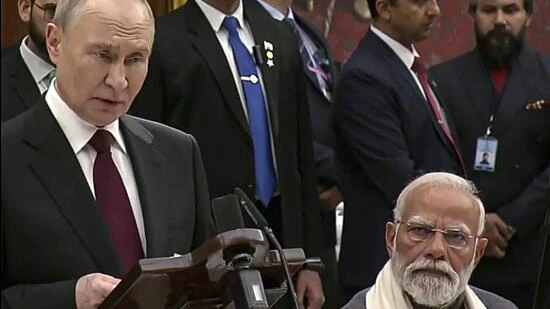
India and Russia on Friday backed an “uncompromising” global campaign against terror without “hidden agendas and double standards”, with Prime Minister Narendra Modi emphasising that terrorism is a direct attack on humanity.
Counter-terrorism figured in discussions at the annual summit between Modi and President Vladimir Putin, and a joint statement issued after the meeting said both sides stand for a “zero-tolerance policy” on terror and speedy finalisation of the Comprehensive Convention on International Terrorism in the UN framework.
“India and Russia have long stood shoulder-to-shoulder in the fight against terrorism,” Modi said at a joint media interaction, speaking in Hindi.
“Whether it is the terrorist attack in Pahalgam, or the cowardly attack at Crocus City Hall, the root of all such incidents is the same,” he said, referring to an attack in Jammu and Kashmir in April by The Resistance Front, a proxy of Pakistan-based Lashkar-e-Taiba, and an assault on a Russian music venue in March 2024 that was claimed by the Islamic State-Khorasan Province, which is based along the Afghanistan-Pakistan border.
India believes terrorism is a “direct assault on the values of humanity”, and “global unity against it is our greatest strength”, Modi said.
According to the joint statement, Modi and Putin said all acts of terrorism are “criminal and unjustifiable, regardless of their motivation by any religious or ideological pretexts” .
The two leaders also backed concerted actions against all UN-listed terror groups and entities, including Al-Qaeda, Islamic State and their affiliates, which should be “aimed at rooting out terrorists’ safe havens, countering the spread of terrorist ideology, eliminating terrorist financing channels and their nexus with transnational crime, and halting cross-border movement of terrorists, including foreign terrorist fighters”.
India and Russia also emphasised the primary responsibility of states and their authorities in combating terrorism. The two sides also recalled the special meeting of the UN Security Council’s Counter Terrorism Committee held in India in October 2022 and referred to the unanimously adopted Delhi Declaration on countering the use of new and emerging technologies for terrorism.
The two sides noted that the declaration aimed to cover the main concerns surrounding terrorist exploitation of information and communications technology, such as payment technologies, social media platforms and fundraising methods and misuse of unmanned aerial vehicles (UAVs or drones).
“Both sides also expressed their readiness to develop further cooperation in this field with a special focus on preventing radicalisation and the spread of extremist ideology in the online space,” the joint statement said.
The two sides further noted the close coordination between India and Russia on Afghanistan, and they highlighted the importance of the Moscow Format meetings on the situation in the restive country.
Modi and Putin welcomed counter-terrorism measures against international terror groups, including Islamic State, Islamic State-Khorasan Province and their affiliates, and expressed confidence that the fight against terror in Afghanistan would be comprehensive and effective.
“They stressed the need to ensure urgent and uninterrupted humanitarian assistance to the Afghan people,” the joint statement said.
Foreign secretary Vikram Misri told a media briefing that the two leaders reiterated the need to fight jointly against all forms and manifestations of terrorism. Modi reiterated India’s zero tolerance stance on terrorism and Putin reiterated Russia’s support for India in this effort, he said.