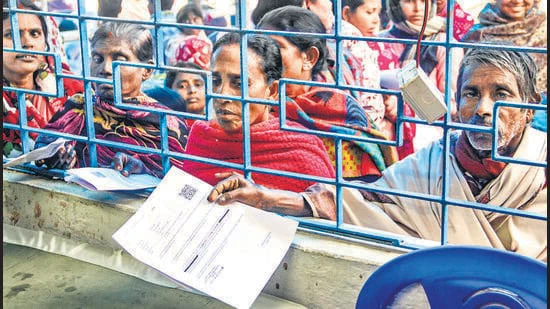
For close to 25 years, Bharat Mahato has pulled his trusted rickshaw through the lanes of north Kolkata, expertly swerving between decaying buildings, past sagging balconies and under loops of wires slicing the sky into claustrophobic strips.
On the mossy green seat of his hand-drawn rickshaw are often stacked bundles wrapped in cloth, piles of scrap, or metal boxes. A trip earns him around ₹150.
Last month, he got word that a local school teacher had come looking for him in one of the mottled buildings that frame the alleys. “It was an old place some of us were sharing. But the landlord raised the rent so we moved elsewhere,” he said.
Eventually, the school teacher – a booth level officer (BLO) looking to distribute forms for the special intensive revision (SIR) of voter rolls – gave up, the old address was deserted and crumbling, and Mahato couldn’t squeeze time between his 12-hour runs ferrying goods. “And anyway, I was thinking of going back home to Jharkhand. I’ll get it done there,” he said. In these old cramped quarters of the metropolis where migration is high, commerce is thrumming but labour-intensive, and incomes are meagre, the contentious exercise has wiped off a third of the rolls.
Two hundred kilometres away lives Shobedhon Bibi, who has never been to Kolkata. In fact, the 50-something woman has never stepped inside a major city. Her village is perched on a sandbar of the Padma, counting down the moment it will be inundated, in Murshidabad district, less than 30 minutes from the Bangladesh border. The boatman of her Ajaynagar Char village paddles her and two other women to the market on the mainland, bulging bags of vegetables and mud-crusted potatoes balanced between her legs and the hull. “We’ve heard that a settlement opare (in Bangladesh) was inundated. So, the water is coming, it’s coming soon,” she said. The boatman, Hitler Mondal, nodded – after all, small mud embankments erected since 2000 have barely stymied the meandering rampage of the river.
Bibi has heard about SIR and received her form. “There’s a small problem in the spelling of my name, but no worries. We’ll correct it,” she said. There is no panic in her voice. “We have kept everything safe in a trunk, like our father told us to. We knew it would come of use soon,” she smiled. In her region, where Muslims are two-thirds of the population, despite poverty and the vicissitudes of nature, the deletions are lower than 5%, smashing speculation about infiltration.
Draft rolls published last month shed 5.82 million names, the deletion percentage of 7.6% being the lowest among states that go to the polls this summer – Kerala has excised 8.6% of names, Tamil Nadu 15.2%, and Uttar Pradesh, 18.7%. Among the 12 regions where the process is underway, the most protests and controversies have been recorded in Bengal, where the ruling Trinamool Congress (TMC) is staunchly opposed to SIR and the opposition Bharatiya Janata Party (BJP) has named infiltration as a key poll plank.
Travelling across four districts, HT drew the following conclusions.
One, the exercise is a far bigger talking point in Bengal than it was ever in Bihar, where SIR was conducted last year.
Two, this awareness has also given way to insecurity and anxiety in many regions, especially due to the Election Commission of India’s (ECI) decision to add extra scrutiny from what it did in Bihar, calling people for physical hearings for reasons as varied as their names not being in the 2002 base roll, discrepancies in spelling, age or mapping of progeny. Nobel laureate Amartya Sen has been issued notice and Indian cricketer Mohammed Shami has been summoned.
Three, the TMC government has managed to seed extraordinary friction in the process but also organisationally built structures to protect its hinterland voter base – reflecting in the relatively low deletions in rural areas.
Four, it is people with structural impairments – such as climate refugees or economic migrants – who face greater risk of their name not making it to the final roll than followers of any particular religion, and five, despite the loud rhetoric about undocumented Muslim immigrants, it is Hindu refugees from Bangladesh who face a risk. The experiences of Mahato and Bibi mark the two extremities of this experience that is set to shape the most important election this year.
Under SIR, BLOs distribute partially pre-filled forms door-to-door. Those whose names can be mapped to the 2002 roll – the last time SIR was held in Bengal – don’t need to submit anything more. But for those who cannot link their names to the 2002 roll and have to submit documents – one of 12 listed papers – the rules are different from Bihar. They have been called for physical hearings – in Bihar, they could have just given a copy of their document to the BLO – leading to resentment and a flurry of media reports of people either sick or old struggling to make it to these meetings. “What was the requirement for the change in rules? For many people, the hearing itself is creating anxiety,” said Tanushree Modak Bhattacharya, a BLO in Kolkata. ECI has exempted those above 85 from the hearings.
The second pain point is the BLO app, also first used in Bihar. There, some BLOs complained that the app stopped sometimes, the QR code didn’t scan, the session ended abruptly, or the OTP required to complete the process never arrived. Some of those issues have been smoothed over in Bengal but two new problems have been flagged. One, some BLOs say people they marked as mapped in the 2002 roll were finally stamped as unmapped in the draft roll. “I personally uploaded the forms of around 30 people whose names were in the 2002 roll but the app never recorded it. Even when we had done the mapping, sometimes the app said no data was found and didn’t record the name,” said Bappaditya Guha, a BLO.
Two, there appear to be some inconsistencies in the way the 2002 roll was digitised and uploaded, leading to problems of spelling, serial names and reading of names. “One problem was that in 2002, the roll was in Bengali in many places. The uploading may have been done without making any corrections and therefore there are problems in first name, middle name etc. Despite us verifying everything, these people have been called for hearing,” said Bhattacharya. Both Guha and Bhattacharya are members of BLO Adhikar Raksha Samiti, an organisation of BLOs that has protested against ECI.
Last week, ECI finally admitted to some problems, saying that “due to incomplete conversion of PDF of 2002 electoral roll data to CSV (comma separated value; a format for storing tabular data in text files), linkage could not be fetched in BLO app in respect of many electors”. This means the number of unmapped people will dip from 3.1 million, but at a time when notices for hearings have already gone out, there is confusion over who needs to show up and who doesn’t. The segment of people with logical discrepancies – yet another category that didn’t exist in Bihar – is also set to drop from 16 million to around nine million but it’s still unclear what will finally be classified as a discrepancy. To be sure, the focus is on the 2.5 million-odd people in this category where the age difference between parents and children is either less than 15 years or more than 50 years, or where the difference between grandparents and grandchildren is less than 40 years, said a poll panel official, requesting anonymity. Among these people is Amartya Sen.
Some BLOs alleged that the new categorisations were unplanned. “We understand the importance of SIR but we weren’t originally told all the work we’d have to do. We were given training about enumeration, form distribution, collection and uploading. But now, ECI keeps changing its decisions and adding new features to the BLO app, creating new deadlines and pressure,” said Swapan Mandal, a BLO from south Kolkata and general secretary of the Votekormi and BLO Aikya Mancha, a body representing election workers and BLOs.
Since early September, Sujit Byapari has sat everyday on a wooden chair-table set outside the main shrine of the Matua sect in the North 24 Parganas district of West Bengal. Crowded around the table typically are a melee of people – most of them classified as scheduled caste – from the same anti-caste 19th century grouping whose followers are separated by the international border of India and Bangladesh. Some have run away after having their homes torched, some moved away when life became precarious, some found their houses encroached, and some found traditional thoroughfares blocked by modern geopolitics.
Byapari, himself a member of the sect whose followers hold sway in 60-odd seats, was born in the tragic island of Marichjhapi – where a state crackdown in 1979 triggered a refugee massacre – but walked across the marshland border when he was 11. “I slipped past the cordon and stayed with my uncle for three years. Then I came back,” he said.
Nowadays, things are more complicated. Many Matuas – around 15 million in West Bengal and another 10 million in Bangladesh – don’t have permanent papers or proof of birth because they were either born across the border or forced to flee. The community leaders have devised two workarounds – one is a card given by the Matua Mahasangha, the umbrella organisation of the Matuas, and another is a certificate under the Citizenship Amendment Act, the controversial 2019 law that fast tracks citizenship for non-Muslims from Pakistan, Bangladesh and Afghanistan.
Matuas are the primary catchment of CAA in Bengal. Yet, progress is slow. One December morning, Byapari is guiding an anxious family of four already troubled that they have spent ₹3,500 on procuring documents. “What’s your father’s name and date of birth? Oh you know 1949? Should I write 1.1.1949? And your mother’s? No, we can’t say 1957-1958, we have to choose a year,” he said. There are at least eight other such facilitators helping people fill two forms – a pink slip on the Mahasangha letterhead that asks for basic personal details, address, Aadhaar number, police station, mobile phone number and a self attestation. This is for the so-called Hindu card, issued by the organisation.
More complex is the second form, printed on a white sheet that asks for the applicant’s name, date of birth, parents’ details, details of their address in India and Bangladesh, the date they came to India, and the name and details of a witness for the arrival and birth. Plastered on the dusty office block are instructions on applying for CAA – a colour photocopy of Aadhaar, a Hindu certificate, a character certificate by an Indian citizen, addresses in India and Bangladesh and the date of entry, an original document from India and an original document from Bangladesh.
The region has clocked the highest number of unmapped voters — especially concentrated around the local assembly seat of Gaighata.
Uttam Mukherjee is one of them. “I came to India from Bangladesh’s Satkhira in 2008 after my house was set on fire, and married here. My wife is an Indian and her name is there in the 2002 list. I couldn’t map myself with my parents or grandparents as they are all from Bangladesh. I have linked myself with my uncle who settled in Kolkata. But will it be enough?” he asked.
Some Mahasangha members blame the local administration for delays. “In the CAA process, the final hurdle is a hearing by local officials but the government is delaying it, and creating problems over things like spelling errors. If the Matuas face more harassment, it’ll hurt the BJP,” said Tarun Biswas, an office-bearer.
The unexpected impact of SIR on a community that’s become a voter base of the BJP over the past decade has sparked heartburn. “As the Matua headquarters is located at Thakurnagar in Gaighata, whenever Bangladeshi Hindus, a large chunk of whom are Matuas, come to India to take refuge, they try to settle in and around Gaighata. It is obvious they won’t have any documents as they fled to evade persecution. We’ll take care of them,” said Subrata Thakur, a BJP lawmaker.
But the TMC alleged SIR would end up hurting the Dalit group the most. “Many came to India after 2002, in the last two decades. How will they map themselves in the 2002 list?” asked Mamata Bala Thakur, TMC MP.
Standing on the banks of a stream, an offshoot of the Padma River at Farajipara in Murshidabad, Kamrul Hussain pointed towards green paddy fields on the other side, once a gushing river and now dotted with small farm settlements.
“Every year, hundreds are left homeless as the river eats up the bank. Villagers try to save whatever they can before shifting further inland. You will find many voters’ names who may have either shifted permanently or were untraceable. But there are no Bangladeshis or Rohingyas here,” said Hossain Tariq Anwar, whose family’s land was gobbled up twice by the river.
This is Jalangi. The remote hamlet sits on the India-Bangladesh border, about six hours from Kolkata. The population largely depends on subsistence agriculture on the sandbars that rise and perish with the river’s whims. About three-fourths of the population is Muslim. This region, which acts as a migration sink for manual labour, looms large over the state’s politics due to allegations of infiltration – now a key motif in the state’s politics.
Yet, SIR has set some equations awry. The percentage of deletions in Murshidabad is 4.8%, among the lowest in the state and a fraction of Kolkata’s 25.9%. In Jalangi, it is even lower – 3.3% or 9,116 names.
“People here have been gathering documents long before SIR was rolled out. One of the reasons was the anti-Muslim remarks of BJP leaders. The villagers got panicky that they may be labelled as Bangladeshis and started collecting documents months ago,” said Abdur Razzak, the TMC legislator from Jalangi.
Soon after SIR was announced, the TMC set up district and block teams. Each booth was given two booth level agents who went to 8-10 households every day. In the block, 17 ‘vote raksha kendras’ were set up. “Anyone needed any document, we were there. The most common document was the residential certificate. We ensured that a certificate was issued within 24 hours,” said party block chief Kabirul Islam.
Such centres dot the state but are most active in the countryside, where TMC workers help people fill forms, procure documents, search for names and submit papers – often through street-corner meetings (of which there are 12 a day) where 70-100 people gather. The party credits this machinery for the relatively low deletions despite an aggressive process, though the BJP blames these workers for intimidating BLOs.
To be sure, not everyone is happy. Jyotsna Bibi, 45, a resident of Joykrishnapur, found 11 out of 12 people in her family missing from the 2002 list. But she has proof of all names in the 1988 rolls. “After SIR in Bihar, it became apparent that Bengal was next and we started gathering documents. Not only do we have the 1988 rolls but also land deeds from the 1970s. We have been here for three generations. We are not infiltrators,” she said.
Murshidabad also has the highest number of voters (407,065) linked with more than six persons in the progeny mapping. It is among the top five districts with voters whose age gap with parents is more than 50 years and grandparents less than 40 years. Jharna Bibi’s family is one such. “Yes, some discrepancies are there because of Bengali to English translations but we are genuine voters. The BLO has made the mistake and we will pay the price,” she said.
The BJP isn’t convinced. “The draft roll has a lot of Bangladeshi and Rohingya voters. The BLOs could not work freely as they feared for their lives. Hence the illegal voters couldn’t be deleted. BJP couldn’t appoint Booth Level Agents (BLAs) in these Muslim dominated areas and hence the illegal voters couldn’t be traced. The BLOs did whatever the TMC’s BLAs directed them to do,” said Gouri Sankar Ghosh, a BJP legislator from Murshidabad.
In the Bengali psyche, Jorasanko holds pride of place as the ancestral home of Rabindranath Tagore. But the Jorasanko seat is more than Nobel nostalgia – it stitches together the cacophony of Burra Bazar, the markets of Posta, the impoverished quarters lining Strand Road overlooking the Hoogly , and the now dilapidated buildings that once housed India’s first China Town in Tiretti Bazar. Sitting in the heart of Kolkata, Jorasanko is the epitome of the old economy – powered by warehouses and manual labour- that once made the city great.
It is also the seat with the maximum share of deletions in the state. Around 37% of the electorate has already been dropped in the draft list and another 11% is classified as unmapped.
In Guha’s booth in Jorasanko, there are 490 names remaining from an initial list of 919, a deletion percentage of 47%. Among them are Asma Khatun and her son Mohammad Aslam, both poorly educated, who live in Damsel Lane and have documents from 1995 but no names in the 2002 roll. “This is a lower-middle class area, sometimes there are 20 labourers sharing ₹1,000- ₹1,200 as rent. This is a 200-year-old area. Plus buildings here collapse all the time – like 10, Tiretti Bazar that once housed 50-odd people is mostly rubble now. Only 15 people live there,” said Mohammad Asif, a resident.
Many of those deleted are women, said Guha, because SIR mandates women link their application with their parents’, not husbands, a task made difficult in low-income migrant homes. “A woman voter was born an orphan and married off. Another was brought up in a mosque and never sent to a school. We don’t know what to do with these cases because we were never given proper training,” he added.
The BJP has pointed to the high deletions in Kolkata – especially the 21.7% in chief minister Mamata Banerjee’s constituency of Bhabanipur – to argue that the TMC was relying on fake voters. “This proves that she relies on fake voters to win. The TMC’s stronghold in Kolkata is because of these fake voters,” said Suvendu Adhikari, the leader of the opposition in the assembly.
But the TMC pointed to alleged mismanagement by ECI and the short timeframe for the deletions. “In Jorasanko, for example, there is a large population from UP-Bihar who might have wanted to keep their names in their home states. Plus, old residential buildings are becoming new commercial plazas as people move out or die. But the main reason for the deletions is the pressure put by ECI on BLOs who are working in a hurry and may not have the time for genuine enquiries,” said Vivek Gupta, the TMC legislator from Jorasanko.
In other states, the buzz around SIR abated after the draft roll was published. But in Bengal, the controversy is only mounting with each day of hearing. Already, the family members of two sitting parliamentarians, a former minister, arguably the biggest living Bengali poet, and three Bengali actors have been called for hearings, sparking dismay. One assistant electoral registration officer in Kolkata confirmed on the condition of anonymity that ECI was insistent on physical hearings and officials conducting the hearings were mandated to necessarily upload photos with the electors. Already, TMC and ECI have clashed over the former’s demand to have BLAs present in the hearings. Banerjee also has promised a personal battle if the hearings lead to more deletions. “The draft roll was only the beginning of the SIR controversy,” said Mandal. “The real mess will begin now.”