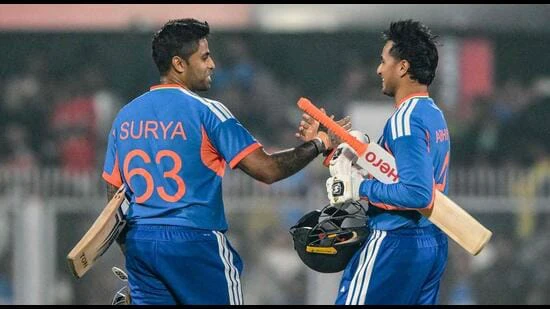
Guwahati: India’s innings on Sunday: Fifty in 19 balls, 94 at the end of the Powerplay, 155 at the halfway stage to script an insane win.
Even a drinks break could not be taken. And it still wasn’t book cricket. No, but if it were up to Abhishek Sharma, Ishan Kishan and Suryakumar Yadav right now, India would mow down totals and chew up bowlers with ludicrous ease. Pushing the envelope is one thing, India are right now kicking down doors even before opposition bowlers get a chance to bolt them. Days ahead of a T20 World Cup at home, these are dizzying levels of fantastical batting.
Abhishek doesn’t believe in half measures, not even off the first ball he faces. There is no cautious prod, no sussing of conditions, hardly any negotiation with the bowler. He believes in clean hits, living and dying by the sword. In Raipur, a clean flick off his legs led to his first-ball dismissal. Here, he backed out of his stumps, down the pitch, and picked a length ball over deep midwicket for a six. Irrespective of the shot, the message is unmistakable: this is a hostile takeover.
Despite the evolving scenes, T20 batting has always had a basic template. Openers laid the foundation, middle-order batters accelerated, and finishers supplied the fireworks. Batting in Powerplays moved from being in survival mode with ambition to pure domination. What’s happening now though is a factory reset, Abhishek being the orchestrator. With him, the powerplay has ceased to be a phase to manage risk and has become a weapon to impose fear. Bowlers no longer ease into spells against him. There is no soft start, not with this Indian top order.
Abhishek warns against getting too comfortable with these starts though. “It’s not easy to do it every time,” he said after his 20-ball 68* helped India win the third T20I with 10 overs to spare. “But I think it’s all about mental as well as the atmosphere you get around your dressing room.”
Two balls now separate Abhishek’s fifty from Yuvraj Singh’s record of 12 balls in 2007. And going by the pace with which Abhishek is rewriting records, it may be a matter of time. “That’s more than impossible for anyone,” said Abhishek when asked about Yuvraj’s record. “But still, you never know. Any batsman could do it because I think all the batters have been batting really well in this series as well and going forward, it’s going to be fun.”
You know it becomes dangerous territory for bowlers when batters begin to have fun, that too in a lopsided format like T20. And with Abhishek, it’s not simply about the sixes he is hitting. Crucially, he has also shown that fearlessness and intelligence can coexist. He will step down the track on the first ball, but he will also take a single when the boundary isn’t on. He will swing hard, but rarely blindly. This balance is what makes his batting influential rather than merely entertaining.
Thus, without being too extravagant in his shot selection, Abhishek is quietly recalibrating the rhythm of T20 batting. When he is at the crease, the opposition feels rushed, captains burn through plans, the nervous energy goes through the roof and bowlers start abandoning lengths they’ve trained for years to trust. You could see that in New Zealand’s body language. Raipur was still competitive, Guwahati was a rout that the visitors couldn’t seem to wait to get over with. All because of the pressure Abhishek applied.
“This is the brand of cricket which we want to play, irrespective of whether we are batting first or chasing,” said Suryakumar at the post-match presentation. “Of course, for example, if we are 20/3 or 40/4 tomorrow, we know how to bat. But if you want to play a different brand of cricket, then I think this is the best way going forward.”
Thing is, India were 6/2 in Raipur, and it still made no discernible difference to their batting approach. The flatness of Indian pitches generally make batting a tad easier, but this edge has been wrested more in the mind than on the pitch. Abhishek in Nagpur, Kishan in Raipur, Abhishek again in Guwahati, someone or the other keeps stepping up. Not to forget how batters like Suryakumar keep finishing the job quietly behind the scenes at a rate similar to Kishan or Abhishek but probably not as flashy.
The last two wins have underscored India’s changed philosophy: runs at the start are worth more than runs later. Hitting the opposition hardest in the Powerplay leaves them dazed and scrambling for options as the momentum compounds every over till it becomes one-way traffic. Abhishek probably understands this better than everyone in world cricket now. His abnormally high strike rate is just a by-product of this psychology.
Batting, thus, has become even simpler for India. Middle order batters walk in with cushions instead of cliffs. Finishers play with freedom rather than desperation. One batter’s intent has converted aggression from impulse into a sound and reliable strategy. Imagine, if you can, where India can go from here.