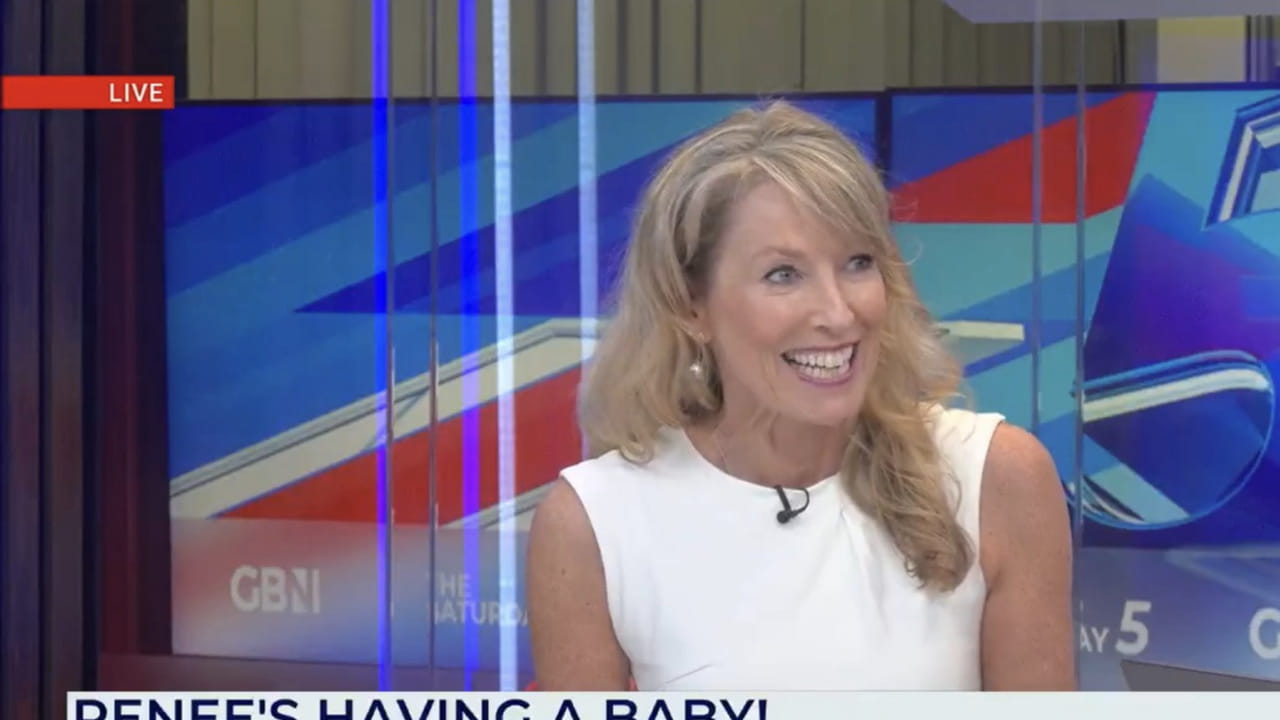
A 59-year-old British television presenter stunned her co-hosts and viewers after announcing her pregnancy live on air.
A 59-year-old British television presenter stunned her co-hosts and viewers after announcing her pregnancy live on air. Dr Renee Hoenderkamp, a general practitioner and panellist on GB News’ The Saturday Five, revealed that she is 12 weeks pregnant with her third child. Her husband is 66.
The unexpected announcement left fellow panellists visibly taken aback. During the broadcast, Hoenderkamp teased that she had some news to share, something that nobody else knew about. She then dropped the surprise, revealing that she was expecting another baby.
After a brief moment of disbelief, her co-hosts erupted into congratulations, with one panellist even getting up to give her a warm hug.
“I have some news to break to the panel today that they’re not aware of, or anybody else, for that matter. I’m actually going to be a mother of three shortly,” she said.
Scroll to load tweet…
While the announcement prompted an outpouring of congratulatory messages, it also ignited a heated debate online. Several social media users questioned her decision to have a child at 59, with some raising concerns about her age and the future of the baby.
TV Host Hits Back At Critics Over Pregnancy At 59
Addressing the criticism in an article for the Daily Mail, Hoenderkamp challenged accusations that she was having a baby for selfish reasons. She questioned why older women were expected to justify their decision to become mothers when younger women rarely faced similar scrutiny.
“Many people have suggested I am having this baby ‘for me’. Well, isn’t that true of almost every woman who deliberately sets out to become a mother?”
“We don’t ordinarily demand that women in their 20s or 30s justify their desire for children as an act of altruism.”
“Why should that desire suddenly become morally suspect simply because a woman is older?”
She argued that critics appeared fixated on the age recorded on her birth certificate, rather than considering her overall health and lifestyle. Hoenderkamp said she takes good care of herself and feels fitter than many people half her age.
Some critics suggested that she “may not live long enough to see this child grow into adulthood”.
Acknowledging that the concern was not entirely unfounded, the mother of two said she had carefully considered the possibility of not being around for her child’s later years.
“It is a legitimate concern, and one I have considered carefully,” she said.
“I cannot promise I will be alive when my daughter turns 30, or even 20. But who can?… Illness and tragedy do not politely wait until someone reaches pensionable age,” she added.
However, she argued that the possibility of an earlier loss should not automatically overshadow the chance of giving a child a happy and loving upbringing.
“That doesn’t mean age is irrelevant. But nor do I believe the possibility of an earlier bereavement automatically outweighs the prospect of a happy, secure and deeply loved childhood.”
Hoenderkamp Questions Double Standards Around Older Parents
Hoenderkamp also called out what she described as a glaring double standard in society’s attitude towards older parents. While her age became a major talking point, she noted that far less attention was being paid to her 66-year-old husband’s age.
She argued that men who become fathers later in life are often spared the kind of public scrutiny faced by older mothers. In some cases, older fatherhood is even viewed as an achievement, particularly when men are at a stage in their careers that allows them to spend more time with their families.
“Older fatherhood has long been treated as an eccentricity, sometimes even an achievement,” she added.
“Yet when a woman chooses to have a baby at 59, the reaction borders on moral outrage. Of course, there are biological differences between older mothers and fathers. But when criticism moves beyond medical risk into accusations of selfishness, why does judgment fall so disproportionately on women?”