
New Delhi: Researchers from IIT Bombay have carefully examined the geological features on Mars to better understand the geological history of the Red Planet. The research was focused on an ancient region of Mars in the southern hemisphere known as the Thaumasia Highlands, located to the southeast of the Tharsis volcanic plateau and southwest of the spectacular Valles Marineris canyon system. The research reveals a gradual shift from a wet, warm climate to a cold and icy one between four and three billion years ago. Valley networks were used as geological thermometers and clocks, to track the changes in the region over time.
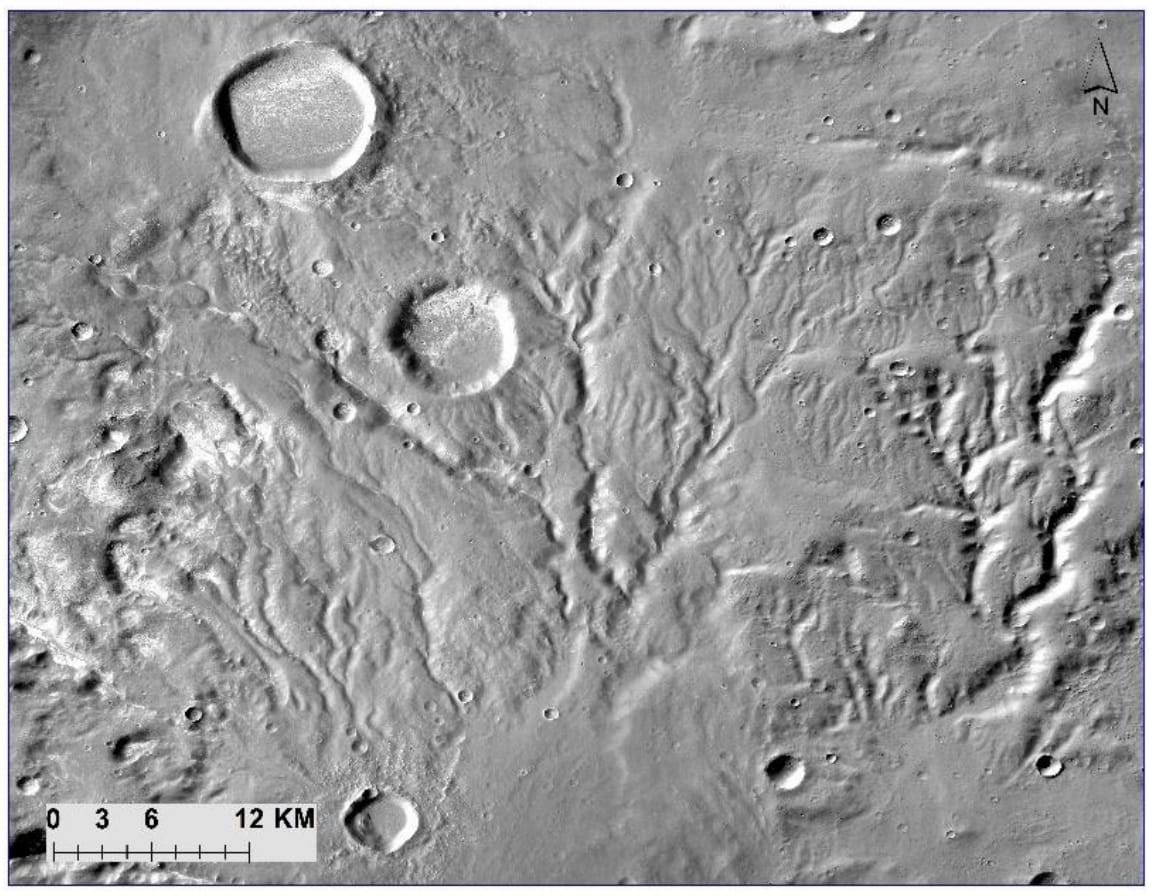
Valley networks in the Thaumasia Highlands. (Image Credit: Mars Context Camera).
One of the authors of the study, Alok Porwal says The Thaumasia Highlands is a region somewhat like the Indian subcontinent. It extends from the equator to higher latitudes, so it has a range of climates and geographies. It also has both very ancient geologic formations and more recent features, which gives an overall view of the planet.” The researchers used data the European Mars Express orbiter, NASA’s Mars Reconnaissance Orbiter and the retired Mars Global Surveyor, as well as ISRO’s Mars Orbiter Mission. Closer to the equator, there were signs of flowing water carving the surface, while farther south, the evidence for ice and glaciers increased.
The wet past of Mars
The research confirms that most of the valley networks on Mars were carved predominantly by surface water during the earliest major geological era of the Red Planet, known as the Naochian period between 4.1 and 3.7 billion years ago. The formation of valleys began to decline with a transition towards fluvioglacial activity, where a combination of water and glacial ice shaped the terrain. By the Hesperian period between 3.7 and 3 billion years ago, the valleys were modified by groundwater erosion and glacial processes, indicating a subsurface cryosphere. A paper describing the study has been published in Advances in Space Research.