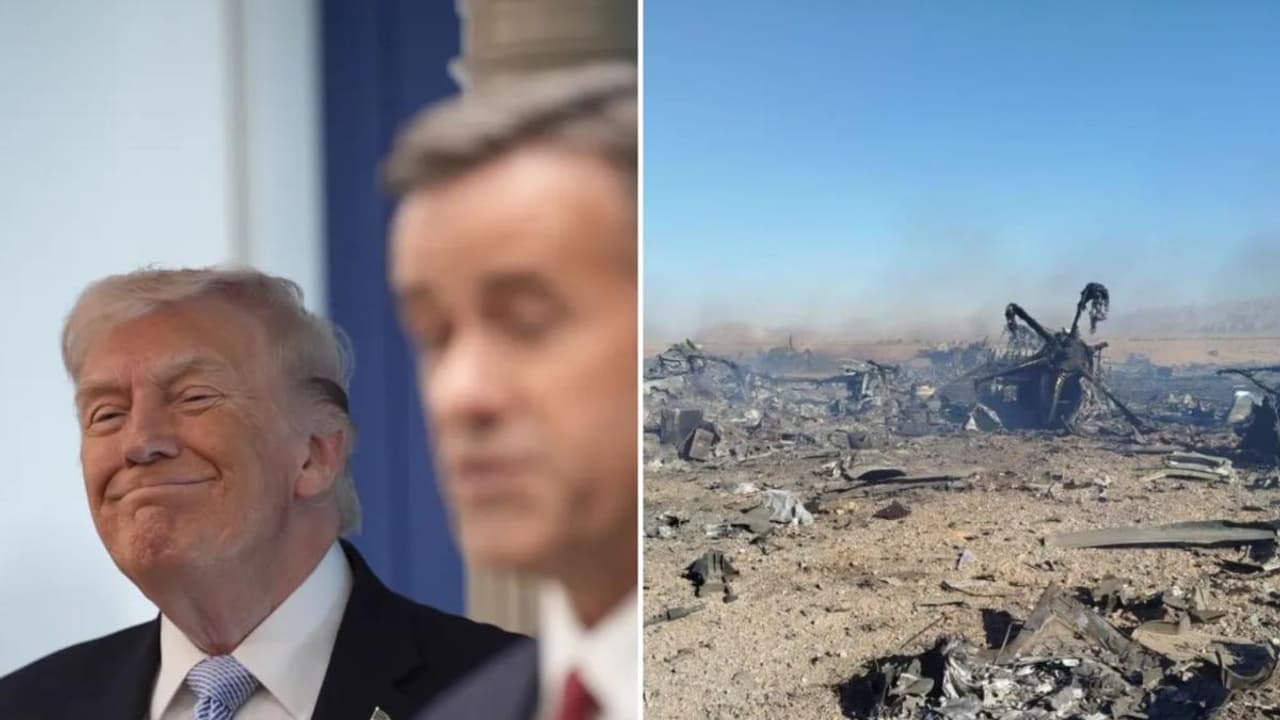
The CIA has reportedly deployed a classified surveillance tool—codenamed Ghost Murmur—to locate a downed American airman deep inside hostile terrain in southern Iran.
The CIA has reportedly deployed a classified surveillance tool—codenamed Ghost Murmur—to locate a downed American airman deep inside hostile terrain in southern Iran. According to sources familiar with the covert operation, this cutting-edge system harnesses long-range quantum magnetometry to detect even the faintest human heartbeat—turning the human body itself into a traceable signal.
Ghost Murmur scans for the subtle electromagnetic signature produced by the human heart. Advanced artificial intelligence then processes this data, isolating a single individual’s signal from vast environmental noise across miles of barren land.
Developed by Lockheed Martin’s secretive Skunk Works division—the same elite unit behind legendary aircraft like the U-2 and SR-71 Blackbird—the technology represents a radical leap in battlefield surveillance.
Scroll to load tweet…
One individual who spoke with the New York Post described Ghost Murmur as ‘hearing a voice in a stadium, except the stadium is a thousand square miles of desert’. They added, ‘In the right conditions, if your heart is beating, we will find you.’
A High-Stakes Rescue in Enemy Territory
The futuristic system was reportedly used to locate a wounded weapons systems officer, publicly known as ‘Dude 44 Bravo’, after his F-15 fighter jet was shot down over southern Iran.
Stranded and injured, the airman sought refuge in a remote mountain cave, surviving for two days as Iranian forces combed the region in search of him.
Despite activating a Boeing-made Combat Survivor Evader Locator beacon, his exact position remained elusive—until Ghost Murmur zeroed in.
The vast, sparsely populated desert turned out to be the perfect testing ground. With minimal electromagnetic interference and almost no competing human signals, the landscape offered what one source described as “an ideal first operational use”.
How ‘Ghost Murmur’ Breaks Scientific Limits
A source explained, ‘Normally this signal is so weak that it can only be measured in a hospital setting with sensors pressed nearly against the chest.’
‘But advances in a field known as quantum magnetometry – specifically sensors built around microscopic defects in synthetic diamonds – have apparently made it possible to detect these signals at dramatically greater distances.’
These sensors work by firing lasers through specially engineered diamonds. At the quantum level, tiny imperfections—known as colour centres—react to magnetic fields, allowing the system to pick up extraordinarily subtle signals, potentially even a human heartbeat.
While such technology has traditionally been used to study massive planetary structures or microscopic neural activity, applying it to track individuals across miles marks an unprecedented leap.
The source cautioned, ‘The capability is not omniscient. It works best in remote, low–clutter environments and requires significant processing time.’
Trump, CIA Confirm Operation But Keep Secrets Tight
The existence of the classified technology was subtly acknowledged during a press conference by CIA Director John Ratcliffe and President Donald Trump.
Mr Ratcliffe stated the agency had ‘achieved our primary objective by finding and providing confirmation that one of America’s best and bravest was alive and concealed in a mountain crevice.’
He added that the airman was ‘still invisible to the enemy, but not to the CIA’.
Trump praised the mission, saying Mr Ratcliffe ‘did a phenomenal job that night’, while hinting at undisclosed capabilities: ‘he did something that I don’t know if you want to talk about it. If you want, you can. I’m not sure he’s supposed to.’
The President even joked about the secrecy, saying he might have to ‘put [Mr Ratcliffe] in jail’ if he revealed too much.
In a striking claim, Trump added that the airman had been detected from ’40 miles away’, though details remain unverified.
A Massive Military Operation Backed the Rescue
The daring rescue mission was nothing short of extraordinary.
Trump described an operation involving 155 aircraft—including 64 fighter jets, 48 refuelling tankers, 13 rescue aircraft, and three helicopters—mobilised to extract the stranded officer from mountainous terrain.
He hailed it as ‘a breathtaking show of skill and precision, lethality and force’ as US forces executed a high-risk extraction deep inside hostile territory.