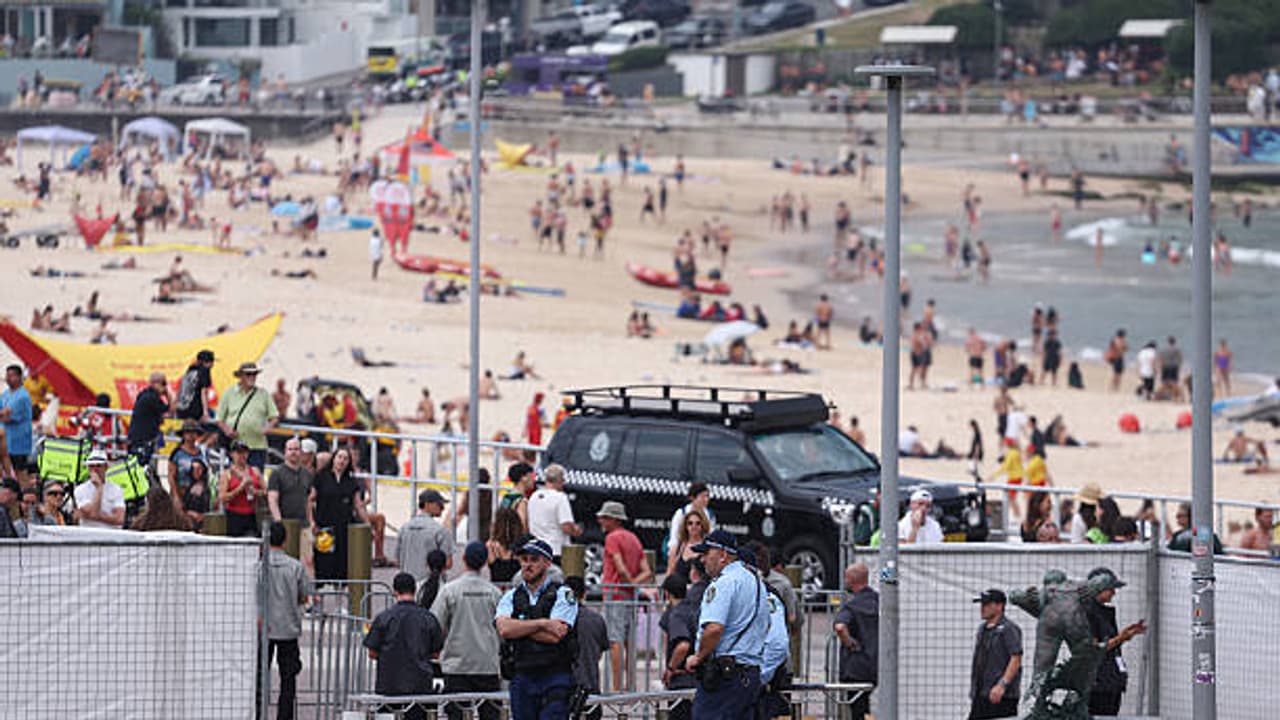
Rahemath Pasha, the 37-year-old Uber driver from Hyderabad was waiting near Sydney’s iconic Bondi Beach on the evening of December 14 when sharp bursts shattered the air, followed by screams that froze his blood.
At first, Rahemath Pasha mistook the sound for celebration. Fireworks, perhaps. The 37-year-old Uber driver from Hyderabad was waiting near Sydney’s iconic Bondi Beach on the evening of December 14 when sharp bursts shattered the air, followed by screams that froze his blood.
For a moment, Pasha convinced himself it was panic – a minor incident amplified by fear. Then he saw people running in all directions. “I saw a man walking forward, firing,” he recalled.
Rahemath was about 400 metres away from the gunmen — a radicalised, armed father-son duo — when they opened fire at a Hanukkah celebration attended by nearly a thousand Jewish people.
“Then I saw people screaming and dropping to the ground,” he told TOI. Until that night, Rahemath had never witnessed a gun being fired.
Such violence is almost unheard of in Australia, a country with some of the world’s strictest gun laws, shaped by sweeping reforms after the 1996 Port Arthur massacre that left 35 dead. Authorities are now calling the Bondi attack Australia’s worst terrorist assault in decades.
Most people ran. Rahemath did not.
He says he doesn’t remember making a conscious choice. “There was an elderly woman waving for help,” he said. Close to 90, she was desperately signalling. She had been shot in the leg — the bullet tearing through one limb and lodging into the other, leaving her unable to move.
“She was very frail,” Rahemath says. “If it had been me, I could have managed. But she couldn’t. I couldn’t shake the feeling.”
As chaos erupted and crowds ran for cover, Rahemath moved toward the gunfire.
“I was terrified,” he says. “This was the first time in my life I had seen something like this. It felt like a movie scene. Blood, bodies, running people. Except people were actually dying.”
“I saw people who were frozen, bleeding, not knowing where to go,” he said.
He held the elderly woman’s hand as lifeguards improvised stretchers using surfboards. She clutched him tightly. For 45 minutes, she refused to let go. “She told me, she was only sitting on the bench singing songs…she kept saying that she had done nothing wrong, for this to have happened to her,” he recalled.
When she was finally placed into an ambulance, she smiled and blessed him. That smile has stayed with him. Much else has blurred. “It felt like a mother’s embrace,” he said. “I hope she survived, I am still trying to find out,” he added.
In the hours that followed, Rahemath helped more than a dozen people — guiding the wounded, comforting those in shock, and assisting police and emergency responders. At one point, he held the hand of a middle-aged man who could not speak. Moments later, the man lost consciousness and died. “He just went quiet, right in my arms,” Rahemath recalls, his voice trailing off.
Later, investigators confirmed the attack was an act of terrorism inspired by Islamic State ideology. Fifteen people, including a child, were killed. Dozens more were injured.
Bondi Beach – where ordinary people like Rahemath lifted the dead and the nearly dead.
Like everyone else there, Rahemath was unarmed and untrained. “I am not a doctor, nor do I have any such prior training” Rahemath says. “But at that moment, leaving did not feel like an option.”
So he focused on small acts — helping someone stand, pointing people away from danger, staying with those who couldn’t yet comprehend the horror unfolding around them.
Around him, bare-chested beachgoers, officers in bulletproof vests, paramedics, and tourists in holiday clothes merged into a haunting procession as the night stretched on. By the time the area was secured, it was nearly midnight. More than five hours had passed.
Rahemath hadn’t noticed the time. Only when the noise faded did his body respond. “I started shivering,” he says. “That’s when it hit me.” A local journalist noticed him shaking, gave him water, and stayed until his breathing slowed.
Rahemath has lived in Australia since 2019, pursuing a commercial chef course. He drives Uber to support his family while searching for a chef’s job. His parents, wife, and two young children live in India.
His parents in Hyderabad saw him on television before they heard his voice. “They couldn’t believe it was me,” he says. “They were watching the Bondi news and suddenly I was there on the screen.”
“They were very scared. I was trying to calm them while I myself was still shaking.”
Asked whether faith shaped his actions, Rahemath pauses. “I believe in humanity first,” he says. “Caste, creed, religion. None of that matters at that moment. Even Islam teaches this. If you save one life, you save all of humankind.” He resists symbolism. “This should not be about breaking stereotypes,” he says. “This is just what a human being should do.”
Three days later, on December 17, he returned to Bondi Beach for a memorial, laying yellow and white chrysanthemums among hundreds of tributes, standing silently.
December 14, 2025, refuses to leave him. Sleep comes uneasily. The images return — the screams, the unbearable silence between shots.
“Sometimes I think – what if something had happened to me? What about my children?” he says.
Still, when asked if he would act differently if faced with that moment again, Rahemath does not hesitate.
“If someone needs help and you are there, you help.”