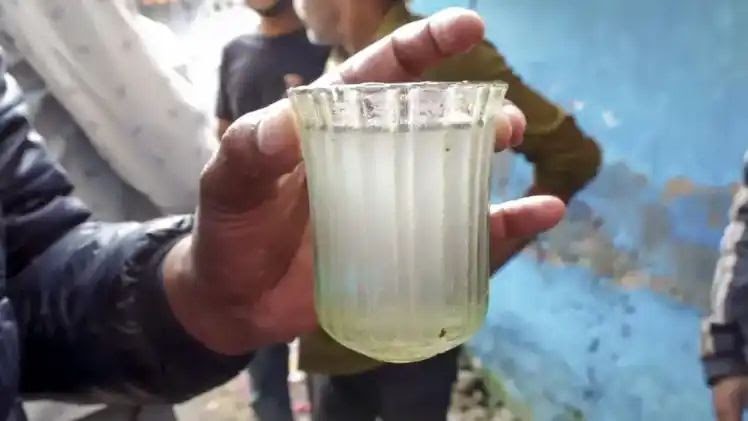
If the dirty water that has taken the lives of many people in Indore spreads to Delhi, then where will it be tested? The people of Delhi should be scared after reading the information that is going to be given further. Because most of the labs that test water here are not proper and reliable.
Despite being the national capital, only 2 out of more than 25 water testing labs in Delhi are government accredited (NABL’s accredited). That means their testing standards are in line with international standards. The problem is that whether it is waste water in Delhi or people’s drinking water, all are tested in these labs. The water testing lab of Delhi Pollution Control Board (DPCC) is also not NABL accredited. The irony is that the Central Pollution Control Board (CPCB) relies on the reports of this lab for monthly testing of Yamuna water.
According to TOI report, Delhi is at the bottom among all the states and union territories of the country in terms of government labs testing water. There are more than 25 water testing labs here. NABL records show that only two zonal labs of Delhi Jal Board (DJB), Haiderpur and Wazirabad, are recognised. The recognition of the remaining labs ended in October. Regarding this, a Delhi government official says that DJB has applied for NABL recognition for some labs.
NABL i.e. ‘National Accreditation Board for Testing and Calibration Laboratories’ is an autonomous body of the country, which ensures whether the labs are conducting accurate and reliable tests as per international standards. Under the Jal Jeevan Mission (JJM) scheme of the Central Government, all the states and union territories of the country have to get their water testing labs accredited. So that the data is correct and reliable.
condition of other states
However, there has been a lot of improvement in the quality of water testing labs under this mission across the country. There are about 2847 water testing labs in India, out of which 1678 i.e. about 59 percent of the labs are NABL accredited. According to the December 4 document of the Union Jal Shakti Ministry, 100 percent government labs in Tamil Nadu, Tripura, Sikkim and Nagaland are accredited. 98 percent labs in Haryana, 94 percent in Assam and 66 percent in Uttar Pradesh have been recognized. In Delhi this account is less than 8 percent.
Experts say that it is important to follow the NABL report regarding water testing. If the report is not from NABL then it is just a piece of paper and has no validity. No court or international agency will accept it as correct.
bad water in delhi
This is the situation when the condition of both air and water in Delhi is very bad. The report shows that in the year 2025, there has been a significant increase in the cases of cholera in Delhi. Dangerous levels of pollutants were found in treated and waste water. Through RTI, some information was obtained about NABL approved CPCB lab, in which samples of sewage treatment plants were tested. According to this, in June 2025, only 4 out of 37 sewage treatment plants in Delhi met the standards.
In the remaining plants, water quality was found to be poor on 8 parameters like fecal coliform, BOD, TSS, phosphate, ammonia. TOI team observed that this ‘impure’ water goes directly into the storm water drain, supplementary drain and Najafgarh drain, which further falls into the Yamuna river.
This was the data of Central Pollution Control Board, but when compared with the data of DPCC i.e. Delhi Pollution Control Board of the same month, the results were completely different. In the data of DPCC, most of the sewage treatment plants were found to be correct and up to the standards.
Now if such difference is seen in the data of two different boards of the government, then how will Yamuna be cleaned?