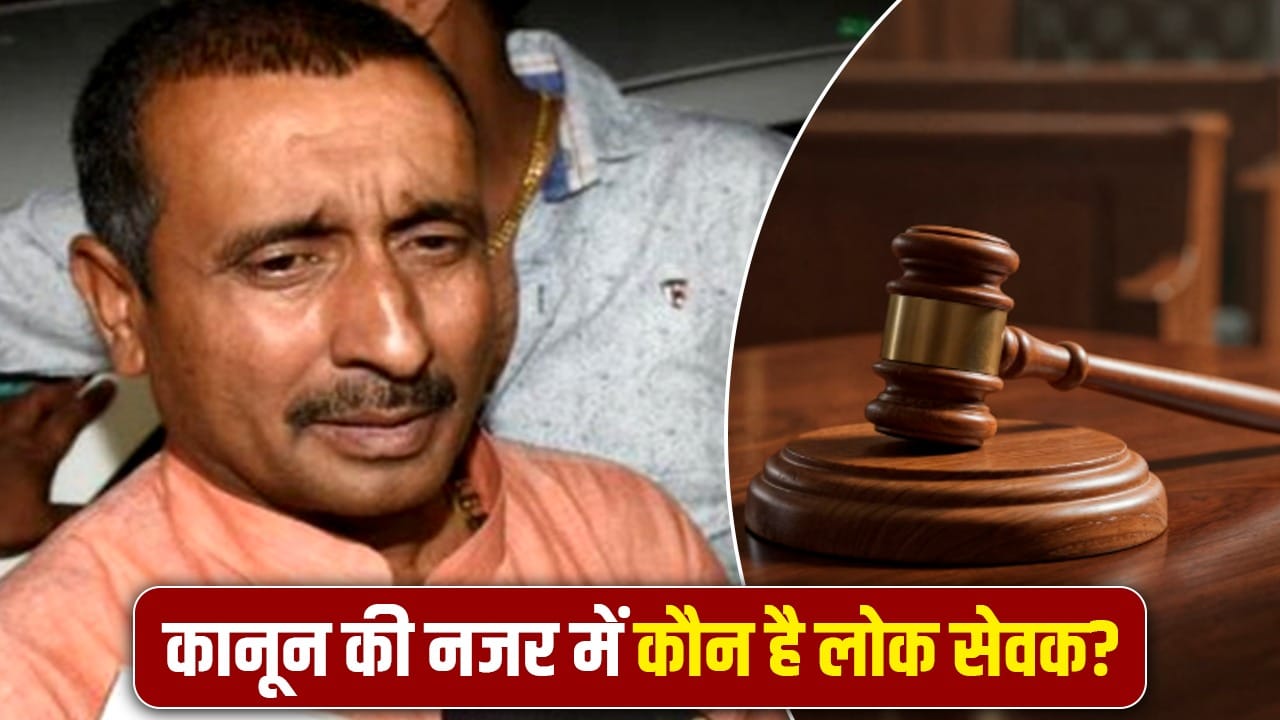
Even though the Delhi Court has given a big relief to Unnao rape case convict and former MLA Kuldeep Singh Sengar by suspending his jail sentence, the court has refused to accept Sengar as a public servant. For this the court gave the example of AR Antulay case of 1984. Now the question arises that in Indian democracy, when an IAS officer or other government employee is considered a public servant, then why are the MPs and MLAs elected by public vote not legally considered the same public servants?
In cases like Kuldeep Singh Sengar, when there is a debate on penalty, punishment or relief, the question becomes even sharper that what is the standard of law for public representatives and where do they fall in the definition of public servant. Let us know through experts what is the definition of public servant and why MLA-MP are not considered public servants.
Who is a public servant?
In simple language, every person who holds any public post to serve the public is considered a public servant. From this point of view, an IAS or police officer, a clerk or peon and an MP or MLA are all doing public service. But every word has a technical definition in the law, which decides which law will apply to whom and in what form. Supreme Court advocate Ashwani Kumar Dubey says that the legal definition of public servant is mainly found in two places. Section 21 of the Indian Penal Code (IPC) and Prevention of Corruption Act, 1988. On the basis of these sections, it is decided who will be prosecuted as a public servant in crimes like bribery, corruption, misuse of office.
They say that the list of public servants given in Section 21 of the IPC includes judges, military officers and government servants, but the word MP or MLA is not clearly mentioned in it. There are separate rules in the Anti-Corruption Act in which MPs and MLAs are considered public servants in cases of corruption. Under Section 2(c) of the Prevention of Corruption Act, 1988, any person who discharges a public duty is a public servant.
MPs and MLAs are elected representatives of the public. According to the Supreme Court’s decision in PV Narasimha Rao’s case, MPs-MLAs are not full-time salaried employees, but are persons holding public office. On this basis, while being an MP-MLA, they can also do other professions like advocacy, which an IAS, IPS or other government employee cannot do.
Why are IAS and other government officers public servants?
In Section 21 of the IPC, it has been made clear who are public servants. This broadly includes those people who are in the employment or service of the government, who are appointed to discharge any public responsibility, officers related to state property, revenue, judicial work, etc., those members/officers of institutions like Panchayat, Municipality, Government Corporation, Authority who have statutory responsibilities.
IAS, IPS, State Administrative Service, Police, Patwari, Tehsildar, Collector, Secretary, etc. are all appointed in Government Service. Their appointment, promotion, disciplinary action, suspension, dismissal etc. everything happens as per the rules/service regulations. Article 309 of the Constitution and its related service rules (such as All India Services Rules) regulate these. For this reason, when an IAS officer takes bribe or misuses it, he is charged under sections of IPC, Prevention of Corruption Act and departmental service rules.All apply, because he is a public servant by law.
Are MPs and MLAs public servants or not?
The biggest confusion arises here. Technically we will have to talk at two levels. The flat answer to this is no. MPs and MLAs are not government employees. They are neither employees appointed under any department, nor are general civil service rules applicable to them. They are constitutional officers elected by the people.
Their position is independent from the government. They are members of Parliament and Legislative Assembly and not employees of the executive.Therefore, under Article 309 or Government Service Rules, they are not placed in the same category of public servant as officers like IAS, IPS.
The second question is whether MPs/MLAs are public servants in criminal law? The point here is quite subtle. The Supreme Court, in several important decisions, has held that MPs and MLAs are public servants for the purposes of the Prevention of Corruption Act, as they discharge public duties and take important decisions related to public money, policies and parliamentary functions.
For example, in PV Narasimha Rao v. State (CBI/SPE), 1998, the Supreme Court discussed the status of Members of Parliament in detail. The court accepted that MPs are not government employees, but they are public servants. In the sense that they are answerable to the public and misuse of their position can be brought under the ambit of corruption.
Furthermore, while interpreting the Prevention of Corruption Act, the courts have made it clear that if public representatives take bribes, accept money for abuse of office or embezzle any government contract, policy or benefit, they can be prosecuted under the same corruption provisions as public servants. That is, MPs and MLAs are considered public servants under criminal law (especially anti-corruption law), but they are not government officials subject to service rules.
Why was the constitutional framework kept separate?
The Indian Constitution rests on three main pillars.
- Legislature Parliament, Assemblies
- Executive Government, Cabinet, Bureaucracy (IAS etc.)
- Judiciary
The IAS and other government officers are part of the executive, which is used by the Council of Ministers to implement policies. MPs/MLAs are part of the legislature, whose job is to make laws, hold the government accountable, pass the budget, and debate policies. If MPs/MLAs were declared government employees in the same manner as IAS, their independence, their ability to monitor the government etc. could be weakened. That is why the Constitution placed them in an independent category, and created separate political and legal mechanisms to hold them accountable for their conduct.
- Election Commission and Representation of the People Act, 1951
- Disqualification rules such as termination of membership on conviction of certain offenses under section 8
- Privileges of Parliament, Assembly Article 105, 194
Due to this structure, direct departmental action or suspension cannot be taken against MPs and MLAs in the same way as is done against an IAS. The main weapons against them are criminal prosecution, punishment and imprisonment, and or disqualification from membership etc.
Conflict of definition and question of accountability
In short it can be said that IAS and other government officers are government employees and public servants under the Constitution and service rules. Departmental action, suspension, dismissal, etc. are possible against them. MPs and MLAs are not government employees, but constitutional officials elected by the public. They are considered public servants for the purposes of criminal and corruption laws, but not in the sense of the Government Service Rules.
The public naturally expects that the higher the position, the more stringent should be its accountability.This problem is less related to definition and more related to political and institutional accountability. Strict laws, transparent policies, timely justice and conscious voters can only be coordinated to ensure that whether it is an IAS, an MP, an MLA, every person exercising public power should truly remain a servant of the people.
Also read: What does India import from Nigeria, where America bombed?