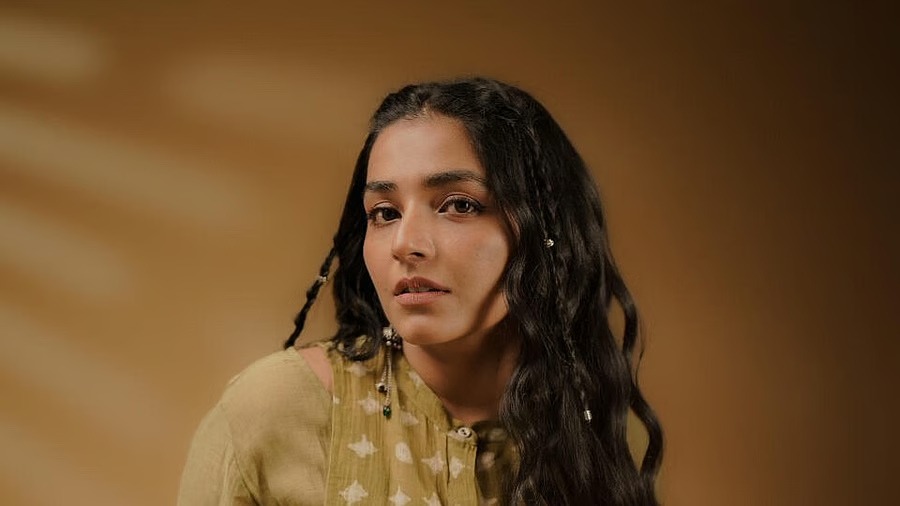
From her compelling performances in Malayalam cinema to carving a niche for herself across South Indian film industries, Rajisha Vijayan has steadily established herself as an actor who isn’t afraid to experiment with roles. Known for bringing authenticity, depth, and nuance to her characters, she has consistently chosen stories that challenge her as a performer. With her latest outing, ‘Bachelor Party 2’, Rajisha adds another interesting project to her filmography. In this conversation with Ikyatha Yerasala, she opens up about her journey as an actor, her upbringing across various cities in India, and more.
How have your expectations from a script evolved over the years?
I look for something that sparks my interest and makes me feel excited about taking it on. I look for something that I haven’t explored before. When I hear a script, I should feel that this is a story that needs to be told and that I want to be a part of it. I’d also love to portray more well-written female characters.
Do women actors have the same freedom and opportunities as their male counterparts to experiment with roles and reinvent themselves?
Honestly, it depends on the project. A film is ultimately a director’s vision, and we are all just tools that a director uses to tell the story. Some directors are very particular and have clarity about what they want, while others are more open to improvisation, suggestions, and collaboration.
That said, the industry and its market are largely male-driven. Cinema may be an art form, but at the end of the day, it is also a business. An actor has to be commercially viable and be able to draw money in. There are very few films where even if a male actor is shouldering the film, the female character is given an equally substantial role rather than being treated as an accessory. It isn’t just about the roles you choose; the director and the script have to choose you, too.
More than a decade after your award-winning debut, how has your understanding of success evolved?
Success, to me right now, is to stay sustainable. Initially, it was about whether I could become an actor, and it later became about making a mark and getting projects. After a few years, it becomes about not getting washed away by the current and standing your ground, doing good work, creating a brand in your name and making people think about the characters you have played. I want to be a part of cinema till the day I die.
Has there been a role that changed the way you look at the world?
My Tamil debut, ‘Karnan’, was one such experience. I grew up across different parts of the country as an Army child. In the defence community, everyone is treated equally, without discrimination or divisions. So, I had very little exposure to caste-based discrimination. While shooting for ‘Karnan’, I was shaken by the realisation that caste divisions continue to exist even today. Learning about the atrocities faced by communities because of caste was really shocking for me.
Another such role was in the movie ‘Mastishka Maranam’. Many of the issues explored in the film are relevant even today, and being part of it gave me a different perspective on several things.
Growing up in an Army family meant living in different parts of the country. How did these experiences shape your outlook on life?
I’ve lived in places such as Pune, Agartala and Punjab, among others. Travelling and meeting people from different backgrounds really broaden your horizons and opens up your way of thinking. You experience cultural differences and sometimes even cultural shocks. Things that might be considered inappropriate in one part of the country could be perfectly acceptable in another. It also makes you more adaptable.
I believe people everywhere have a lot of love to give; they just express it differently. In Punjab, people are more extroverted and shower you with affection. In Bengal, too, there is plenty of warmth, but it is expressed more subtly. Women in Bengal stand out because they are powerhouses. In Kerala, I’ve found people to be quite open to different ideas. These experiences have taught me to appreciate how beautifully diverse our country is.
And then there’s the food! As Indians, we are truly blessed to have such an incredible variety of cuisines. Naga and other Northeastern cuisines are also absolutely delicious.
If you could choose your next role without worrying about commercial success or audience expectations, what kind of character would you like to explore?
I’d love to do a rom-com because I feel we’re really lacking in that genre today. The more positive spectrum of human emotions is not being explored enough on screen. We’re seeing a lot of action, horror and violence, and I really miss chick flicks, romantic comedies and those gut-wrenching love stories. I would also love to do an out-and-out comedy or a spoof film that families can watch together and laugh their hearts out.
Are you open to doing a Kannada film in the future?
Of course! I’ve already explored three South Indian languages, and I would like to explore Kannada projects. Whenever I visit Bengaluru, many people recognise me through ‘June’, my Malayalam film. I admire Kannada actors such as Rishab Shetty and Rakshit Shetty, and I think Kannada is a culturally rich language. I loved films such as ‘Sapta Saagaradaache Ello’ and ‘Gantumoote’. I’d also love to explore Hindi cinema, as it’s a language I speak fluently.