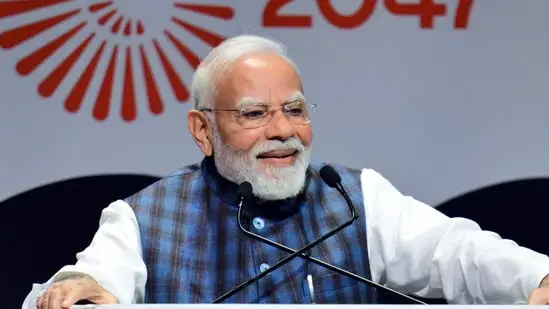
Prime Minister Narendra Modi on Thursday heaped praise on the government’s income tax relief to the corporate sector but also asked industries if they increased salaries or hired more employees.
At the Federation of Indian Chambers of Commerce and Industry (FICCI)’s centenary convention, PM Modi urged India Inc or the corporate sector to ensure that the benefits of tax cuts also reached employees.
“In 2014, the basic corporate tax rate was 30%. We reduced it to 22%. Today, in India, there is no income tax on earnings up to ₹12 lakh,” the prime minister said.
He then turned his attention to industry leaders. “I have waived income tax on ₹12 lakh bracket, but did you increase salaries or the number of employees? ‘Modi ji aap karo hum dekh lenge‘, is this how things will function?,” PM Modi asked, drawing laughter from the crowd.
Modi said the government had taken the decision to provide substantial income tax relief despite knowing that industry leaders might not be satisfied with the measures.
He added that the income tax relief had significantly increased people’s purchasing power and asked businesses to acknowledge the government’s efforts.
“Friends, we had the courage to provide such a massive relief in income tax. This has significantly increased the purchasing power of our people,” he said.
Modi also highlighted changes to income tax return filing and refund procedures, saying the government had simplified the system to prevent taxpayers’ money from remaining stuck unnecessarily. “Earlier, you must remember, it used to take eight months for a letter to arrive. Today, does a return get processed within a week or not?” he said.
Modi urges industries to look beyond domestic market
Beyond taxation, Modi also called on Indian businesses to expand their global ambitions, deepen domestic manufacturing and increase value addition, saying the country’s domestic market should serve as a launchpad for international competitiveness rather than a comfort zone.
Addressing industry leaders as FICCI marked its 100th year, he asked businesses to make national interests central to their long-term investment decisions. “In every long-term investment decision of yours for the next 20 years, make India First your foundation,” he said.
The prime minister said India needed to reduce its dependence on imports and strengthen domestic manufacturing across sectors where it already had the resources and potential to produce goods for domestic and international markets.
Citing pharmaceuticals as an example, Modi said India had established itself as the “pharmacy of the world” through its strength in finished medicines but continued to import large quantities of active pharmaceutical ingredients (APIs), bulk drugs and intermediates.
“In finished medicines, we have strength. Now we will have to build our capabilities in ingredients as well,” he said.
Modi urged companies to identify imported products that could be manufactured domestically and invest in the technology required to produce them. “What kind of a country is this, and what kind of industrialists are we, if we export wheat and import bread?” he asked.
Modi cites India’s economic growth, exports
Modi said India had moved from being counted among the world’s “Fragile Five” economies to becoming the fastest-growing major economy.
He cited a recent World Bank report, claiming that 500 million Indians had moved out of poverty over the past 12-13 years.
The PM also pointed to merchandise exports of nearly USD 50 billion in October, describing the figure as India’s highest monthly goods export performance.
He said global institutions, including Moody’s Ratings, S&P Global Ratings, Fitch Ratings, the World Bank and the Asian Development Bank, had revised their growth projections for India upwards, with the economy expected to grow at around 7%