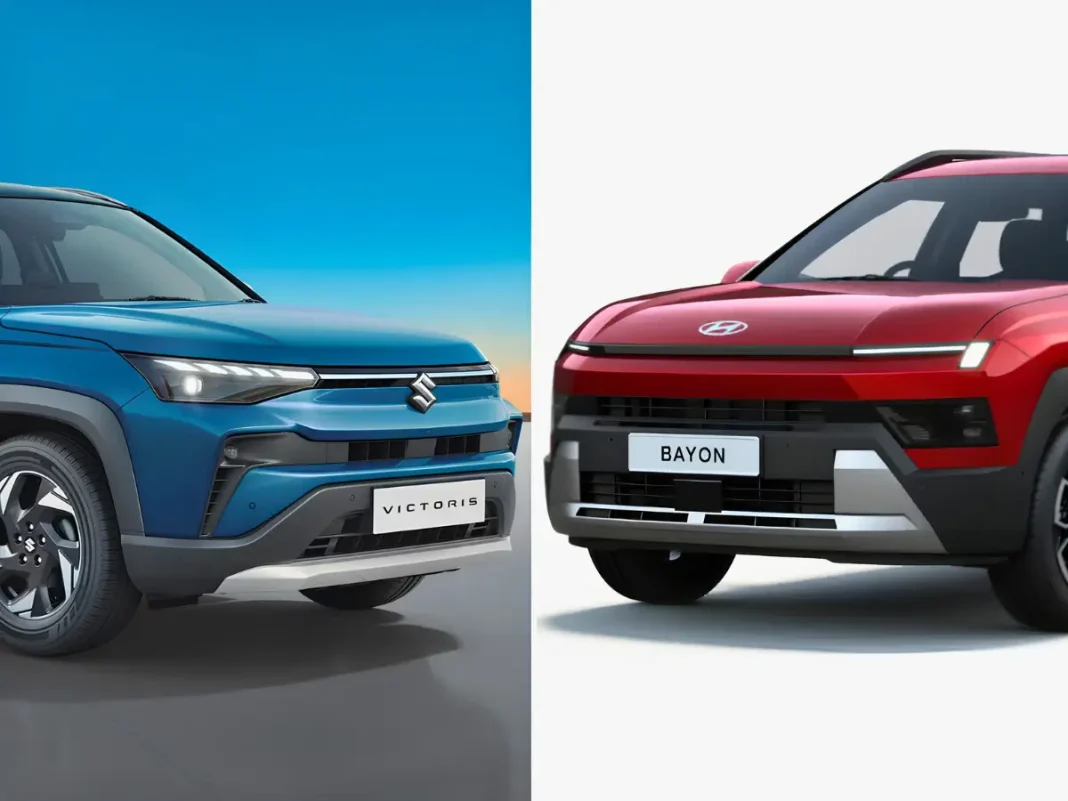
The Hyundai Bayon is the latest entrant in the midsize SUV segment, priced between Rs 10 lakh – Rs 18 lakh (all, ex-showroom). It’s an option for buyers looking for a Creta-like SUV at a relatively affordable price point. In terms of pricing and positioning, the Bayon directly rival the Maruti Suzuki Victoris, which is currently available within the price range of Rs 10.50 lakh – Rs 19.99 lakh (ex-showroom).
Here, we compare the mileage and running cost of the and the Maruti Victoris SUVs.
Powertrains Options
Measuring 4,245mm in length, the Hyundai Bayon comes with a 1.5-litre naturally aspirated petrol engine, generating 115bhp and 144Nm of torque. Transmission options include a 6-speed manual and a CVT (iVT). Meanwhile, the Maruti Victoris is available with 1.5-litre mild hybrid petrol, strong hybrid and CNG powertrain options.
ARAI Mileage Comparison

Hyundai claims that the Bayon CVT offers a claimed ARAI fuel efficiency of 18.6kmpl. The official mileage figure for the manual variant is yet to be announced, but it’s expected to be around 18.2kmpl.
On the other hand, the Maruti Victoris 1.5-litre petrol manual and automatic delivers claimed ARAI mileage of 21.18kmpl and 21.06kmpl, respectively. The petrol AllGrip AWD automatic returns 19.07kmpl, while the CNG version promises 27.02km/kg. The Victoris strong hybrid with e-CVT offers an impressive fuel efficiency of 28.65kmpl.
On paper the Maruti Victoris has an upper hand over the Bayon in terms of fuel efficiency. The Bayon also misses out no hybrid and CNG powertrain options for now.
Fuel Cost Per Km & Per Year

The following comparison is based on assumptions that petrol costs Rs 100 per litre, CNG costs Rs 90 per kg and each SUV covers 12,000km per year. It’s important to note that fuel prices vary by city, so the actual running costs may differ. The calculations are based on ARAI fuel efficiency figures, and real-world bills will vary for both SUVs.
As per the table, the Victoris petrol automatic saves about Rs 7,500 annually over the Bayon CVT, whereas its strong hybrid version saves nearly Rs 22,600 per annum, which is around Rs 1.1 lakh over five years. The Victoris CNG has the lowest fuel cost per-km cost.
Overall, the Maruti Victoris hybrid and CNG versions offer lower fuel bills than the Bayon. However, their higher purchase price need to be considered while calculating the total cost of ownership.
Frequently Asked Questions
Which SUV offers better mileage, Bayon or Victrois?
With every powertrain, the Maruti Victrois emerges as a more frugal option than the Bayon. It’s fuel efficiency figures range between 19.07kmpl to 28.65kmpl, depending on the variant and powertrain, compared with 18.6kmpl for the Bayon CVT.
What is the Hyundai Bayon’s mileage?
The Bayon CVT offers a claimed ARAI fuel efficiency of 18.6kmpl. The official mileage figure for the manual variant is yet to be revealed.
Does the Bayon have a hybrid or diesel option?
No, the Bayon doesn’t come with hybrid or diesel engine options. It’s currently available with a 115bhp, 1.5-litre naturally aspirated petrol engine.
Which SUV is cheaper to run Bayon or Victrois?
Based on claimed fuel efficiency figures and the assumed fuel prices, the Victrois is more affordable to run than the Bayon.