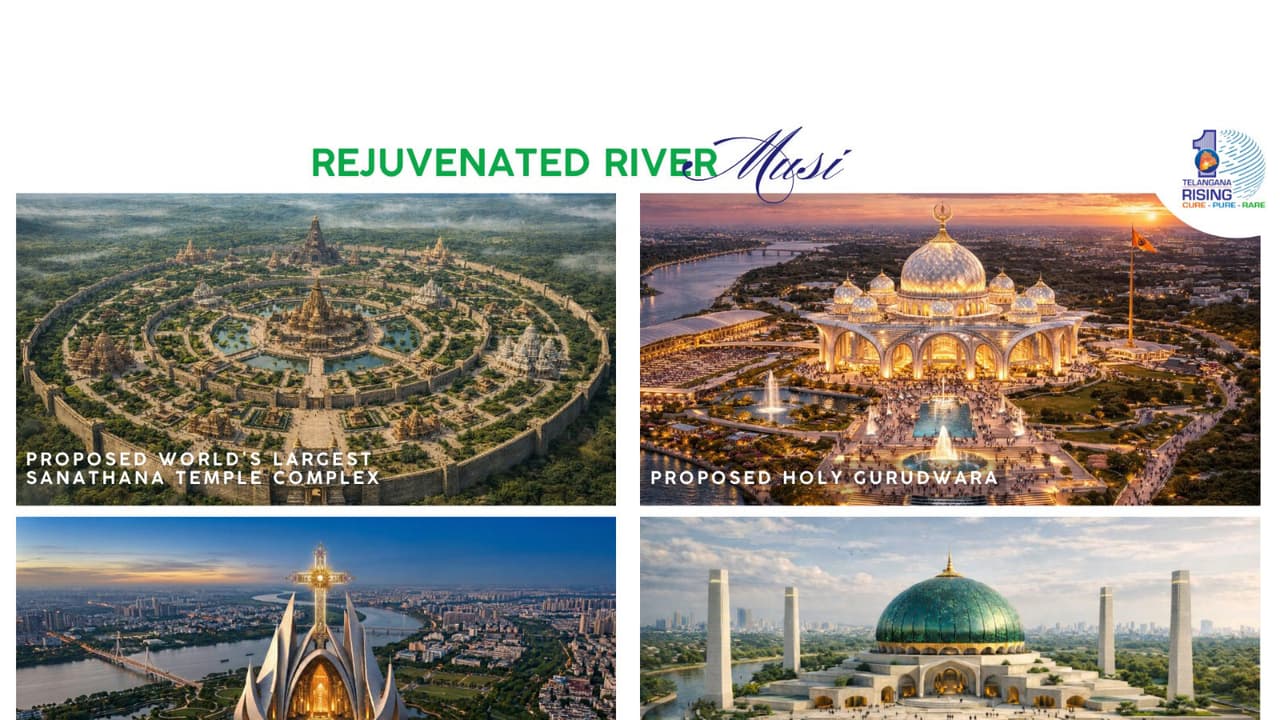
Hyderabad’s Musi Rejuvenation Project, led by CM A Revanth Reddy, aims to restore the river’s ecological balance while promoting religious unity. The plan includes building a temple, mosque, gurudwara, and church along the riverfront.
A Transformative Vision for Hyderabad’s Musi River
In the heart of Hyderabad, a transformative vision is taking shape along the banks of the historic Musi River–one that blends environmental revival with a profound message of unity. The Musi Rejuvenation Project, championed by CM A Revanth Reddy, is not just an urban development initiative; it is an ambitious effort to restore ecological balance while celebrating India’s rich tapestry of faiths. According to an official statement, at the core of this visionary project lies an inspiring idea: the creation of a sacred riverfront that welcomes and represents all major religions. Once rejuvenation is complete, the Musi catchment area will host a harmonious ensemble of spiritual landmarks–a temple, a mosque, a gurudwara, and a church–symbolising coexistence, respect, and shared heritage.
A Riverfront of Faiths and Shared Heritage
The Chief Minister has announced plans to develop “Dakshina Kasi” along the river, reviving the spiritual legacy of the region. As part of this initiative, foundation stones have already been laid for the revered Omkareshwara Swamy Temple and Veerabhadra Swamy Temple. These temples, rooted in a history that spans over 1,400 years, are being developed across 8 acres with a substantial investment of ₹700 crores, ensuring that the region’s cultural and spiritual identity is preserved for generations to come.
Beyond the temples, the government’s commitment to inclusivity is reflected in its pledge to construct a mosque, a gurudwara, and a church within the Musi riverfront zone. This bold initiative stands as a living testament to communal harmony–an embodiment of the idea that faith, in all its forms, can coexist peacefully within a shared space.
From Neglect to a Vibrant Ecosystem
The Musi River, once a lifeline of civilisation in Telangana, has suffered decades of neglect, pollution, and misuse. Previous attempts to restore it fell short, but the current administration sees this challenge as an opportunity. The project aims to cleanse and revive not only the Musi but also the Esa River, transforming them from polluted stretches into vibrant ecosystems that support life, culture, and community, the statement said.
Recognising that great civilisations have historically flourished along riverbanks, the government envisions the Musi riverfront as a hub of economic, cultural, and spiritual activity. With Telangana being a landlocked state, this rejuvenation effort carries even greater significance–offering a renewed connection between people and water.
Tackling Pollution with Decisive Action
Environmental concerns also drive this initiative. Rising pollution levels in the Musi have adversely affected nearby regions, including parts of the Nalgonda district. Learning from the environmental challenges faced by major cities, the government is determined to act decisively to safeguard Hyderabad’s future. Plans to divert water from the Godavari River aim to ensure continuous flow, helping restore the river’s natural vitality.
Ultimately, the Musi Riverfront Project aspires to be more than just infrastructure–it seeks to become a symbol of hope, unity, and renewal. By bringing together sacred spaces of multiple religions along a rejuvenated river, Hyderabad is poised to present a powerful message to the world: that diversity is not a barrier, but a bridge. In this evolving landscape, the Musi will no longer be remembered for pollution and neglect but for harmony, heritage, and the shared spirit of humanity.
(Except for the headline, this story has not been edited by Asianet Newsable English staff and is published from a syndicated feed.)