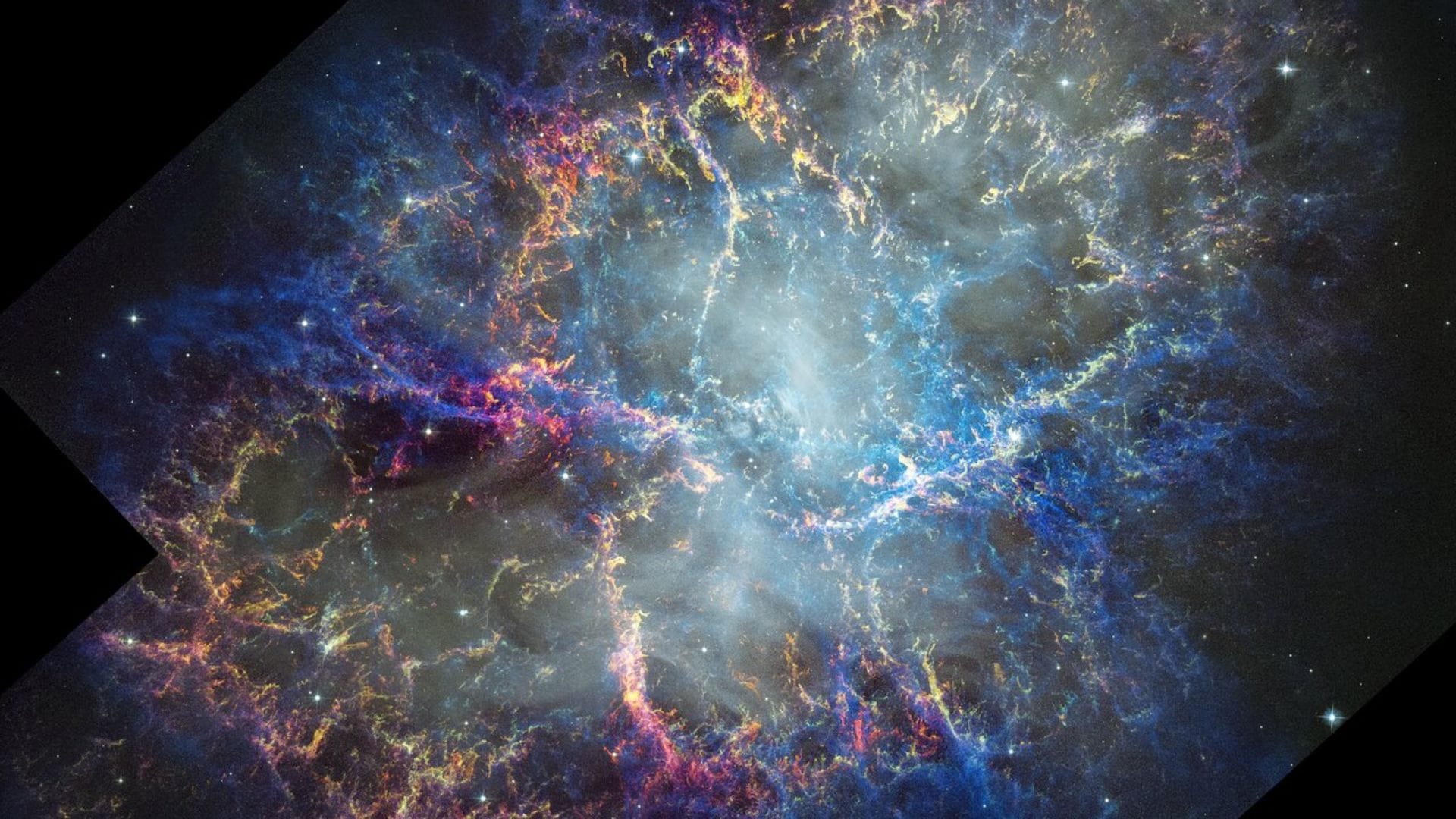
New Delhi: The Hubble Space Telescope has revisited the Crab Nebula, a quarter century after first observing the supernova remnant in 1999-2000. The Crab Nebula is the aftermath of the supernova designated as SN 1054, located at a distance of 6,500 lightyears from the Earth in the constellation of Taurus. The star violently exploded in a supernova explosion nearly a millennium ago, creating a star so bright that it was visible even in the day for a few weeks. The Crab Nebula continues to expand, with the new observations improving the scientific understanding of how supernova remnants evolve over time. A paper describing the research based on the new observation has been published in The Astrophysical Journal.

Hubble’s capture of the Crab Nebula from 1999-2000. (Image Credit: NASA, ESA, STScI, William Blair (JHU); Image Processing: Joseph DePasquale (STScI)).
The supernova remnant itself was discovered in the mid-18th century. In the 1950s, Edwin Hubble was one of many astronomers who noted a close correlation between Chinese astronomical records of a supernova and the position of the Crab Nebula. Astronomers then went on to discover a rapidly rotating neutron star, the remnant core of a dead star, embedded within the crab nebula, reconciling modern observations with ancient records. Hubble has traced the outward movements of the filaments over 25 years, indicating that the strands of gas and dust are moving at 5.5 million kilometres per hour. Hubble is the only astronomical instrument with the combination of longevity and resolution to capture these detailed observations.
Outer filaments moving more rapidly
For better comparison, the researchers reprocessed the older image of the Crab Nebula captured by Hubble. The variation in colours shows a combination of changes in local temperature and density of the gas, as well as its chemical composition. The researchers noted that the filaments around the fringes of the nebula appear to have moved more than those towards the centre. They also appear to be simply moving outwards as against getting stretched over time and expanding. While most explosions are driven by shockwaves from the supernova, the filaments in the Crab Nebula are being moved by the pulsar wind powered by synchrotron radiation, created by the magnetic field of the pulsar interacting with the shed material. The observations have also provided valuable insights into the 3D structure of the nebula.