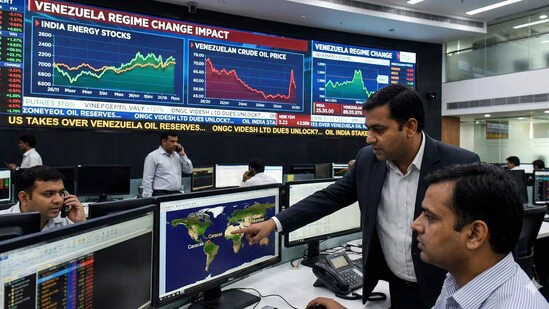
The US attack on Venezuela to dismatle the regime of President Nicolás Maduro is creating dichotomy of sorts for India-a neutral outlook for the stock market but a potential billion-dollar windfall for state-run oil producers.
The geopolitical pivot reinforces a “weaker oil price” scenario that could aid US disinflation and support emerging market assets over the long term, according to Ankita Pathak, Head of Global Investments at Ionic Asset by Angel One.
US-Venzuela impact on India’s oil sector
The regime change in Venezuela is less about macroeconomics and more about hard cash, and ONGC Videsh Ltd. appears to be the primary beneficiary. As per PTI, a US-led restructuring of Petróleos de Venezuela SA could unlock nearly $1 billion in pending dues for ONGC Videsh.
ONGC Videsh, which holds a 40% stake in the San Cristobal field, has been unable to repatriate ~$536 million in dividends accrued up to 2014, alongside a similar amount for subsequent years. Production at the field has collapsed to between 5,000 and 10,000 barrels per day due to US sanctions since 2020.
With US restrictions likely to ease, ONGC Videsh aims to deploy rigs from its Gujarat assets to revive output to the 80,000-100,000 bpd range, officials said.
“A US-led takeover (of Venezuela) could deliver a direct benefit to India, potentially unlocking close to $1 billion in long-pending dues,” analysts told PTI, adding that Oil India Ltd. and Indian Oil Corp. Ltd. could also see value unlocked in their minority stakes in the Carabobo-1 project.
US-Venezuela impact on India’s stock market
That’s largely tied to the trajectory of crude oil prices. According to Pathak, while near-term supply disruptions may cause intermittent price spikes, the “longer-term bias remains negative as supply dynamics improve”.
“Over the medium to long term, weaker oil prices could ease US inflation pressures, potentially enabling further rate cuts and a weaker dollar-supportive for emerging markets,” Pathak wrote in note.
For India’s stock market specifically, the impact “remains largely neutral beyond indirect effects from oil price movements”.
Here’s a look at Indian stocks and assets that can be impacted:
- ONGC: Potential recovery of $1 billion in dividends and production upside at San Cristobal, according to PTI.
- Gold: Hedge against near-term geopolitical friction.
- Reliance Industries: Potential margin benefits from diversified crude sourcing, according to Kpler.
US-Venezuela impact on India’s oil trade
The return of Venezuelan barrels could, however, alter India’s refining strategy. Since the Ukraine war, India has relied heavily on discounted Russian crude. Renewed access to Venezuela’s heavy, sour crude-which Indian refineries are uniquely complex enough to process-offers a diversification opportunity.
“If sanctions are eased… Venezuelan crude could offer additional flexibility to Indian refiners and help ease supply concentration risks,” Nikhil Dubey, senior research analyst at Kpler, said in a statement. “That would reduce India’s reliance on Russian oil imports, a key bottlenesk in ongoing India-US trade discussions.”
According to GTRI data, India’s crude imports from Venezuela fell 81.3% to just $255.3 million in FY25, while exports-led by pharmaceutical goods-stood at a modest $95.3 million.
“Given the low trade volumes…the current developments in Venezuela are not expected to have any meaningful impact on India’s economy,” GTRI asserted, warning that India must navigate the “wars for raw materials” carefully to protect its strategic autonomy.
Investment Outlook
As the Latin American region stabilises, investment strategists are advising caution mixed with selective opportunism. Pathak from Ionic Asset highlights that “precious metals, especially gold, are likely to remain well supported amid heightened geopolitical uncertainty”.
While near-term volatility is likely as markets digest the diplomatic fallout, the removal of Venezuela’s political overhang is a “constructive” development for the medium term. “Volatility may offer selective opportunities in geographies and sectors less exposed to oil prices,” she said.