19
Image Credit : Getty
Celebrating Navy Day 2025
New Delhi: Over the past ten years, the Indian Navy has gone through a major change. Post 2008 Mumbai terror attacks, its focus was mainly on coastal defence and preventing threats near India’s shores. Today, that focus has widened.
The Navy is steadily becoming a blue-water force that can control sea lanes, project power and operate across the wider Indian Ocean. This change can be seen in its aircraft carriers, submarines, information networks and strong push for self-reliance under Aatmanirbhar Bharat.

29

Image Credit : Getty
From Coast to Open Seas
In the years after 26/11, the Navy concentrated on securing India’s long coastline. Coastal radars, fast patrol boats, stricter port checks and joint patrols were strengthened. At that time, the goal was simple: deny hostile forces access to Indian waters.
But the security situation around India began to change. Over the last decade, China has expanded its footprint in the Indian Ocean, sent submarines into the region and invested heavily in ports that could be used for both civilian and military purposes, which is indicative that protecting alone the coastline was not enough.
The Indian Navy started preparing to operate far from home, to protect trade routes and to maintain control over important sea lanes.
39
Image Credit : Getty
Carriers at the Heart of Change
Aircraft carriers have played a key role in this shift. INS Vikramaditya, which joined the fleet in 2013, gave India modern carrier strike capability. It allowed regular operations of MiG-29K fighter jets and helped the Navy gain critical experience in carrier-based air power.
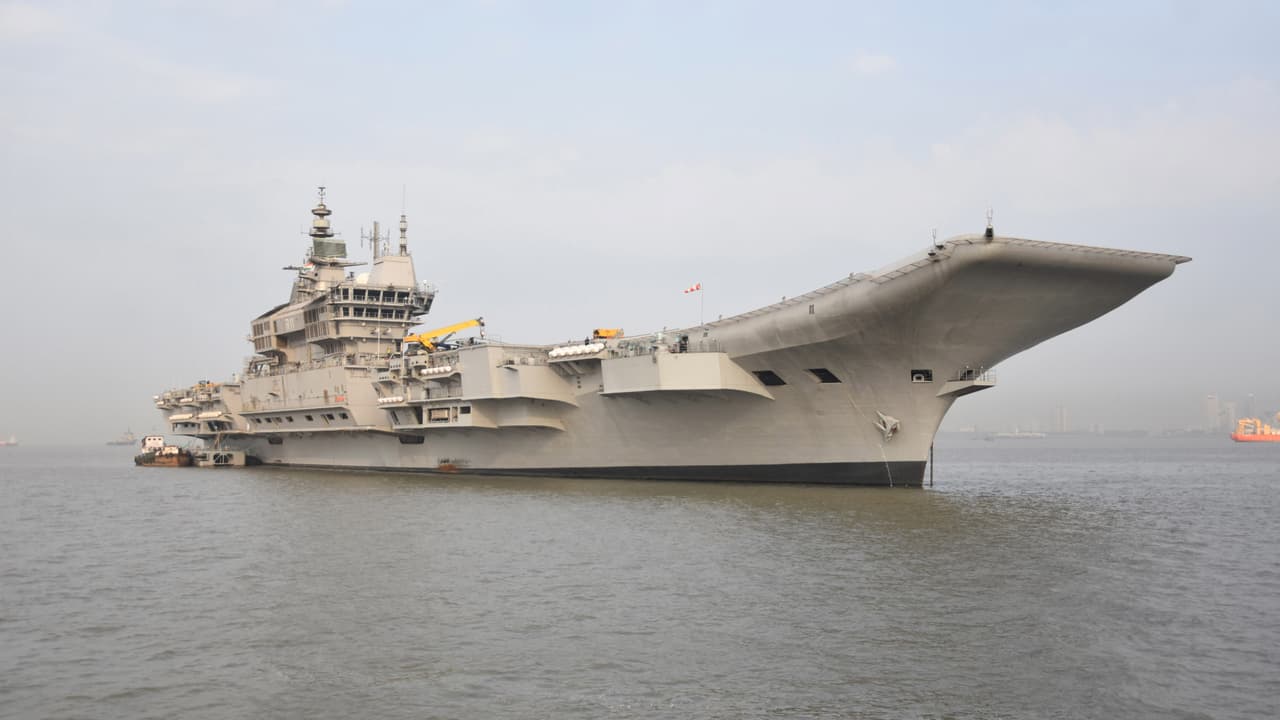
The bigger step came in September 2022 with the commissioning of INS Vikrant, India’s first indigenously built aircraft carrier. Built at Cochin Shipyard, Vikrant showed that India could design and build a large and complex warship on its own.
By 2025, both Vikramaditya and Vikrant were operational, allowing the Navy to operate two aircraft carriers at the same time for the first time in its history.
This greatly improved India’s ability to control large sea areas on both its western and eastern coasts. The Navy is also working with HAL on the Twin Engine Deck Based Fighter (TEDBF), which will eventually replace the MiG-29K fleet.
49
Image Credit : Getty
Growing Strength Under the Sea
India’s submarine force has also grown steadily. Under Project 75, the Scorpène-class submarines were inducted, giving the Navy improved stealth and patrol capability. These submarines play an important role in both denying and controlling sea space.
At the nuclear level, India’s sea-based deterrent has become stronger. INS Arihant became operational in 2018, and INS Arighat followed in 2024. A third indigenous nuclear ballistic missile submarine – Arindaman is expected to join soon. These submarines form the underwater leg of India’s nuclear deterrence.
India is also working on nuclear-powered attack submarines under Project 75 Alpha for long-range missions. In addition, another Russian nuclear submarine is expected to be leased later this decade to expand deep-sea operations.
59
Image Credit : Getty
Fighting with Information as Much as Firepower
Modern naval wars are not fought by ships alone but by information. Over the past decade, the Indian Navy has built strong network-centric systems using satellites, sensors, drones and secure communication links.
India’s coastal radar network, space-based surveillance and the Information Fusion Centre–Indian Ocean Region now allow near-real-time tracking of shipping and naval movement across a large part of the Indian Ocean.
Exercises like TROPEX regularly test how well ships, submarines, aircraft and electronic systems work together in real-time operations.
The Navy’s doctrines are also changing to reflect this new style of warfare, with greater focus on joint operations, faster decision-making and distributed combat.
69
Image Credit : Getty
People and Thinking Are Changing Too
The Navy’s transformation is not limited to ships and weapons. Its people and working culture are also changing.
Speaking ahead of Navy Day, the Indian Navy Chief Admiral Dinesh K Tripathi highlighted this shift, saying the Navy believes strongly in gender-neutral forces, has begun inducting women pilots in both fighter and helicopter streams, and has adopted gender-neutral language in its official documents.
He also said the Navy constantly learns from its own operations and from global practices.
A new Maritime Doctrine has been released, and a revised Naval Strategy will follow next year. These documents will formally guide the Navy’s future operations and long-term planning.
79
Image Credit : Getty
A Strong Push for Indigenous
Self-reliance has become a major driver of the Navy’s modernisation. Since 2014, more than 40 warships and submarines have been built in Indian shipyards. Today, over three-quarters of the Navy’s fleet by numbers is made in India.
The Maritime Capability Perspective Plan now aims to make the Navy almost fully self-reliant by 2047. Public and private shipyards, MSMEs, DRDO and start-ups now play a major role in building ships, sensors, weapons and propulsion systems. INS Vikrant stands as the clearest symbol of this industrial progress.
89
Image Credit : Getty
India as a Regional Maritime Supporter
The Navy’s growing strength is also visible in its wider regional role. Indian warships regularly carry out anti-piracy patrols, escort merchant ships, evacuate civilians during crises and provide humanitarian assistance and disaster relief across the Indian Ocean.
From the Gulf of Aden to nearby island nations, the Indian Navy is increasingly seen as a first responder in times of trouble. India’s SAGAR policy also reflects this aim of shared security and growth in the region.
99
Image Credit : Getty
A Decade That Changed the Navy
From INS Vikramaditya to the locally built INS Vikrant, from coastal patrols to nuclear submarines in deep waters, the Indian Navy of today is very different from what it was a decade ago.
What was once mainly a coastal defence force focused on denying access near India’s shores is now becoming a balanced blue-water navy capable of controlling sea space, deterring threats and operating far from home.
Backed by Indian industry, new technology, updated doctrine and a changing workforce, the Indian Navy is now a key pillar of India’s growing role in the Indo-Pacific.
Stay updated with the Breaking News Today and Latest News from across India and around the world. Get real-time updates, in-depth analysis, and comprehensive coverage of India News, World News, Indian Defence News, Kerala News, and Karnataka News. From politics to current affairs, follow every major story as it unfolds. Get real-time updates from IMDon major cities’ weather forecasts, including Rain alerts, Cyclonewarnings, and temperature trends. Download the Asianet News Official App from the Android Play Store and iPhone App Store for accurate and timely news updates anytime, anywhere.