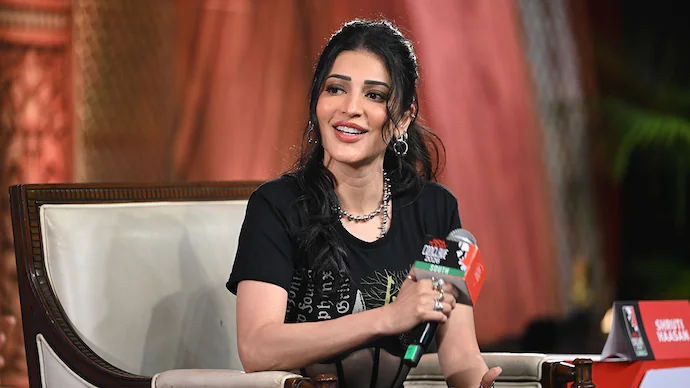
ACCIDENTAL DEBUT
In a refreshing antidote to typical industry-origin stories, Haasan explicitly demystified her entry into cinema. She revealed that acting was never the blueprint; her true aspirations lay in film writing. Her debut in the landmark film Hey Ram was born out of sheer logistical panic. While apprenticing in the costume department under her mother’s guidance, she was thrown in front of the camera simply because the production desperately needed an immediate fill-in for a minor role.
UNIQUE IDENTITY
Addressing the industry’s historical discomfort with her offbeat persona, Haasan explained how she transformed being labelled “peculiar” from a career liability into a “badge of honour”. Navigating the shadows of being a child of cinematic giants Kamal Haasan and Sarika Thakur, she refused the standard industry template of conformity. Her survival strategy has been simple: absolute, unapologetic authenticity, forcing a rigid industry to adapt to her rather than vice versa.
MULTI-HYPHENATE REBELLION
Haasan pulled back the curtain on the outdated industry norms that initially pressured her to choose between acting and music. Rejecting the old-school mandate of single-track focus, she credited modern digital ecosystems for finally allowing her to exist as a true multi-hyphenate. She signalled a definitive shift in her creative capital towards independent music and global collaborations, describing the sonic medium not as a side hustle, but as the literal anchor of her artistic soul.
OF TOKENISTIC LABELS
When asked about the ‘Pan-India’ phenomenon, she swiftly deconstructed the term. Noting that while the buzzword is new, the actual craft of shattering regional and linguistic barriers was mastered decades ago by cinematic pioneers, chief among them her father Kamal Haasan. She took a sharp stance against superficial industry trends, stating a hard preference for scripts with rich, well-defined character writing over patronising, marketing-driven labels like “women-oriented” cinema.
THE JOURNEY AHEAD
Looking at her upcoming slate, Haasan teased a high-profile Telugu venture alongside Dulquer Salmaan, offering a humorous contrast between Salmaan’s serene calm and her own volatile, high-energy screen presence. Coupled with her return in the second season of the streaming hit Call Me Bae and an upcoming independent music tour, the Conclave South session underscored an artiste operating at the peak of her autonomy—disciplined, deeply self-aware and fiercely authentic.
SESSION HIGHLIGHTS | Shruti Haasan
- “I’ve always been the slightly odd one out… Over time, I have learned to accept my own uniqueness as a badge of honour.”
- “It’s my duty as an artiste to be myself, not realising that’s not the template to be accepted as a mainstream heroine at that time.”
- “The actors of the 70s and 80s have aced that game (pan-India cinema) and done it better than we are doing it now.”
- “I’m a socially conscious person and in any capacity that I can, I would like to contribute; I don’t think it necessarily has to be politics for me.”
- “I feel that we have all kind of lost that joy and fearlessness that we had as children. My aim is to go back to that version of me.”