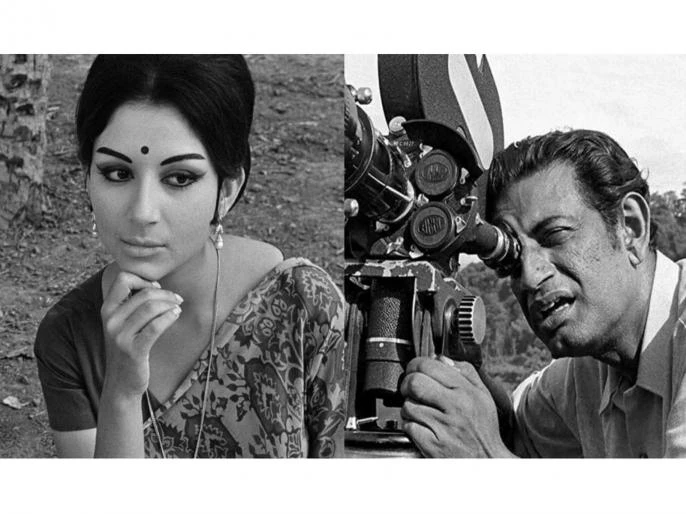
However, long before the actress became a mainstream star, Tagore’s journey into cinema began in a far more intimate space. It all started in Bengali cinema, under the watchful eye of one of India’s greatest filmmakers, Satyajit Ray, when she was barely in her teens.
Tagore was just 14 when Ray cast her in ‘Apur Sansar’ (1959), the final film in his acclaimed Apu Trilogy. At that age, she had no formal “exposure” to films, no understanding of the mechanics of acting, and little sense of the cinematic legacy she was stepping into. Looking back now, the actress recalls that the experience felt less intimidating than one might imagine, thanks largely to Ray’s gentle approach.
Speaking to ANI, the veteran actor recalled her very first shot on set, a moment she says she still remembers clearly.
“Oh my God, that’s going to take a long time. But it was wonderful. And I still remember it. So my first shot was entering the house and looking around. And of course, one doesn’t forget one’s first shot…”
She credits the first Indian Oscar-winning director, whom she affectionately refers to as “Manik da,” for creating an environment where even a newcomer felt at ease. According to her, he never made actors feel that a scene was “difficult.” For a young girl stepping onto a film set for the first time, that reassurance made all the difference.
“It was all kind of new for me to discover. So it was lovely, it was very stress-free. And that is the beauty of Manik da. Because he never made his actors feel that the scene was difficult. So it was my first day, I was very new, and I had no exposure to films. He just made it all very easy for me,” she told ANI.
Over the years, Tagore and Ray went on to collaborate on five films to form one of Indian cinema’s most celebrated actor-director partnerships. Beyond ‘Apur Sansar,’ their work together included ‘Devi,’ ‘Nayak,’ ‘Aranyer Din Ratri,’ and ‘Seemabaddha.’
That legacy was revisited recently in Delhi, where Ray’s ‘Aranyer Din Ratri’ (Days and Nights in the Forest, 1970) was screened in a restored 4K version. The film, which explored urban alienation and social tensions, remains one of Ray’s most layered works, and one that holds vivid memories for Tagore.
Recalling the shoot, she spoke about the physical demands of filming in Jharkhand. The cast had to travel via Ranchi before driving to the location, which Ray had chosen deliberately for its seasonal look. She remembered the “heat,” the sparse trees without leaves, and the “absence of electricity,” all elements Ray wanted to capture visually. While she had access to a generator and a cooler, she added how the rest of the cast endured the discomfort together but chose to laugh instead of complain.
“Yes, in Jharkhand. We had to get off at Ranchi and then drive. It was beautiful, I mean, he wanted that particular location and that time of the year. So it was very hot, and the trees were all sparse. There were no leaves, and he wanted that kind of look. We didn’t have electricity, but I was given a generator with a cooler. The boys were all very uncomfortable, but we just laughed about it. In the evenings, it was very pleasant,” she said.
Each film Tagore did with Ray had its own speciality, and even today, these masterpieces hold a special place in fans’ hearts. All five films revealed a different side of her restrained, introspective, and modern qualities, which often stood apart from the more glamorous roles she later played in Hindi cinema.