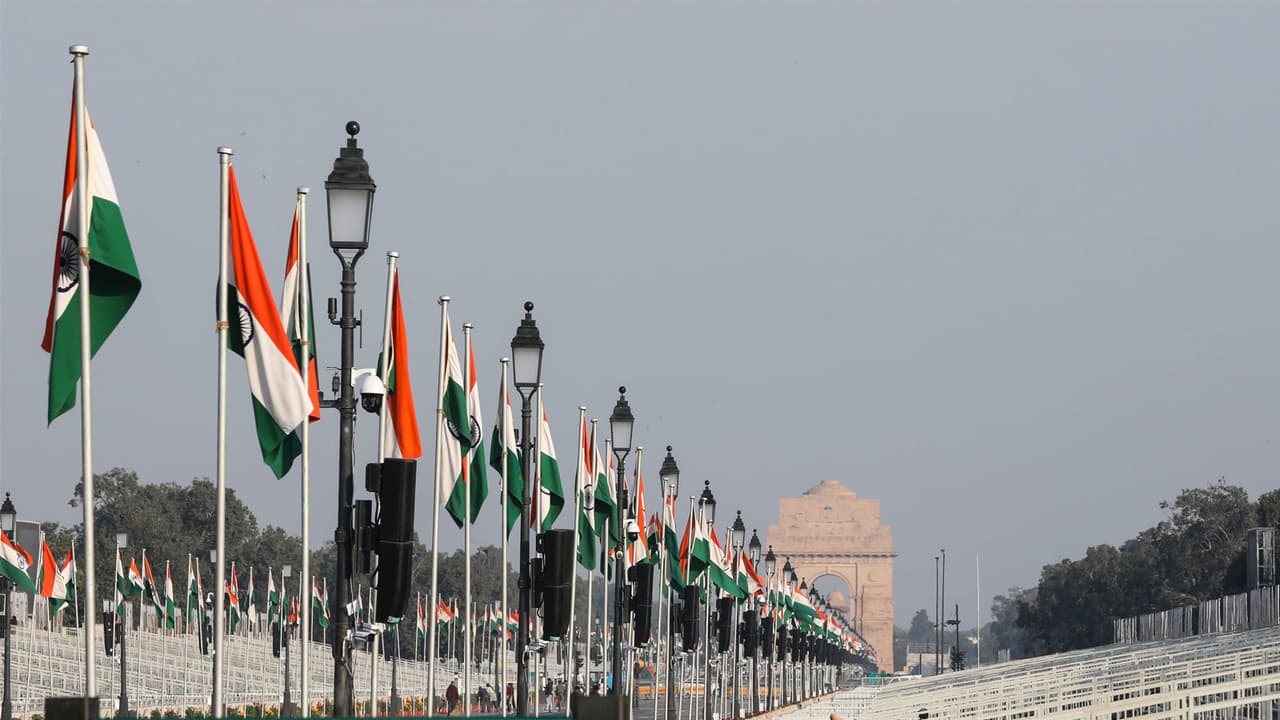
India’s 77th Republic Day celebration marks a significant evolution from the first simple event in 1950. Initially costing just Rs. 11,093 with 3,000 soldiers, it now costs hundreds of crores.
The nation is ready for the 77th Republic Day. The Vande Mataram concept will add more splendor to this year’s event, which showcases the country’s military and cultural strength to the world. With Vande Mataram completing 150 years, the event at Kartavya Path in the national capital, Delhi, will witness even more innovations.
While the first Republic Day in 1950 was a simple affair costing just Rs. 11,093, the 77th year’s celebration will cost hundreds of crores. So, how has India’s Republic Day evolved over 7 decades? Here are some interesting facts about this year’s specialties.
The First Republic Day Celebration Was Simple
The first Republic Day was simple. On Thursday, January 26, 1950, at 10:18 AM, in the Durbar Hall of the then Viceroy’s House (now Rashtrapati Bhavan), India’s last Governor-General, C. Rajagopalachari, declared India a democratic republic. Six minutes later, Rajendra Prasad was declared the first President. He then took the oath of office.
The Governor’s flag was lowered, and the President’s flag was hoisted at Rashtrapati Bhavan. The national anthem was played, and the celebration began. The first Republic Day parade was held at the Irwin Amphitheatre (now the Dhyan Chand National Stadium). President Rajendra Prasad, holding the national emblem, the Ashoka Lion Capital, left the Bhavan with his bodyguards. The parade proceeded, and he delivered the first Republic Day speech. 15,000 people witnessed this event.
3000 Soldiers in the Parade:
After Rajendra Prasad’s oath, the Republic Day was celebrated very simply. Unlike today, there were no tableaus, motorcycle stunts, or cultural performances. The event was entirely focused on the armed forces. It was designed to reflect military strength and the country’s culture. 3000 soldiers participated in the parade. Brigadier Moti Sagar of the Gorkha Regiment led the soldiers’ march.
A Cost of Just Rs. 11,000
Three years after India gained independence, it witnessed its festival of democracy. The government at that time spent only Rs. 11,093. However, that number saw a significant increase thereafter. Within 6 years, it rose to lakhs. According to reports, it was Rs. 5.75 lakh in 1956, Rs. 17.12 lakh in 1971, Rs. 23.38 lakh in 1973, and increased to Rs. 69.69 lakh in 1988. Although recent figures are not available, the expenditure in 2015 was Rs. 320 crore.
First Foreign Guest, Sukarno
It is a tradition to invite foreign guests every year for Republic Day. In 1950, Indonesia’s first President, Sukarno, was the first guest. This visit was a symbol of diplomacy between the two countries. Through Sukarno’s invitation, Indian Prime Minister Nehru quietly supported Indonesia’s freedom struggle against Dutch rule. Thus, Sukarno’s presence demonstrated solidarity among newly independent nations. This tradition has continued every year since then. However, there were no invitations for foreign dignitaries in 1952, 1953, 1966, 2021, and 2022.
Kartavya Path to Witness Many Firsts
The parade, which witnesses many innovations every year, will continue that tradition this time as well. The Suryastra rocket launcher, Bhairav commander, over 6,000 defense personnel, and 10,000 guests are among the many firsts this year’s event will witness.
Battle Array/Combat Formation:
It is customary for the Indian Army to march on Kartavya Path. But for the first time, they will participate in a ‘Battle Array,’ a state of combat readiness. Just as the army is equipped with tanks, missiles, and drones on the battlefield, the mechanized forces will march in the same formation.
River Names for Guest Galleries:
This time, the guest galleries at Kartavya Path have been named after rivers. Major rivers like Beas, Brahmaputra, Chambal, Chenab, Ganga, Indus, Jhelum, Kaveri, Krishna, and Yamuna have been used for the names.
Suryastra Rocket and Bhairav’s Splendor:
For the first time, the Suryastra rocket launcher system will be displayed. This rocket, which can hit targets up to 300 km away and destroy enemy hideouts, has been built under the ‘Make in India’ concept with Israeli assistance. The newly formed Bhairav Battalion will also participate.
Animals for the First Time, Mudhol Hound
For the first time, animals from the army will also participate in the parade. This includes Karnataka’s Mudhol Hound, Zanskar horses, and the rare Bactrian camel, among other animals, which will participate in attractive attire.
Simran to Lead CRPF Contingent
For the first time, a female officer will lead the CRPF’s men’s contingent. Assistant Commandant Simran Bala from Jammu and Kashmir will lead a team of 140 men. Simran, from Naushera in Rajouri, is the first woman from her village to join the CRPF as an officer.
Invitation to 10,000 Special Guests
Invitations have been extended to achievers in sports, agriculture, science, and industry; beneficiaries of various government schemes who have succeeded in life; scientists; laborers; those rescued from begging; artisans; successful self-help groups; women entrepreneurs; street vendors; and accomplished public representatives.
Display of States’ Traditional Attire
Fifty couples from various states residing in Delhi have been invited to the event. They will participate wearing the traditional attire of their respective states.