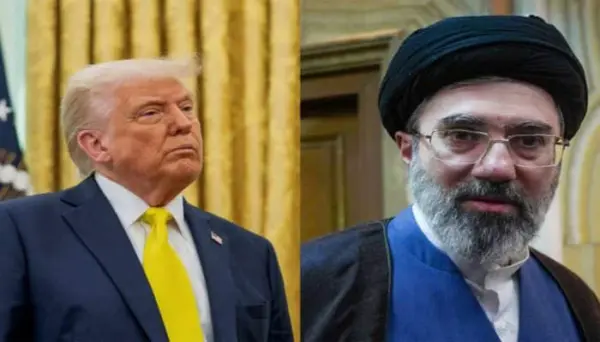
US-Iran Tension: Irans policymakers do not appear ready to end the US-initiated war against Tehran in a hurry, even as the military confrontation is taking a heavy toll on their countrys economy and infrastructure.
Iran may be trying to show that the course of the war cannot be decided by the United States.
There is also a calculation in Tehran that a prolonged conflict could increase the military, economic and political costs for Washington and make the United States more willing to accept some of Irans demands.
The question now is how long Iran can actually sustain the war.
How long can Iran keep fighting?
Parts of Irans defence industry and missile production facilities have been targeted during the war. There is no independent assessment that gives a reliable picture of the damage caused to those facilities or the missile stockpile Iran has at present.
London-based think tank Chatham House said in its latest assessment that there is no reliable data for Irans present missile stockpile. The number of missiles being launched by the country has fallen over time, but this does not tell the full story about Tehrans ability to continue fighting.
Iran can produce drones and cruise missiles more easily and quickly. New commanders have also been appointed to replace those killed during the conflict, while the broader command structure has continued to function.
Experts say Iran may be able to maintain its ability to launch missiles for a long time. However, the intensity may decrease and it can cause disruption in the Strait of Hormuz.
Iranian policymakers also believe a long war can impose costs on the United States. American defence reserves used to intercept Iranian missiles and drones have been drawn down to some extent. Some US estimates have warned that replacing these weapons could take time.
The impact of the war on oil prices and the domestic political situation in the United States has raised hopes in Tehran that it can force Washington to accept some of its conditions.
Support for President Donald Trump is strong among Republican voters, while opinion polls have shown rising dissatisfaction among Americans over the conflict and worries that the US president is not achieving the wars stated objectives.
If Tehrans calculation proves correct, Iran does not need to militarily defeat the United States. A longer and more expensive war could itself become a way to increase pressure on Washington.
Military strikes have so far failed to force Iran to stop fighting, and there is no clear sign that this will happen soon.
How long can Irans economy withstand the war?
Iran entered the war with an economy facing high inflation, weak investment, a steep fall in the value of the rial and deep structural problems.
According to a World Bank estimate, the countrys economy contracted by about 2.7% during the financial year 2025-26..
The war has added to the economic burden. Irans Statistical Centre says that the 12-month inflation rate has reached 62%. The situation has been difficult in southern provinces, which are hard by the conflict. In Hormozgan, for example, inflation has crossed 101%.
Irans deputy labour minister has said the war has resulted in the loss of more than 1 million jobs, with around 2 million people directly or indirectly unemployed.
The International Monetary Fund expects Irans economy to contract by about 5.4% in 2026, while inflation could approach 69%.
The length of the war and the extent to which it disrupts trade and oil exports will play a major role in determining how much further the economy is affected.
The Strait of Hormuz plays an important role in this calculation. Disruption along the route can increase the cost of the conflict for the United States and the international energy market. At the same time, a US naval blockade and restrictions on shipping can make it difficult for Iran to export oil and earn much-needed revenue.
Experts say economic difficulties do not automatically lead to a change in policy. Authoritarian governments can survive extremely difficult economic conditions for years.
According to them, inflation, unemployment and structural problems can increase public anger, but Tehrans military policy may not change unless those problems lead to widespread protests or divisions within the government.
Iran divided over the war
There are differences within Iran over what the countrys best course should be. Parliament Speaker and head of Irans negotiating delegation Mohammad Bagher Ghalibaf has warned that Tehran should not get trapped in continuous conflicts. He has also criticised those who oppose negotiations.
Hardline parliamentarian Amirhossein Sabeti has taken a much tougher position. He has said that even if the United States accepts all of Irans conditions and signs an agreement, the war would still continue.
The disagreement cannot simply be divided between people who support war and those who want peace. Ghalibaf has also said he would not accept an agreement that does not protect Irans rights.
The main argument is about how much Tehran can gain by keeping up its military campaign and when the cost of continuing the war becomes greater than the possible gains.
There is no independent and reliable opinion poll showing what Iranians think about continuing the war. Social media cannot provide a true picture of public opinion across the country.
Iran also needs a way out of the war
A prolonged war can also damage Irans regional position. In recent years, Tehran has worked to improve relations with Arab Gulf states, particularly Saudi Arabia. Repeated attacks on bases, infrastructure and shipping routes in these countries could damage that progress.
The Gulf states have so far tried to reduce tensions and return to dialogue. If they increasingly see Iran or armed groups backed by Iran as a threat, their interest in stronger defence cooperation with the United States could grow. Cooperation against Tehran could also become closer.
Tehran can gain political value from putting the United States under military and economic costs only if it can turn that into concessions at the negotiating table.
It is still unclear what kind of agreement could give Iran an acceptable end to the war or how such an agreement could be reached. The missing part of Irans strategy, according to the analysts, is how to turn the influence it has gained during the war into lasting political gains.
Tehran has shown that it can disrupt energy supplies to the world and put pressure on the United States and its allies. But it is not clear how it can sustain a long-term confrontation with Washington and the Gulf states.
So far, military, economic and political factors have not forced Iran to stop fighting. The longer the war continues, the more difficult conditions are likely to become for Irans economy. Its regional relationships could also suffer, making it difficult to reach an agreement that delivers enough political gains to cover the costs of the conflict.