The setting almost seemed too serene for what was unfolding.
At Okazaki Chuo Sogo Park, the archery range sits amid a vast green expanse, giant trees rising beyond the field and the quiet of a Japanese morning broken only by the sound of bows being drawn and arrows striking targets 70 metres away.
Then, the unthinkable happened. South Korea lost.
For 28 years, the Korean women had owned the Asian Games team recurve title. Since 1998, they had won it at every Games. Seven gold medals, seven generations of archers, no interruption. India had never even reached the final.
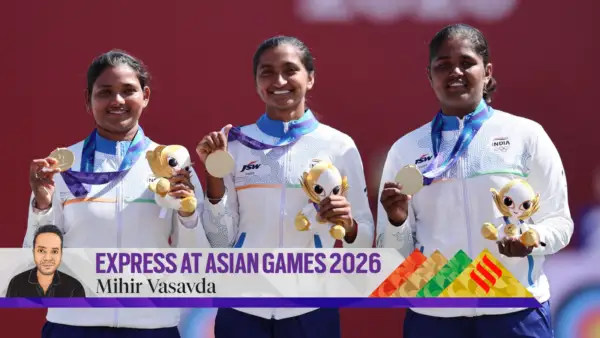
On Friday, Ankita Bhakat, Kirti Sharma and Kumkum Mohod ended that run, beating the Koreans 5-3 to win India’s first women’s team recurve gold at the Asian Games. “We weren’t scared at all,” Kirti said. “In the morning, we decided to play happily and enjoy the game regardless of whether we won a medal or not.”
The three Indians had arrived here carrying very different stories.
Ankita, 28, grew up in Kolkata, where her father used to deliver milk packets, starting work at 4am; her mother had kept a fast since Friday and ended it only after the gold was confirmed. Kirti, 19, comes from a farming family in Haryana. When she needed a new recurve bow in 2022, her father, Vijay Kumar, borrowed Rs 60,000 from a commission agent, promising to repay the loan from the farm’s future yield. And Kumkum, still 17, comes from Amravati, where her father Anil makes cardboard boxes for sweet shops and until recently competed using second-hand bows.
None of that seemed to matter once they stepped onto the line. Neither did the Korean pedigree.
When the announcer introduced South Korea as 10-time Olympic champions, Kumkum muttered: “Today’s Asian Games title will be ours.” Kirti had felt similarly. The prospect of facing Korea, she said, never scared her. “Competing alongside those two, who were playing their first Asian Games, gave a lot of freedom. They didn’t have any baggage of the past,” Ankita, the senior-most of all, said.
Playing without carrying past wounds mattered because on Friday, India didn’t just have to face the three Koreans. There was also the wind, which became the invisible fourth opponent. It was strong enough to alter the way the Indians looked at the target. They began reading the 10-ring like the face of a clock, working out where to aim so that the wind would carry the arrow towards where they actually wanted it to land. “We were aiming more towards 9 o’clock because the wind was pushing towards 3 o’clock. We aimed for 8 or 9 o’clock,” Kirti said.
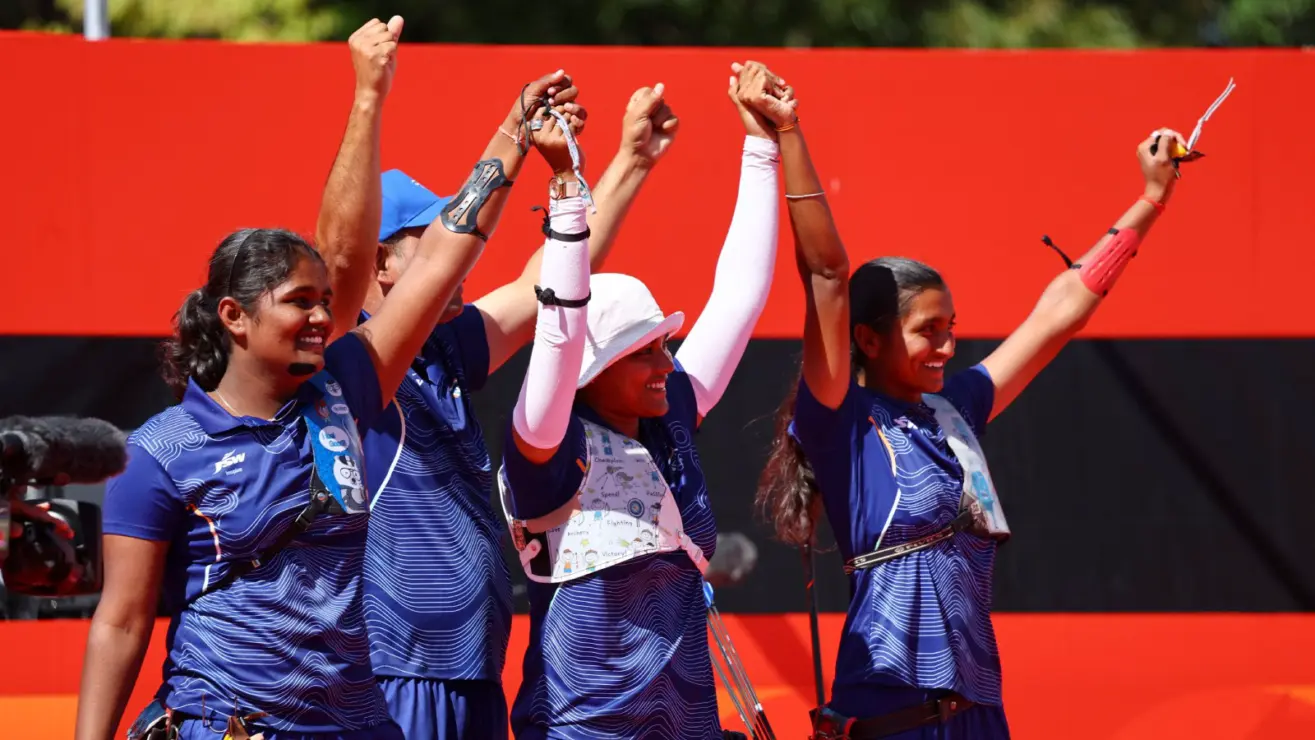 India ended South Korea’s streak of 7 gold medal winning run at Asiad. (Reuters)
There was improvisation, too. When Kirti felt pressure shooting second, shooting a 7 and two 8s, they shuffled the order and moved her up – the pressure relieved, she shot a couple of 10s and 9s. “We were able to make such tough decisions in the middle of the match, which was crucial. We were able to identify issues and take measures immediately,” Ankita, who – like her teammates – shot 400 arrows a day in training, said.
The opening two sets offered no separation. Both teams shot 54 in the first and 56 in the second, leaving the match locked at 2-2. Then, Korea blinked. Its three archers finished the third set with three consecutive 8s. India took advantage, shooting 8, 9, 10 to win the set 55-51 and move 4-2 ahead.
Korea now had to win the fourth set to stay alive. India needed only a tie to win the match. The Koreans finished the set with 54. India, at first, seemed to have fallen a point short. The drama came when the Indian score was being confirmed. Kirti’s first arrow had initially been marked an 8, which would have left India on 53. A review upgraded it to a 9, taking India to 54, enough to earn one point for the tied set and take the match 5-3.
India had not merely won a gold medal. They had snatched away a title that had seemed almost hereditary.
The Korean reaction was striking precisely because this was so unfamiliar. The three archers stood together afterwards, some of them in tears. They embraced, lingered around the range and tried to absorb the fact that a streak that had begun before any of them had entered international archery was now over.
“We were hoping we would have a shoot-off, because we are really good at it,” Oh Yejin said. “We wanted it so badly.” Lee Yunji was left apologising for being part of the team that had ended the run. “I feel very sorry that we ended up bringing that run of seven consecutive titles to an end,” she said.
A Korean reporter wandered around the venue afterwards, still trying to take in the scale of what had happened. “Very depressed,” he said.
It was an extraordinary sight: a sport in which South Korea’s women had spent nearly three decades making title triumphs look routine had suddenly produced a different picture. And three Indian women stood at the centre of it.