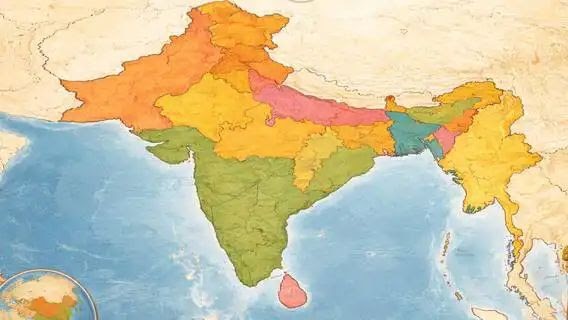
Today, when the neighboring country Pakistan is roaming around the world carrying the bowl of its poverty, then seeing its plight brings to mind the pages of history. Today, to hide their ruin, the rulers of debt-ridden Pakistan are threatening rich countries like UAE about being a part of united India, but do they even know how powerful and glorious the united India whose name they are taking was?
This was the India before which the whole world bowed its head. Let us know what its limits were.
What was the definition of India in ancient texts?
According to a famous verse of Vishnu Purana, the land situated north of the sea and south of the Himalayas is Bharatvarsha. In ancient times it was called ‘Jambudweep’, which reflects the legacy of Chakravarti emperor Bharat. It was a unit where the influence of a single culture extended from the peaks of the Himalayas to the waves of the Indian Ocean.
How far was the mighty Aryavarta and Jambudweep extended?
To understand the nature of united India, we will have to look at its old map. This included today’s Afghanistan, Pakistan, Bangladesh, Nepal, Bhutan, Myanmar and Sri Lanka. At that time Afghanistan was called ‘Upganasthan’ and Myanmar was called ‘Brahmadesh’. This entire region was not only geographically united, but was also extremely powerful commercially and militarily.
By what name were today’s Indonesia and Thailand known?
The identity of united India was its cultural harmony. Thailand was then called ‘Golden Land’ or ‘Shyamdesh’, while Indonesia was known as ‘Yavadweep’. Tibet was recognized as ‘Trivishtap’. Vedic and Buddhist ideology was prevalent in all these areas. Politically and religiously, the influence of only one civilization was visible on this vast land.
Mythological names of historical cities
History tells us that many of today’s famous cities were once a part of the Indian identity. Multan was called ‘Moolsthan’, which was a major religious centre. Peshawar was known as ‘Purushapur’ and Kabul as ‘Kubhanagar’. These cities were the main stops on the trade routes of that time, which testified to the economic strength of united India.
Acharya Chanakya and Chandragupta laid the foundation of the great empire.
The biggest credit for turning united India into reality goes to Acharya Chanakya and Chandragupta Maurya. Seeing the threat of foreign invasions, Chanakya laid the foundation of a great empire by uniting small states. Chandragupta Maurya defeated the Greek invader Seleucus Nicator and made Kandahar and Herat a part of India, thereby securing the Indian borders to the far west.
Emperor Ashoka and the climax of the frontiers
India was at the peak of its power during the time of Emperor Ashoka of the Maurya dynasty. His administration was so organized that even today his inscriptions are found from Afghanistan to South India. This is proof that at that time the whole of India lived united under one rule and one flag and no outside power had the courage to raise its eyes.
When did foreign invasions and shrinking of borders begin?
In the history of about 2500 years, there were continuous attacks on the borders of united India. Shakas, Huns, Arabs, Turks, Mongols and finally British rulers gradually divided this vast land into pieces. With time, cultural identity got entangled in political boundaries and that vast empire remained limited to the map of today’s modern India.
Greater India’s global influence
India’s influence was not only within its borders, but it was also seen as ‘Greater India’. The ‘Ankor Wat Temple’ built in Cambodia and the ‘Srivijaya Empire’ of Indonesia are living proof of this. Even today, the deep impression of Sanskrit and Ramayana can be clearly seen on the language, traditions and food habits of the countries of South-East Asia.
Unbroken heritage of united India
Ultimately, united India is not just a piece of land, but a living ideology. This region extending from the Himalayas to the sea was once the center of knowledge, science and religion. Political boundaries may have changed in today’s world, but history continues to remind us that there is strength in unity and how deep and ancient are India’s roots.