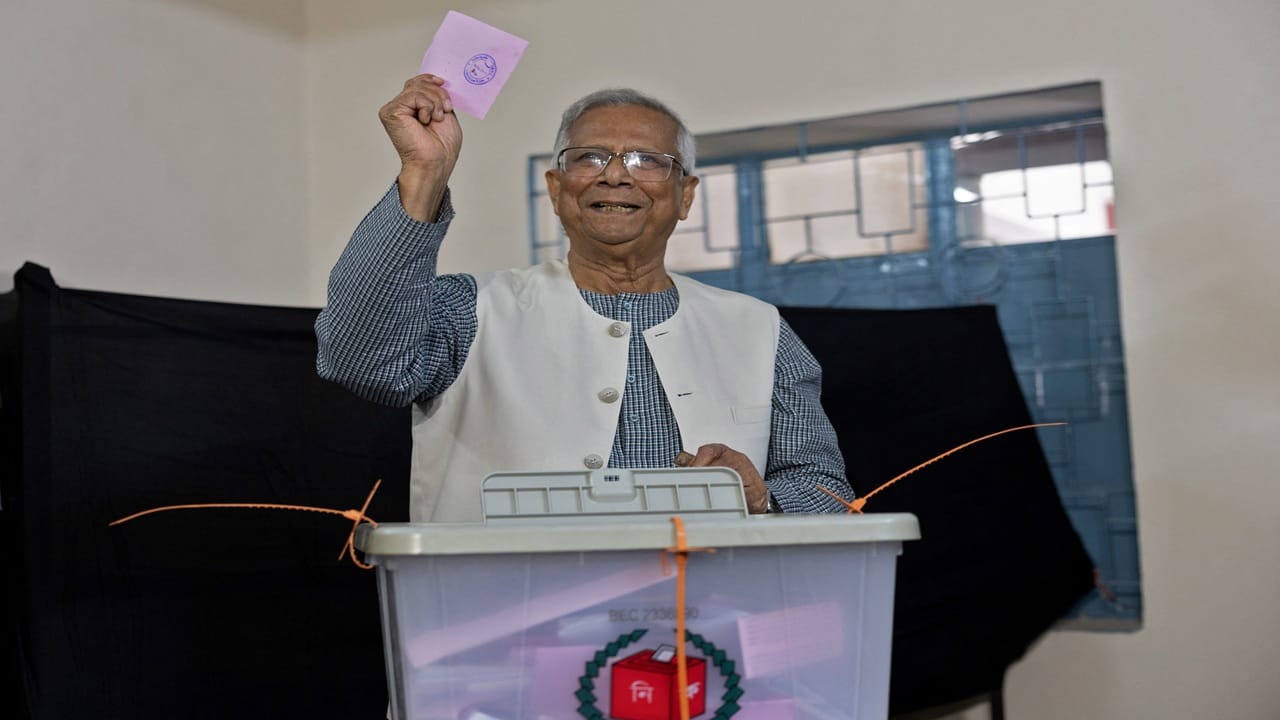
New Delhi: Bangladesh conducted one of the most significant elections in its history on February 12, 2026. It was the first general election since the 2024 uprising that removed the previous government. It was held under an interim administration led by Muhammad Yunus. The election produced a clear landslide victory for the Bangladesh Nationalist Party (BNP), led by Tarique Rahman.
The election results are extremely important for Bangladesh which now would be governed by a new government after an administration advised by Muhammad Yunus. Yunus took charge of Bangladesh’s interim government in August 2024 after a massive student-led uprising had pushed long-time Prime Minister Sheikh Hasina out of office. Yunus was brought in as a non-party figure to stabilise the country and prepare for elections. The current elections and their success can in some part be attributed to him, in what was arguably his principal responsibility.
The Yunus story
While the successful conduction of elections validated Yunu’s tenure, it was not totally uncontested. Domestically, critics argued that law-and-order management remained inconsistent. Also fundamental political tensions remained unresolved.
Even during his short tenure some political groups pressed him to move faster toward elections, while others wanted deeper reforms before any vote. Divisiveness thus persisted throughout resulting in an administration squeezed between competing expectations.
In terms of governance, Yunus attempted to frame the interim period as one of structural reset rather than short-term crisis management. Emphasising reform commissions, voter-list cleanup and a broader anti-corruption drive, Yunus was seen to be working towards rebuilding trust in the country’s electoral process after years of polarisation. Another area which was seen contentiously was the country’s economic trajectory under the Yunus administration. Practically the interim government did not have a strong mandate for major economic moves, so was forced to work with limited measures, thus facing discontent from the general public.
What now?
While a new, more permanent dispensation would administer Bangladesh now, the contribution of Muhammad Yunus at a delicate point of the country’s history cannot be minimised. Not exactly a political figure before his current stint as advisor to interim government, it is highly unlikely that Yunus would be associated with electoral politics, at least in the near future.
Rather it is more likely that his influence would continue as a moral and intellectual authority. What also would remain is a political legacy that remains contentious. For some, he will be remembered as the custodian who ensured a transition to a new order, but for some critics he will continue to represent someone who presided over a controversial reset of the government. His tenure nonetheless remains as a bridge, of some wins and some losses, coming unexpectedly but a stint that is sure to echo in Bangladesh’s future history books.