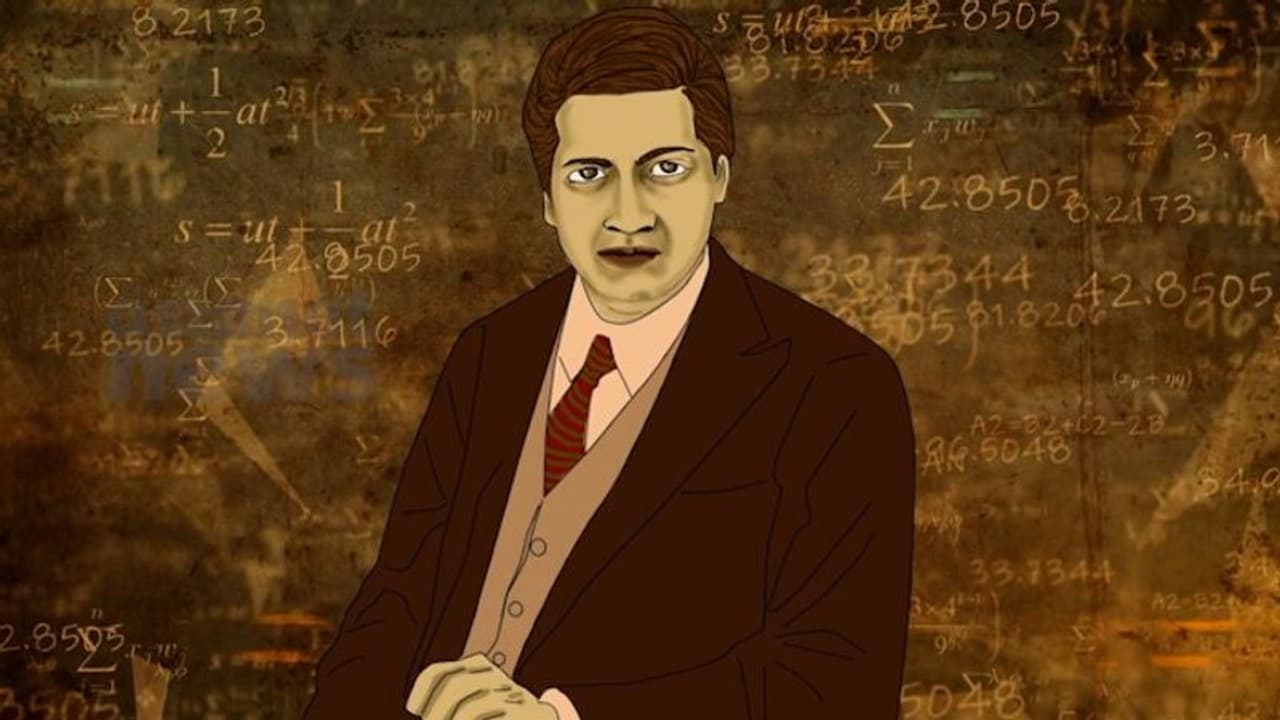
On National Mathematics Day 2025, India remembers Srinivasa Ramanujan not just as a prodigy of numbers, but as a symbol of perseverance, intuition and the limitless possibilities of the human mind.
Every year on December 22, India celebrates National Mathematics Day to mark the birth anniversary of Srinivasa Ramanujan, a man whose ideas arrived decades before the world was ready to understand them. Even a century after his death, Ramanujan continues to shape modern mathematics, cybersecurity, quantum physics and black hole theory—fields he never lived to see.
Few stories capture the romance of mathematics like the one that unfolded quietly in the library of Trinity College, Cambridge.
Scribbled in black ink, about 130 unlabeled pages filled with baffling equations lay forgotten in a box of old letters and bills for nearly fifty years. In 1976, mathematician Prof George Andrews of Pennsylvania State University stumbled upon them by chance. What he had rediscovered would later be hailed as one of the greatest posthumous mathematical revelations of all time.
Physicist Freeman Dyson famously described those pages as:
“flowers that grew from seeds that ripened in Ramanujan’s garden.”
These were Ramanujan’s “mock theta functions”, written in the 1920s, just days before his death—formulae so deep that mathematicians are still decoding them today.
Equations That Shape the Modern World
Once considered too obscure to comprehend, mock theta functions are now indispensable. Mathematicians use them to strengthen internet encryption, while physicists deploy them to unravel the mysteries of black holes and fundamental particles.
Ramanujan’s genius, however, was evident long before these applications emerged.
His mentor GH Hardy, one of the world’s greatest mathematicians, once said of him:
“I have never met his equal, and I can compare him only with Euler or Jacobi….with his memory, his patience and his power of calculation, he combined a power of generalisation, a feeling for form, a capacity for rapid modification of his hypothesis, that were often really startling, and made him, in his own peculiar field, without a rival in his day.”
Yet, the man Hardy admired so deeply was also a young Indian who failed university exams, lived in poverty, and died at 32 from a mysterious illness.
The Elbow That Made a Genius
Ramanujan’s brilliance was inseparable from hardship. Once, his friend KS Srinivasan met him in Chennai and said reverently:
“Ramanujan, they call you genius.”
Ramanujan replied with disarming humility:
“What? me, a genius? Look at my elbow, it will tell you the story.”
Srinivasan noticed his elbow—rough and blackened.
Ramanujan explained:
“Night and day I do my calculations on slate. It is time consuming to look for a rag to wipe it with. I wipe the slate almost every few minutes with my elbow. I suppose my elbow is making a genius of me.”
When Srinivasan asked why he didn’t use paper, Ramanujan’s reply revealed the stark reality of his life:
“When food itself is a problem, how can I find money for paper? I may require four reams of paper every month.”
Another friend, T Srinivasacharya of Pachaiyappa College, recalled how Ramanujan reused paper, writing with red ink over old calculations, filling pages from top to bottom, bottom to top, and even sideways. His notebooks remain silent witnesses to that struggle.
From Kumbakonam to Cambridge
Born in December 1887 in Erode, Tamil Nadu, Ramanujan survived smallpox at the age of two while most of his siblings did not. His talent surfaced early. At 13, he studied advanced trigonometry. By 15, he had mastered cubic equations. At 16, he devoured a book containing 5,000 theorems and began exploring Bernoulli numbers.
After graduating school in Kumbakonam, he joined college—but failed most subjects because he could focus on nothing except mathematics. Eventually, he abandoned the idea of a degree altogether.
Married at 21 to 10-year-old Janaki, Ramanujan tutored students to survive, while quietly pursuing his passion. In 1911, he published his first paper in the newly launched Journal of the Indian Mathematical Society. Two years later, he began writing letters to British mathematicians.
Only one replied with belief.
Hardy, Faith and Contradictions
That reply came from GH Hardy, who—along with JE Littlewood—invited Ramanujan to England in 1914.
Their partnership was a study in contrasts. Hardy was an atheist who trusted logic and proof. Ramanujan was deeply religious and intuitive, often attributing his insights to Goddess Mahalakshmi, saying equations appeared to him in dreams.
Yet together, they transformed mathematics.
At Cambridge, Ramanujan earned a Bachelor of Science (later renamed a PhD) in 1916, became a Fellow of the Royal Society at just 30, and a Fellow of Trinity College—the first Indian to achieve the latter.
An Early End, an Eternal Legacy
The First World War took a toll. As a vegetarian in England during food shortages, Ramanujan suffered malnutrition. Diagnosed with vitamin deficiency and tuberculosis, he returned to India in 1919.
He died a year later, in 1920, aged just 32—but not before leaving behind thousands of unproven theorems, many of which would be validated decades after his death.
Inspiration Beyond Mathematics
For Indian nationalists under British rule, Ramanujan was a symbol of intellectual self-belief. In 1917, PV Seshu Iyer wrote:
“The poet went out, sang and was honoured with a prize and a knighthood. The scientist struck famous academies of Europe and America in tremulous wonder and S. Ramanujam is in a fair way to do a similar thing for mathematics.”
Future Nobel laureate Subrahmanyan Chandrasekhar recalled being inspired as a child when his mother narrated Ramanujan’s story.
Today, Ken Ono, Professor of Mathematics at Emory University, calls him: “a role model for the possible.”
Ono’s Spirit of Ramanujan Project now supports young mathematicians and scientists aged 12 to 18, especially those without institutional backing—mirroring Ramanujan’s own journey.
Why Ramanujan Matters in 2025
As India marks National Mathematics Day 2025, Ramanujan’s life reminds us that genius is not born in comfort, nor nurtured by privilege alone. It can emerge from hunger, faith, failure and relentless perseverance.
Mystification may inspire awe—but determination inspires generations.
More than a mathematician, Srinivasa Ramanujan remains India’s enduring proof that ideas, once imagined, can outlive time itself.