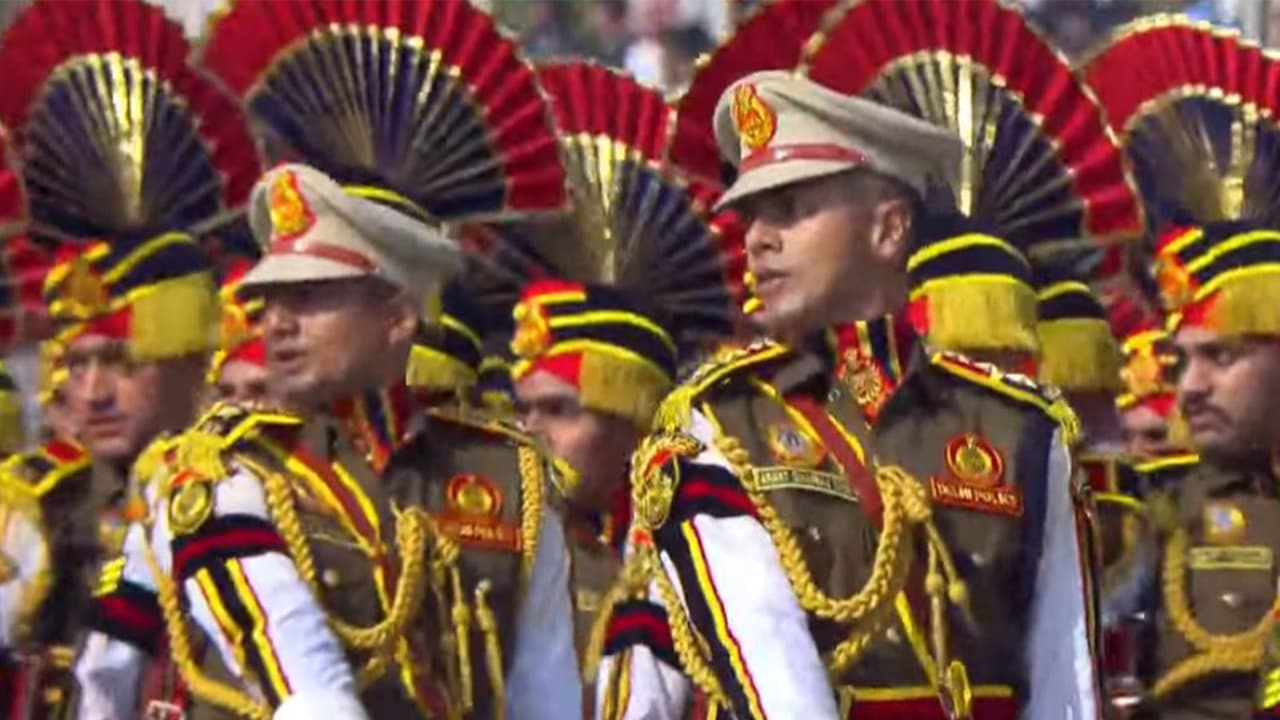
Recalling a childhood song, Suvir Saran reflects on Republic Day as a moment for quiet introspection. He champions India’s plurality, citing Dr. Ambedkar’s warnings and contrasting true, courageous patriotism with global political spectacle.
Republic Day never arrives loudly for me. It comes the way memory does–softly, unexpectedly, carrying with it the smell of winter mornings and the echo of a song I learned before I knew what a constitution was.
There is a particular stillness to January in India. A pale sun hanging low, as if reluctant to interrupt the quiet. The air feels scrubbed clean. Flags flutter without frenzy. And somewhere in that hush, I always hear her voice again.
A Melody for Moral Education
Mrs. Nalini Kumaran. She was our music teacher. Gentle, precise, endlessly patient. The kind who believed that melody was a form of moral education. It was she who first taught us the National Cadet Corps anthem. We stood in rows during morning assembly–shoulders stiff, shoes dusty, voices unsure–and followed her pitch as she led us through the song.
And when we reached that line–Bikhre bikhre taare hain hum, lekin jhilmil ek hai…something in me shifted. I didn’t yet have the language for it, but I felt it. That quiet thrill of recognition. That understanding that difference was not disorder. That plurality was not a problem to be solved but a beauty to be protected. That we were not meant to be identical to belong. We were meant to shine differently.
I fell in love with that line then, and I have carried it with me ever since–into adulthood, into writing, into conversations and classrooms and podcasts and interviews. I return to it often, especially when the world feels louder, harsher, more certain of its own righteousness. Because what that song taught me, as a young boy in India, was this: that our individuality is not something to be erased for the sake of unity. That our languages, our faiths, our disagreements, our doubts–these are not defects in the design. They are the design. That is the India I learned to love. And that is the India I think of every Republic Day.
The Constitution as Protection
Republic Day, after all, is not a performance. It is not a parade. It is a pause. A moment when the nation looks inward and asks itself, not how powerful it is, but how principled. At the centre of that question stands the Constitution. And behind it, unmistakably, stands Dr. B.R. Ambedkar.
Ambedkar did not romanticise India. He loved it fiercely enough to tell it the truth. He wrote the Constitution not as poetry but as protection, as a shield for the vulnerable, as a structure strong enough to hold contradiction, dissent, and diversity. He warned us, with startling clarity: “Constitutional morality is not a natural sentiment. It has to be cultivated.”
And in words that feel almost prophetic today, he said: “Bhakti in religion may be a road to the salvation of the soul. But in politics, bhakti or hero-worship is a sure road to degradation and eventual dictatorship.” Ambedkar understood something many forget: democracies do not die overnight. They erode slowly. Through applause where there should be questions. Through silence where there should be dissent. Through comfort where there should be courage.
A Warning From Across the Ocean
Which is why this moment in history feels so uneasy. Across the ocean, the world watches the United States–once the loudest evangelist of democratic ideals, struggle under the weight of its own contradictions. A sitting president, Donald Trump, has turned public discourse into spectacle, politics into performance, cruelty into currency. With every speech, every televised tirade, something essential erodes–decency, restraint, the very idea of truth.
What is unfolding there is not strength. It is spectacle. Not leadership, but loudness. And it is not confined to America. Across Europe, too, right-wing extremism finds new confidence. Fear is rebranded as patriotism. Exclusion masquerades as identity. Old ghosts, once buried, now speak in modern tongues. And everywhere they rise, they leave behind smaller hearts and narrower futures.
India’s Promise: Unity in Plurality
Which is why India must pause. Must reflect. Must remember who it is. Because India has always offered the world something rarer than power: possibility. Not uniformity, but unity. Not purity, but plurality. Not domination, but dialogue. This land has carried contradictions for millennia, many Gods, many tongues, many truths–and survived precisely because it learned how to hold them together.
Patriotism Beyond Bravado
The NCC anthem understands this instinctively. Kashmir ki dharti pyari hai, Sartaj Himalaya hai… Sadiyon se humne isko apne khoon se paala hai… These lines are not about possession. They are about care. About inheritance. About responsibility. And when the song speaks of raising a sword, Desh ki raksha ke liye hum shamsheer utha lenge… it does so without bravado. The sword here is symbolic. It is resolve, not rage. Protection, not provocation.
What the anthem ultimately teaches, what Mrs. Kumaran taught us without ever spelling it out–is that patriotism is not loud. It is luminous. It does not demand sameness. It does not fear disagreement. It does not flinch from self-examination. A true patriot does not sugarcoat. Does not simplify. Does not mistake obedience for loyalty. A true patriot speaks up–not to tear the country down, but to hold it up to its highest self.
The Truest Salute of All
And so, on this Republic Day, I find myself returning once more to that childhood line, still radiant with meaning: Bikhre bikhre taare hain hum… We are scattered stars. Different. Distant. Distinct. Lekin jhilmil ek hai. But together, we shine.
And as the parade rolls past, as the tricolour climbs the winter sky, as the nation falls into that brief, reverent silence between drumbeats and applause, I hope we remember this: That the Republic is not a spectacle to be watched, but a promise to be kept. That its strength lies not in uniformity, but in understanding. And that our greatest duty, as citizens, is not to shout our love for the country–but to live it, carefully, courageously, and with care. That, perhaps, is the truest salute of all. (ANI/ Suvir Saran) Disclaimer: Suvir Saran is a Masterchef, Author, Hospitality Consultant And Educator. The views expressed in this article are his own.
(Except for the headline, this story has not been edited by Asianet Newsable English staff and is published from a syndicated feed.)