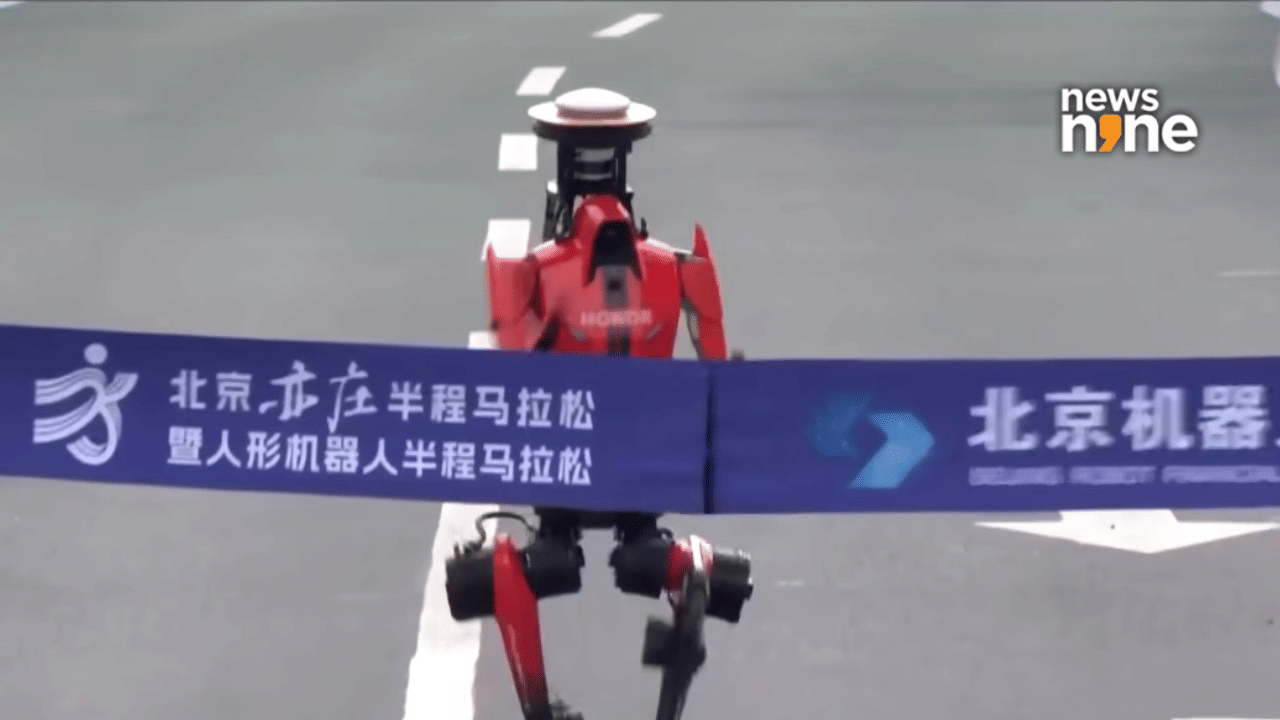
New Delhi: Robots stepping into endurance sports is no longer just a lab experiment. Recently, a humanoid robot stunned spectators in Beijing after completing a half marathon in a time that beats recent elite human benchmarks.
The race was held at the Beijing Economic-Technological Development Area, also known as Beijing E-Town, alongside a standard human event. What began as a showcase of robotics quickly turned into a moment that many in the crowd did not expect to witness so soon.
Just wrapped up: Beijing Yizhuang Humanoid Robot Half Marathon 2026.
Champion: Honor’s “Lightning” robot finished in 50:26 — smashing the human half-marathon world record by ~17 minutes. pic.twitter.com/3B4XUPrYSS
— Tesla Aaron L (@TeslaAaronL) April 19, 2026
Humanoid robot sets record pace at Beijing half-marathon
According to an official WeChat post by the organisers, the humanoid robot developed by Honor finished the 21 kilometer race in 50 minutes and 26 seconds. That timing is faster than the recent human benchmark set by Jacob Kiplimo, who clocked around 57 minutes at a Lisbon road race in March.
The jump in performance is sharp when compared to last year’s debut event. Back then, the fastest robot took over 2 hours and 40 minutes to complete the same distance. This year’s result shows how quickly hardware and control systems are evolving.
Spectators noticed the shift. Sun Zhigang, who attended both editions, said, “I feel enormous changes this year. It’s the first time robots have surpassed humans, and that’s something I never imagined.”
Design choices and engineering focus
Engineers from Honor said the robot was built by studying how top human runners move. The machine uses long legs measuring close to 95 cm, paired with a liquid cooling system developed internally to manage heat during long runs.
Du Xiaodi, a test development engineer at Honor, linked the project to wider industry use. “Looking ahead, some of these technologies might be transferred to other areas. For example, structural reliability and liquid-cooling technology could be applied in future industrial scenarios,” he said.
Race highlights both progress and gaps
The event was not without issues. A few robots struggled to maintain balance. One fell at the starting line, and another collided with a barrier mid-race. These moments showed that stability and real-world adaptability still need work.
Even with those setbacks, robots drew more attention than expected. Wang Wen, who attended with his family, said the machines had taken much of the spotlight away from human runners.