India and the EU are expected to make an important announcement on a major trade deal Tuesday.
The parade has always been a celebration of military might and nationalism, and it was especially so this year given Operation Sindoor, India’s attack, last May, on terror installations in Pakistan after a dastardly terror attack in Pahalgam. The operation found prominence during the 90-minute programme parade on Kartavya Path, with a tri-services tableau themed on it and a special arrowhead formation during the flypast.
The cultural section of the parade was themed around the 150th anniversary of India’s national song, Vande Mataram.
“The Republic Day parade showcased India’s formidable security apparatus, reflecting the nation’s preparedness, technological capability and unwavering commitment to safeguarding its citizens…The Republic Day parade celebrated India’s cultural diversity, with vibrant performances and tableaux,” Prime Minister Narendra Modi said on X.
Double-humped Bactrian camels and Zanskar ponies were also part of the ceremonial event for the first time, as were black kites (raptors) and five indigenous dog breeds. A total of 30 tableaux — 17 of states and Union Territories and 13 of various ministries and departments — rolled down Kartavya Path, showcasing the legacy of Vande Mataram.
The celebrations began with Modi paying tribute to India’s fallen heroes at the National War Memorial, a monument dedicated to soldiers who fell in post-Independence wars and operations.
The national flag was unfurled on the arrival of President Droupadi Murmu along with this year’s chief guests, von der Leyen and Costa in a four wheeled carriage drawn by six horses. The ceremonial battery of the army’s 172 Field Regiment sounded a 21-gun salute with the 105mm light field guns.
Before the parade began, Murmu awarded the country’s highest peacetime gallantry medal, Ashoka Chakra, to Indian astronaut and fighter pilot Group Captain Shubhanshu Shukla, who served as pilot for the historic Axiom Mission to the International Space Station last year.
Drones and their growing impact on military operations took centre stage at the parade as a raft of unmanned systems capable of missions ranging from surveillance and reconnaissance to precision strikes rolled down Kartavya Path for the first time, underling their emergence as formidable battlefield assets in the backdrop of Operation Sindoor.
The parade — led by Lieutenant General Bhavnish Kumar, General Officer Commanding, HQs Delhi Area — unfolded in a new phased battle array format. A sequenced display of weapons and systems showed how they are deployed in combat — starting with high-mobility reconnaissance vehicles being provided aerial support by helicopters and followed by tanks; infantry combat vehicles and light strike vehicles; mounted unmanned ground vehicles, Shaktibaan and Divyastra artillery elements specialising in drone warfare; artillery gun systems; universal rocket launcher; different types of missiles including BrahMos and Akash; and fighter jets.
The weapons and systems showcased in the parade for the first time included a new universal rocket launcher system called Suryastra and the long-range anti-ship hypersonic missile. Hypersonic missiles that can travel at speeds of more than Mach 5 or five times the speed of sound.
The other weapons and systems displayed included medium-range surface-to-air missile system, Abhra missile system, T-90 and Arjun tanks, Amogh ATAGS (advanced towed artillery gun system), Dhanush artillery gun, BMP-II infantry combat vehicles, all-terrain vehicles, and light strike vehicles.
“Black kites — ingenious and vigilant birds, have played a silent yet vital role. Providing crucial surveillance and anti-drone support beyond the Line of Control, they stand as unseen guardians of the skies. Loyal and steadfast, they serve alongside the soldiers of the Indian Army, and today, they march in spirit with the nation’s pride,” a defence ministry handout said.
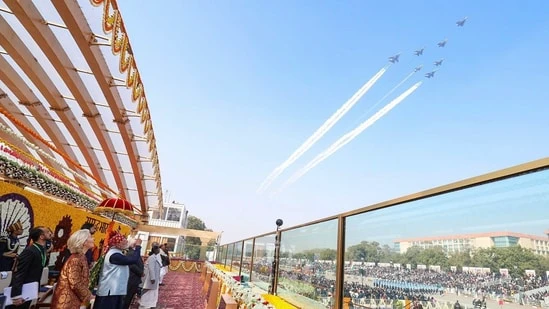
The flypast featured 29 aircraft including seven fighter jets in a formation called Sindoor that was introduced to depict the role of the Indian Air Force during Operation Sindoor – India’s four-day military operation against Pakistan terror bases – last year.
The fighters that were a part of the new spearhead formation included two Rafales, two MiG-29s, two Sukhoi-30s and a Jaguar. The aerial display, which is the highlight of the parade, was conducted in two blocks for the first time — during the parade, and at the end. It was traditionally carried out at the end of the parade but this year it aligned with IAF’s role in the battle order.
The tri-services tableau showcased the mock-ups of major weapon systems deployed by the Indian forces during Operation Sindoor. The tableau, Operation Sindoor: Victory Through Jointness, put the spotlight on precision air strikes by IAF, swift naval manoeuvres, and coordinated ground offensives by the army, reflecting a decisive joint military campaign. India has been working on the concept of jointness, or unified commands, recognising a shift over the years in how wars are fought.
The presence of the dignitaries from the EU (a large delegation) which is set to sign a trade deal with India likely to be announced on Tuesday, was significant. Von der Leyen attended the event in a maroon and gold silk brocade outfit and a small EU military contingent carrying the military staff flag and flags of Operations Atalanta and Aspides, the naval operations of the grouping, also participated in the parade.
“India is privileged to host European Council president António Costa and European Commission president Ursula von der Leyen during our Republic Day celebrations. Their presence underscores the growing strength of the India-European Union partnership and our commitment to shared values. The visit will add momentum to the deepening engagement and cooperation between India and Europe across diverse sectors,” Modi said on X.
During the parade, around 2,500 artists performed in a choreographed dance to the tune of the Vande Mataram, which was composed by Academy Award-winning musician MM Keeravani and went beyond the usual two stanzas adopted as the national song.
The dancers showcased folk and classical forms from across the country in a tribute to the enduring legacy of Vande Mataram, written by Bankim Chandra Chattopadhyay in 1875 and later adopted as the national song.
Prints of a series of paintings created by artist Tejendra Kumar Mitra in 1923 were displayed as view-cutters along Kartavya Path. The works, originally published in the Bande Mataram Album (1923), illustrate verses of ‘Vande Mataram’ and were positioned along enclosure backdrops lining the parade route. Separately, the tableaux of fivestates and ministries featured the Vande Mataram.
The theme of the parade — “Swatantrata Ka Mantra – Vande Mataram” — came at a time when the song’s history, its truncated form, and political choices have taken centre stage following an extended debate in Parliament last year.