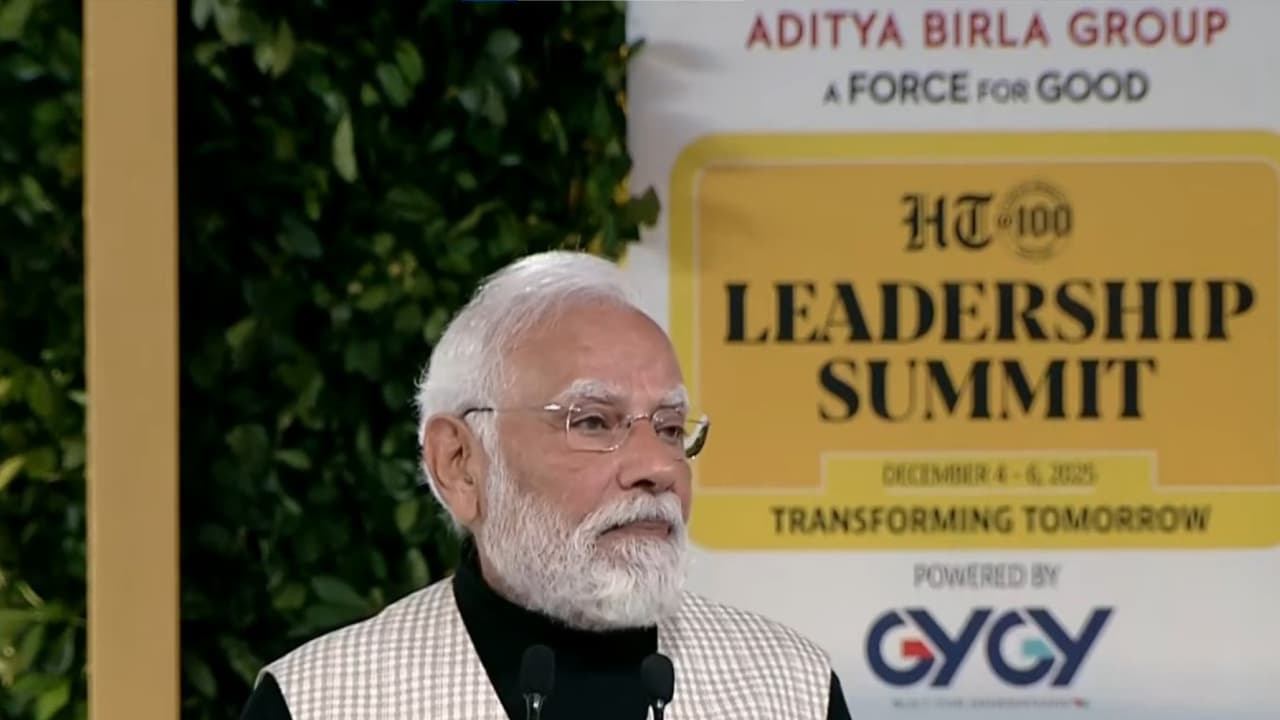
PM Modi slammed the term ‘Hindu rate of growth’ as a reflection of a ‘slavery mentality’. He said this colonial mindset tried to prove Hindu culture was the cause of slow growth and his government is working to free India from it.
Noting that India is the fastest-growing major economy in the world today and is being described as a global growth engine, Prime Minister Narendra Modi on Saturday said that use of the term ‘Hindu rate ofgrowth’ for India’s low growth rate from 1950s to 1980s reflected mentality of slavery and an attempt to portray an entire society as unproductive.
Addressing the Hindustan Times Leadership Summit here, PM Modi took a dig at opposition parties and lambasted “so-called intellectuals who search for communalism in everything” and asked if they did not see communalism in the expression “Hindu rate of growth” which then found a place in books and research papers.
PM Modi on ‘Hindu Rate of Growth’
“Such was the impact of this colonial mentality that even today, when many around the world describe India as a global growth engine, how often do you hear anyone speak proudly about this rapid growth? Has anyone ever referred to it as the Hindu rate of growth? The term Hindu rate of growth was used at a time when India struggled even to reach a growth rate of two to three per cent. Linking a country’s economic performance to the faith of its people was no coincidence,” PM Modi said.
“Do you think linking a country’s economic growth to the faith and identity of its people happened by accident? No, it was a reflection of a slave mentality. An entire society, an entire tradition, was made synonymous with unproductiveness and poverty. An attempt was made to prove that our Hindu civilization and Hindu culture were the cause of India’s slow growth rate. And just imagine, the so-called intellectuals who today are constantly looking for communalism in everything, every aspect, did not see communalism in the Hindu rate of growth. This term was included in books and research papers during their time,” he added. The term ‘Hindu rate of growth’ has been used in some writings to describe low Indian economic growth rates from the 1950s to the 1980s, which averaged around 4 per cent.
‘Colonial Mindset a Barrier to a Developed Bharat’
The Prime Minister said no nation can move forward without self-confidence. “Unfortunately, long years of colonial rule shook this very confidence in India. The reason for this was a deep colonial mindset. This colonial mentality has become a major barrier in achieving the goals of a developed Bharat. That is why today’s India is working to free itself from this mindset,” he said.
Devastation of Manufacturing and Defence Sector
PM Modi remarked that the colonial mindset had devastated India’s manufacturing ecosystem and explained how the nation is reviving it. He highlighted that even during the colonial period India was a major producer of arms and ammunition, with a strong network of ordnance factories, exporting weapons and having them widely used in world wars. The Prime Minister noted that after independence, the defense manufacturing ecosystem was destroyed, as the colonial mindset led those in government to undervalue weapons made in India, turning the country into one of the world’s largest defense importers.
Lost Opportunities in Key Sectors
Emphasising that this is not merely about the return of assets but about trust, about the commitment to continuously earn the trust of the people, PM Modi added that the trust of the people is the nation’s true capital, and such campaigns could never have been possible under colonial mindset. “The nation must be completely freed from the colonial mindset in every sphere,” he said. He highlighted that just a few days ago he made an appeal to the country, urging everyone to work with a ten-year time frame. He noted that Macaulay’s policy sowed the seeds of mental slavery in India about 190 years back. The Prime Minister emphasised that in the next ten years, all citizens must ensure that the country is liberated from the colonial mindset. “India is not a nation that simply follows a set path, and for a better tomorrow it must expand its horizons”, underscored the Prime Minister.
He emphasized the need to understand the future requirements of the country and find solutions in the present. He highlighted that this is why he often speaks about the Make in India and Atmanirbhar Bharat campaigns, noting that if such initiatives had begun four to five decades earlier, India’s situation today would have been very different. PM Modi recalled the example of the semiconductor sector, mentioning that five to six decades ago a company had come forward to set up a semiconductor plant in India but was not given due attention, resulting in India falling behind in semiconductor manufacturing.
Emphasising that the same mentality affected the shipbuilding industry, which for centuries had been a major center in India, the Prime Minister recalled that even five to six decades ago, forty per cent of India’s trade was carried on Indian ships, but the colonial mindset gave preference to foreign ships. He remarked that the result is evident, as a nation once known for maritime strength became dependent on foreign ships for ninety-five per cent of its trade, leading India today to pay nearly $75 billion, or about six lakh crore rupees, annually to foreign shipping companies. “Whether it is shipbuilding or defence manufacturing, today every sector is striving to leave behind the colonial mindset and achieve new glory”, underscored the Prime Minister.
Breaking the ‘Vicious Cycle of Distrust’ in Governance
PM Modi remarked that the colonial mindset caused great damage to India’s governance approach, as for a long time the government system was marked by distrust of its own citizens.
From Distrust to Self-Attestation and Jan-Vishwas
He recalled that earlier people had to get their own documents attested by a government officer, but this distrust was broken and self-attestation was accepted as sufficient. Highlighting that there were provisions in the country where even minor mistakes were treated as serious crimes, PM Modi said to change this the Jan-Vishwas law was introduced, through which hundreds of such provisions were decriminalized.
Fostering Entrepreneurship with Mudra Yojana
He further noted that earlier even for a loan of Rs 1000, banks demanded guarantees because of excessive distrust. The Prime Minister emphasized that this vicious cycle of distrust was broken through the Mudra Yojana, under which guarantee-free loans worth Rs 37 lakh crore have been given so far. He remarked that this money has given confidence to the youth of families who had nothing to offer as a guarantee, enabling them to become entrepreneurs.
Returning Unclaimed Assets to Build Trust
Noting that in the country it was always believed that once something was given to the government, it was a one-way traffic with nothing coming back, PM Modi emphasised that when trust between the government and the people becomes strong, the results are evident through another campaign. The Prime Minister highlighted that it would be surprising to know that Rs 78,0000 crore lie unclaimed in banks, Rs 14,000 crore with insurance companies, Rs 3,000 crore with mutual fund companies, and Rs 9,000 crore in dividends, all unclaimed. He underlined that this money belongs to poor and middle-class families, and therefore the government is working to return it to its rightful owners. PM Modi further noted that special camps have been started for this purpose, and so far in about 500 districts such camps have returned thousands of crores of rupees to the rightful beneficiaries.
A Journey of Transformation and National Resolve
Emphasising that this is not merely about the return of assets but about trust, about the commitment to continuously earn the trust of the people, PM Modi added that the trust of the people is the nation’s true capital, and such campaigns could never have been possible under the colonial mindset. “The nation must be completely freed from colonial mindset in every sphere”, stressed the Prime Minister. He highlighted that just a few days ago he made an appeal to the country, urging everyone to work with a ten-year time frame. “India is not a nation that simply follows a set path, and for a better tomorrow it must expand its horizons,” he said.
PM Modi pointed out that before 2014 India imported 75 percent of its mobile phones, whereas today mobile phone imports have nearly dropped to zero and the country has become a major exporter. He emphasised that after 2014 a reform was introduced, the nation performed, and the transformative results are now being witnessed by the world. Underlining that the journey of transforming tomorrow is a journey of numerous schemes, policies, decisions, public aspirations, and public participation, PM Modi emphasised that it is a journey of continuity, not limited to the discussion of a summit, but a national resolve for India. (ANI)
(Except for the headline, this story has not been edited by Asianet Newsable English staff and is published from a syndicated feed.)