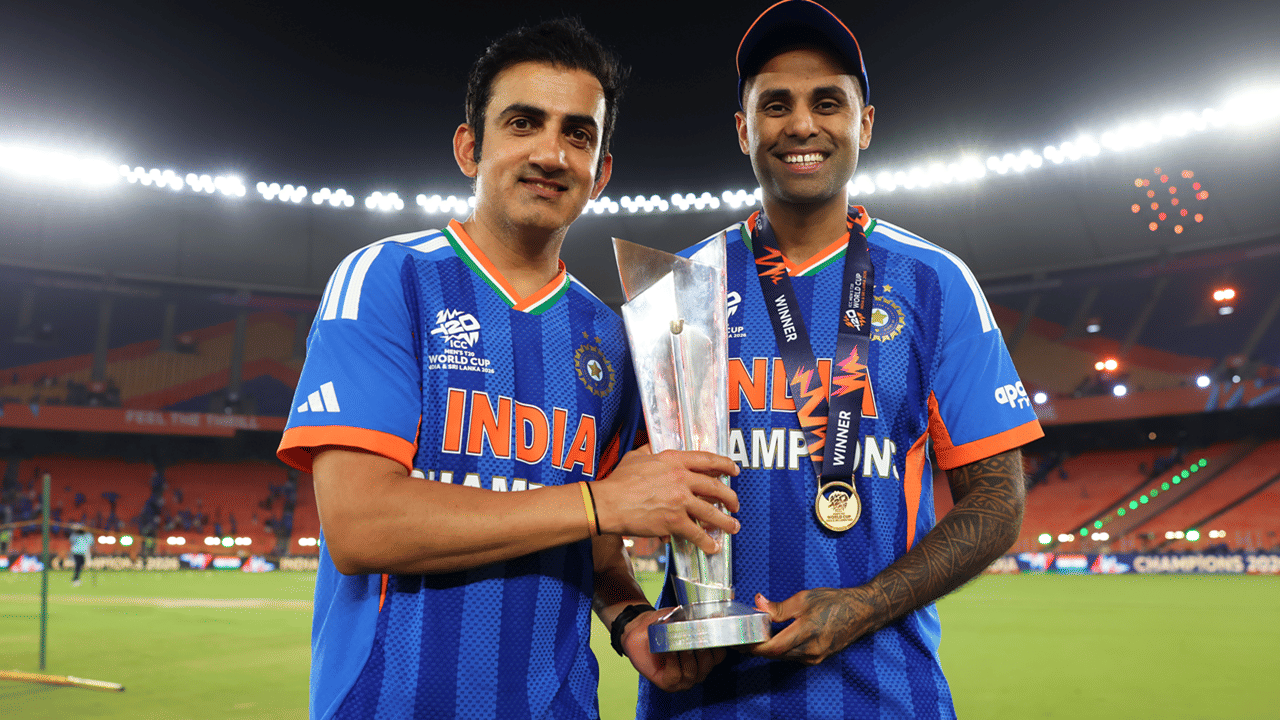
New Delhi: India head coach Gautam Gambhir explained how his high risk, high reward philosophy propelled India to success in the T20 World Cup 2026. India defeated New Zealand by 96 runs in a lop-sided final at the Narendra Modi Stadium in Ahmedabad on Sunday, March 09 to lift their second straight title, becoming the first team to successfully defend their T20 World Cup crown.
India didn’t enjoy a perfect campaign in the tournament, but peaked at the right time to lift the prestigious trophy. India produced stunning batting performances in the semifinal and the final to bat the opposition out of the game on their way to lifting the title. On Sunday, it was complete annihilation from the Indian batters as they posted a mammoth 255/5 in 20 overs, the highest total in a T20 World Cup final.
Sanju Samson slammed a magnificent 89, while Abhishek Sharma and Ishan Kishan scored explosive half-centuries as the Indian batters made a mockery of the Kiwi bowling attack. Jasprit Bumrah and Axar Patel then combined to help India bowl out New Zealand for 159 runs to secure a record third T20 World Cup title.
Opening up on his coaching philosophy, Gambhir revealed how he instilled a fearless attitude in the players. The Indian head coach said he kept it simple by asking his players to play high risk high reward cricket. Gambhir said he knew a team cannot dominate and win a tournament by being subdued.
“Very simple. High risk, high reward. In 120 or 240 balls, you should create as much impact as you can. Because you don’t have a chance to make a comeback. And ultimately, you can never win in the T20 format by being subdued. You can never dominate by being subdued. You can never dominate by being in your shell,” Gambhir told India Today in an interview.
Team management judges player by impact, not runs: Gambhir
Ahead of the start of the tournament, Abhishek Sharma was India’s undisputed trump card with the bat, while Sanju Samson had lost his place in the XI after his poor show in the home series against New Zealand. However, as it turned out, Abhishek endured a disastrous campaign, while Samson turned out to be India’s saviour in the knockout stage.
Despite three ducks in his first three games, the Indian team management kept backing Abhishek, who eventually delivered in the final with an impactful 18-ball fifty against New Zealand. Samson, on the other hand, won the Player of the Tournament with 321 runs despite having played only five matches in the competition.
Opening up on the selection dilemma during their campaign amid Abhishek’s poor run, Gambhir said no team can expect all of their players to be in form during a tournament. He also lauded Samson for grabbing his chances by both hands in what was a dream campaign for the right-hander.
“Look, it will never happen that all the players will be in form. It has never happened with any team that all their players are in form going into a World Cup. Because it will also happen that some will be in form and some will not be in form,” said Gambhir
“Like, if you see, Sanju was not in the form, or Sanju’s runs were not made against New Zealand. But the way he batted in the World Cup, I think, it’s a dream for any cricketer. If you talk to me, in fact, it was the other way around for Abhishek Sharma. So this is the T20 format,” he added.
Further shedding light on his coaching mantra, Gambhir revealed how outside noise bears little impact on the team management when it comes to selection matters. The India head coach stressed that a player might get judged based on his runs outside, but it is important for the coaches to judge them on the basis of their impact during a World Cup.
“In the T20 format, we judge the players as to how many runs they make. But the team management judges how they create an impact,” Gambhir added.