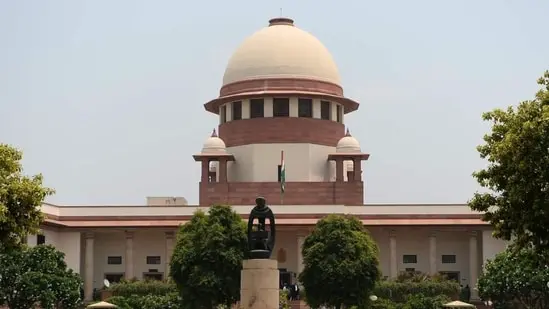
The Supreme Court on Tuesday said that “getting heard” and having a “promise of future” were the biggest assurances for the youth, as it indicated that it would on Wednesday constitute a high-powered committee to inquire into allegations of excessive police force as well as violence against police personnel during the July 20 march to Parliament.
The protest came during a movement headed by the Cockroach Janata Party (CJP) targeting inefficiencies in the conduct of the NEET exam for admission to medical colleges, and seeking the resignation of the education minister.
The committee was proposed to comprise former Supreme Court and high court judges, and a retired officer of the rank of director general, with the bench indicating that it might include a former Central Bureau of Investigation (CBI) director general or a former state police chief. The panel will examine the factual aspects of the allegations and submit periodic reports to enable the court to issue further directions.
A bench, comprising Chief Justice of India Surya Kant and justices Joymalya Bagchi and V Mohana, said it would pronounce its order on the committee on Wednesday after receiving suggestions from all sides.
“We are constituting a judicial high-powered committee,” the bench said.
The proceedings covered competing allegations arising from the July 20 student protest — petitions alleging excessive force by police as well as pleas concerning violence against police personnel and legality of the protest. The court, on its part, made clear that both sides would be examined by the proposed panel, rather than the inquiry being confined to allegations against the police.
Senior advocate N Hariharan, appearing for the petitioners, said an investigation would adequately address the allegations raised by families of injured police personnel as well as the issues raised by the Centre. The bench agreed that parties could either place their issues before the court or directly approach the committee. Senior counsel Gopal Sankaranarayanan, Menaka Guruswamy, Shadan Farasat, advocate Vrinda Grover, among others, also appeared for the petitioners in the matter.
The bench also returned to the issue of first information reports (FIRs) registered against students and young protesters.
Solicitor general Tushar Mehta said that the Centre and Delhi Police were not opposing the quashing of FIRs against student protesters, but maintained that persons with serious criminal antecedents who had allegedly infiltrated the protests could not be treated on the same footing.
The bench, however, said that the authorities could not leave such persons as a generic category of “undesired elements” and would have to identify them. “Your agency must have identified those who were students and the others who were undesired elements. Unless we have the list, how are we going to quash it?” the bench asked.
The impasse between protesters and the government ended with the resignation of then education minister Dharmendra Pradhan, and the undertaking that complaints filed against protesters would be withdrawn.
When advocate Rizwan Ahmad, representing a petition that cited the absence of permission for the protest, suggested that students could be asked to file affidavits expressing regret for their conduct during the march, the bench declined to make such an assurance the basis for relief.
“It’s a question of life and career of thousands of innocent students…We have to build confidence among the youth. That confidence is the assurance and not any affidavit,” the bench said.
The bench also stressed that students participating in a peaceful and lawful protest have constitutional protection under Article 19, while distinguishing them from persons with serious criminal antecedents who may have entered the gathering and indulged in violence.
The proposed committee will examine whether the police used excessive force and whether protesters indulged in violence against police personnel, the bench clarified. It has emerged that the police used pellet guns at one stage on July 20.
The Delhi Police, in its counter-affidavit filed by deputy commissioner of police (DCP) Sachin Sharma, defended its action as a “graded” response after protesters allegedly breached multiple barricades and attempted to move towards Parliament. The police claimed that more than 240 police and uniformed personnel and around 200 protesters were injured.
The police said the allegation of excessive force was unsustainable given the scale of the gathering, claiming that about 5,000 police personnel were deployed to manage more than 30,000 protesters spread across nearly three kilometres.
The affidavit contends that the gathering consequently assumed the character of an unlawful assembly and that the attempt to proceed towards Parliament was itself unlawful. The police has also sought to counter the petitioners’ reliance on photographs, video clips and media and social-media reports, saying these materials were selective, incomplete and not independently verified and therefore presented only one side of the events without capturing the police’s efforts to control the situation.
But, the bench made clear that it did not want to reach any premature conclusion on individual incidents. “If we ourselves start examining these allegations and giving findings or directions, we may end up performing the role of the high-powered committee,” the bench said.
The solicitor general also urged that the court should not prejudge the incidents while the committee was being constituted. The bench agreed, saying the committee would hear all sides, could take up issues requiring immediate attention, and could engage domain experts wherever scientific or technical questions arose.
The court indicated that it had already obtained the consent of a former director general of CBI and a former director general of police of a state, both of whom had retired and had no connection with the matter.
The bench said that both were “outstanding officers” and that it had examined their professional records and areas of expertise. It indicated that both could even be requested to join the committee.
A counsel also suggested including a woman member, given allegations concerning women protesters. The bench said all suggestions would be considered before the order was issued.
The proposed inquiry will also examine factual aspects of the use of facial-recognition technology during the protests, but the bench made clear that the larger constitutional questions will ultimately be decided by the Supreme Court itself.
Senior advocate Menaka Guruswamy argued that collection and processing of facial-recognition data raised questions of privacy and Article 21, particularly since private companies were allegedly involved in processing the material.
The bench said the issue would have to be examined through the lens of proportionality, and clarified that while the committee could examine the factual aspects, “the questions of law will ultimately be considered by us”.
Mehta, meanwhile, said that there was a misconception about the technology, claiming it did not indiscriminately identify everyone at the protest but checked faces against National Crime Records Bureau (NCRB) records of persons with serious criminal antecedents, followed by field verification.
The bench said that the committee would not be confined to a single report. It would examine issues as they arise and submit periodic reports, enabling the Supreme Court to issue interim and other directions where necessary.
The court also indicated that the proposed mechanism would provide victims an immediate avenue to be heard and that necessary legal consequences would follow from its recommendations.
The hearing came against the backdrop of the court’s earlier finding that allegations of police excesses and violence against police personnel made out a prima facie case for an independent probe. It had earlier directed preservation of CCTV, drone, body-camera, wireless and PCR records and protection of protesters’ personal data.
Commenting on Tuesday’s hearing, CJP spokesperson Saurav Das said the Supreme Court sought a list of FIRs against students and protesters nationwide to consider quashing them under Article 142, but the Centre resisted. He added: ”The government must stop playing these games because the next time, the youth of this country come on the streets, they wouldn’t want to go back very soon.”