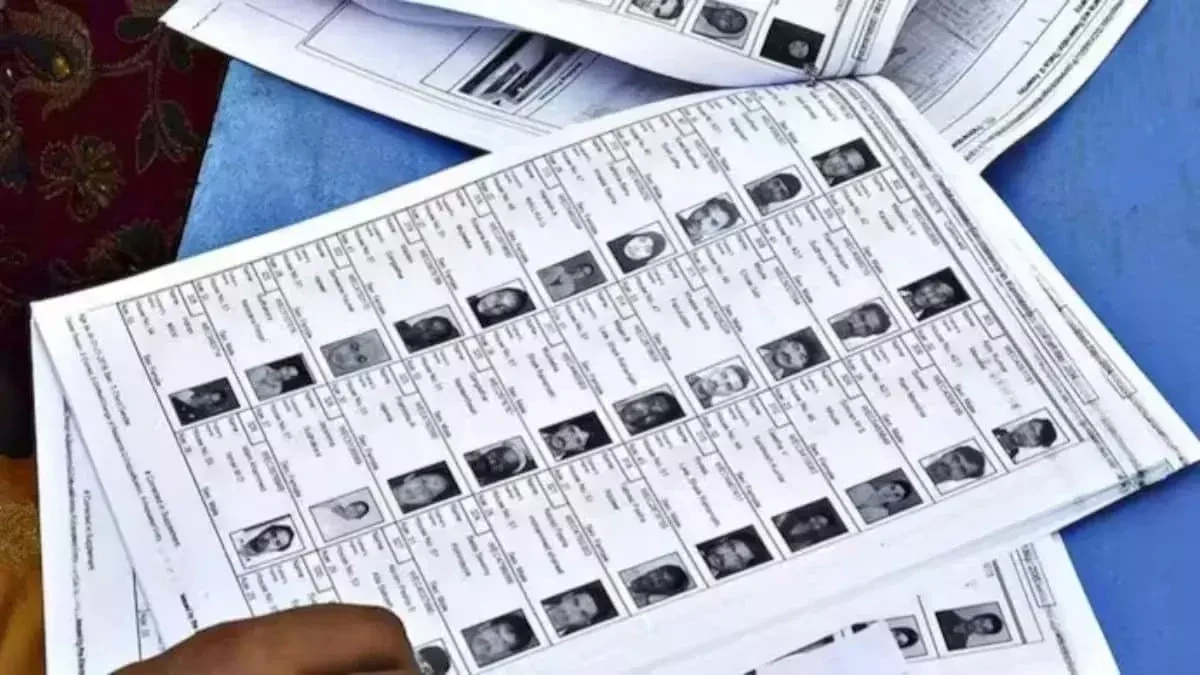
The Special Intensive Revision (SIR) process-launched across 12 states and Union Territories-has sharply raised the political temperature since last week.
The Election Commission of India has described this exercise as essential for ensuring the purity of democracy and the credibility of the electoral rolls. On the other hand, several political parties, especially the Trinamool Congress (TMC), are accusing it of being a political strategy ahead of the upcoming Assembly elections and are strongly opposing it.
What is SIR and Why is it Mandatory?
SIR stands for ‘Special Intensive Revision’ of the electoral roll. In simple terms… it is not a routine annual update but a thorough, door-to-door verification of the entire voter base. Through this process, new voters are added, deceased or migrated voters are removed, and duplicate or fake entries are identified with deeper scrutiny.
The Election Commission has clearly stated that due to rapid urbanization, mass mobility, people changing states frequently, and a surge in new voters, the regular summary revision alone is not sufficient. Hence, SIR has become extremely necessary.
According to official information, the legal validity of SIR falls under Article 324 of the Constitution and the provisions of the Representation of the People Act, 1950. The Commission has called it a “natural, regular, and constitutional” exercise, which it can implement whenever required.
Report – What Has Happened So Far?
• The new phase of SIR began on 4 November 2025 and is likely to continue in many states until 2026. • Not just in West Bengal… but nationwide, around 18.70 lakh deceased voters have already been identified in the electoral rolls. • The Commission informed the court that more than 99% of voters have received SIR forms, and about 70% forms have been returned. Therefore, the claims of voters being “massively excluded” are, according to the Commission, “highly exaggerated.” • Enumeration forms under SIR are also available online, allowing voters to fill and submit forms anytime from home.
The Election Commission has also said that the inclusion or deletion of names will be done only by following due process. No voter’s name will be removed “without legal procedure.”
Why the Political Controversy? Purification or Politics?
Though SIR has officially been described as a voter-list purification exercise, political controversy has escalated significantly. The opposition-particularly TMC-claims that this exercise is a strategy to disrupt the balance of political power ahead of next year’s Assembly elections.
They allege that the timing and methodology of SIR could bring large changes in the voter list to benefit a particular party, especially in regions where political equations are complex.
Some BLOs (Booth Level Officers) deployed in states like Gujarat, Bihar, and Bengal have also mentioned facing personal pressure and operational difficulties.
ECI’s Position: Accountability, Transparency & Clarification
The Election Commission has categorically stated that SIR is a constitutional and lawful process. According to the Commission, the cleaner and more reliable the voter list, the stronger the democracy.
It also clarified that no name under SIR will be removed “without completing the mandatory process.” Verification of voter identity, residence, and death records will determine deletions from the rolls.
What Happens Next?
Now that lakhs of deceased or invalid entries have been removed, the voter list for the 2026 Assembly elections is expected to be far clearer. Political parties will need to re-evaluate their strategies. However, it is evident that SIR has already taken a major step toward changing electoral calculations.
For years, gaps in the voter list raised questions about voter identity and voting credibility-now those questions have started receiving answers.
On the other hand, warnings from opposition parties suggest that political dissatisfaction remains high. There is still room for disputes, complaints, and legal battles.
SIR-though aimed at making the voter list clean and trustworthy-has become politically and constitutionally contentious due to its scope, method, and timing. The exercise is important for strengthening democratic processes, but only sustained transparency and accountability can reassure citizens that the “voter list” is genuinely the right of every eligible citizen.