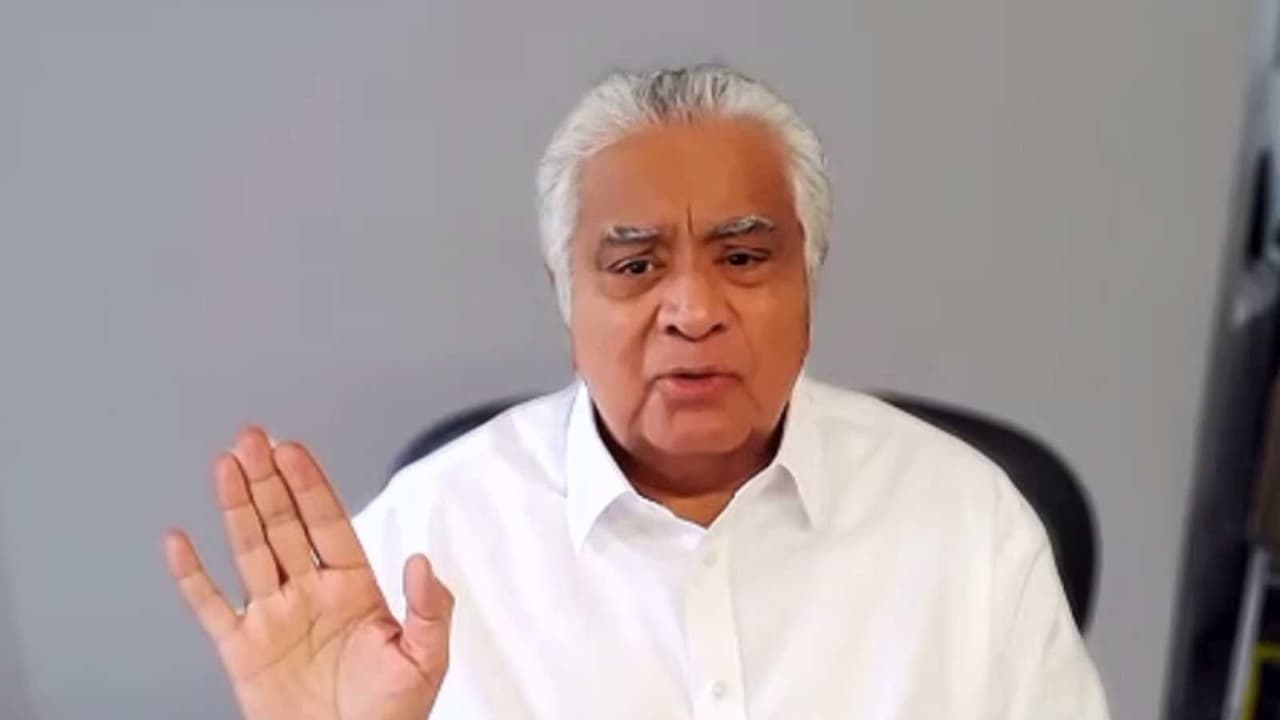
Former Solicitor General Harish Salve criticised the Opposition’s protest against CEC Gyanesh Kumar, saying political criticism should not target constitutional institutions as it undermines the country’s institutional framework.
Former Solicitor General Harish Salve on Wednesday criticised the Opposition’s ongoing protest against Chief Election Commissioner Gyanesh Kumar over the Special Intensive Revision (SIR) of electoral rolls, saying political criticism should not cross the “legitimate boundaries” or turn constitutional institutions into targets.
‘Politics getting beyond legitimate boundaries’
Speaking to ANI, Salve said political parties were free to criticise their opponents, but alleged attacks on constitutional institutions could undermine the functioning of the country’s institutional framework.
“I think the politics is getting a little beyond what its legitimate boundaries are. I can understand criticizing political parties, criticising political opponents, but constitutional institutions should not be made targets of political attacks, and that’s exactly what we see is happening today,” Salve said.
His remarks came as Opposition parties stepped up their protest against CEC Gyanesh Kumar over the SIR exercise, with leaders demanding greater clarity on the revision of electoral rolls and raising questions about the functioning of the Election Commission.
On alleged dissent within EC panel
Salve also questioned reports suggesting differences among the three Election Commissioners over decisions related to the SIR exercise. He said the reports did not establish clearly whether there had been a formal dissent or whether decisions had been taken collectively.
“Indian Express published an unsubstantiated, and not even a clear allegation – it published that there had been some objections. Did they decide by mutual agreement, or was it just the Chief Election Commissioner who was going counter to what his colleagues said?” he said.
Explaining how a three-member panel would ordinarily function, Salve said that a member who genuinely disagreed with a decision would be expected to record or raise such dissent rather than allow a decision to be presented as unanimous.
“If there are three people on a panel, if I am dissenting, if my colleague is dissenting, and the third person is saying, ‘No, this is a unanimous decision,’ I will say, ‘No, sorry, this is wrong, there’s no decision, won’t allow this to go through,’” he said.
Salve said the Election Commission’s subsequent clarification that its decisions were unanimous should have brought the controversy over alleged differences within the poll panel to an end.
“They had a press conference, they issued a press note… they’ve had a meeting in this, and then they issued a press note clarifying that all the decisions were unanimous, that should have put an end to all this nonsense,” he said.
He, however, said the controversy surrounding the alleged modification of Form 6 was a separate legal issue and should not be conflated with questions over the Election Commission’s institutional functioning.
“It’s a separate issue about Form 6, whether Form 6 has been validly amended, not validly amended, etc., that’s a separate matter,” Salve said.
‘EC co-equal, Supreme Court has final say’
The former Solicitor General also outlined the constitutional position of the Election Commission vis-a-vis other institutions, saying each constitutional body has authority within its designated sphere.
“The way our Constitution is structured, you have co-equal institutions. We have the Legislature, we have the elected Executive, you have the Judiciary, and the Election Commission is co-equal in the sense that in their own area, they are supreme,” he said.
He added that the Supreme Court has the final say when questions arise over whether a constitutional institution has acted beyond the boundaries prescribed by law.
“Any issue in which the other institutions transgress the lines, the boundaries laid down by the Constitution or by the law, the Supreme Court has the last word,” Salve said.
‘Dragging a constitutional institution into the mud’
His comments came as Opposition parties led by Congress president Mallikarjun Kharge continued their campaign against CEC Gyanesh Kumar. Following a meeting chaired by Kharge, Opposition leaders planned to march towards Jantar Mantar, with Leader of Opposition in the Lok Sabha Rahul Gandhi reiterating the demand for the CEC’s resignation.
The Opposition has accused the Election Commission of irregularities in the SIR process and has alleged concerns over electoral roll revisions. The Election Commission has rejected allegations of wrongdoing and maintained that its decisions were taken unanimously.
Salve said the Supreme Court’s examination of the matter could ultimately settle the controversy. He noted that the court could examine the relevant documents and, if it found any legal infirmity, could intervene.
“If the Supreme Court finds that there’s anything wrong, they will set aside the orders,” he said.
He further criticised what he described as the politicisation of the Election Commission, saying the dispute should be resolved through constitutional and judicial mechanisms rather than political attacks.
“This is just, unfortunately, dragging a constitutional institution into the mud, and an unfortunate turn in politics,” Salve said. (ANI)
(Except for the headline, this story has not been edited by Asianet Newsable English staff and is published from a syndicated feed.)