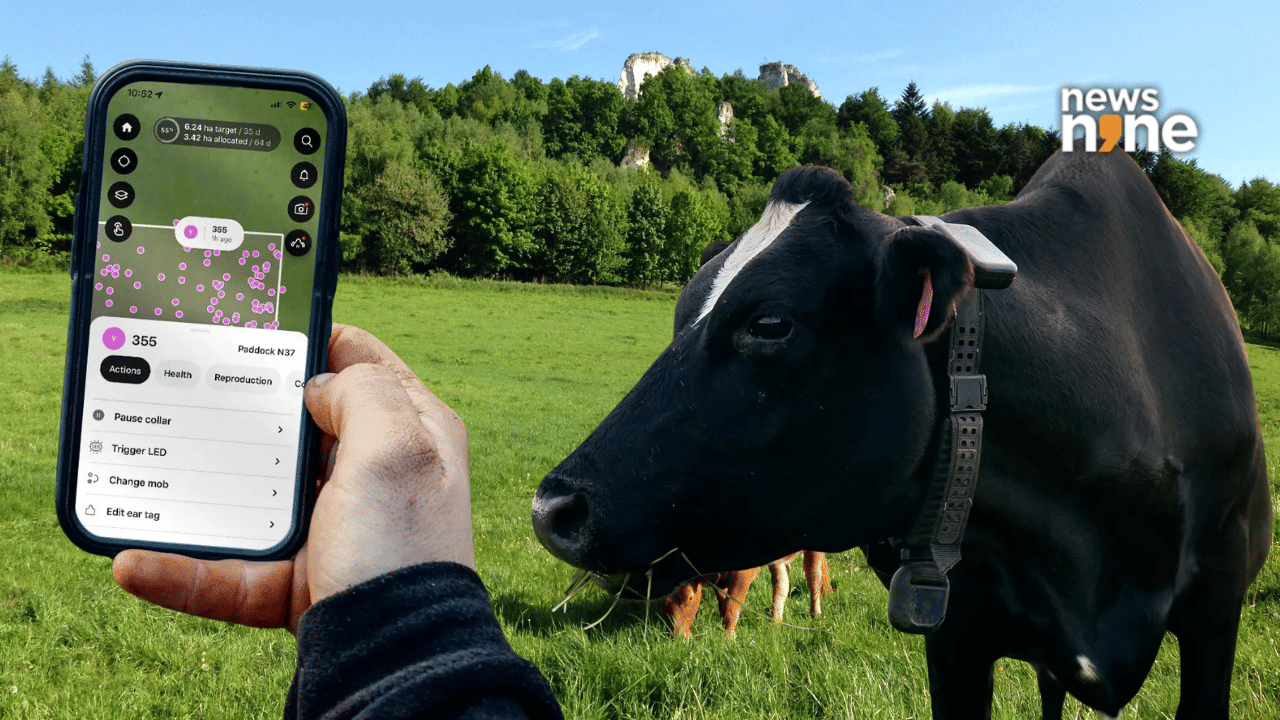
New Delhi: An Auckland-based startup is quietly turning heads in the global AI space, and this time it is not about chatbots or data centres. Halter, a company building AI-powered collars for cows, is now in talks to raise fresh funding at a valuation of around $2 billion, roughly ₹16,600 crore.
The development comes at a time when the agricultural tech sector has seen weak investor interest. Many startups have struggled to survive, yet Halter seems to be moving in the opposite direction. Strong demand from investors has made the current funding round oversubscribed, showing that some niche AI ideas are still attracting serious money.
How Halter’s AI collars work on farms
Halter’s idea is simple, but quite clever. The company builds solar-powered smart collars that farmers attach to cattle. These collars connect to a mobile app and help farmers track and manage their animals remotely.
Instead of building physical fences, the system creates virtual boundaries.
Here is what the collars can do:
- Track the location of each animal in real time
- Monitor health indicators and behaviour
- Guide cows using vibration and audio signals
So yes, cows can now be herded without a person walking behind them.
Funding talks and investor interest
According to people familiar with the matter, the new funding round is expected to be led by Founders Fund, the venture firm linked to Peter Thiel. Talks are still ongoing, and the final size of the round has not been fixed yet.
The company had earlier raised $100 million at a valuation of about $1 billion in 2025. Now, it is aiming to double that number.
Investor demand appears strong. One reason could be Halter’s clear business model. The company charges farmers a monthly fee per animal, usually between $5 and $8, making it a recurring revenue system.
AI meets agriculture
Agriculture has not been the fastest sector to adopt new technology. High costs and operational challenges have pushed many agtech startups into trouble in recent years.
Halter’s approach fits into what is often called precision agriculture. The goal is to use data and automation to improve productivity and reduce manual effort.
Founder Craig Piggott summed up the idea earlier, saying, “The goal was to make pasture farming more sustainable and productive using technology.”