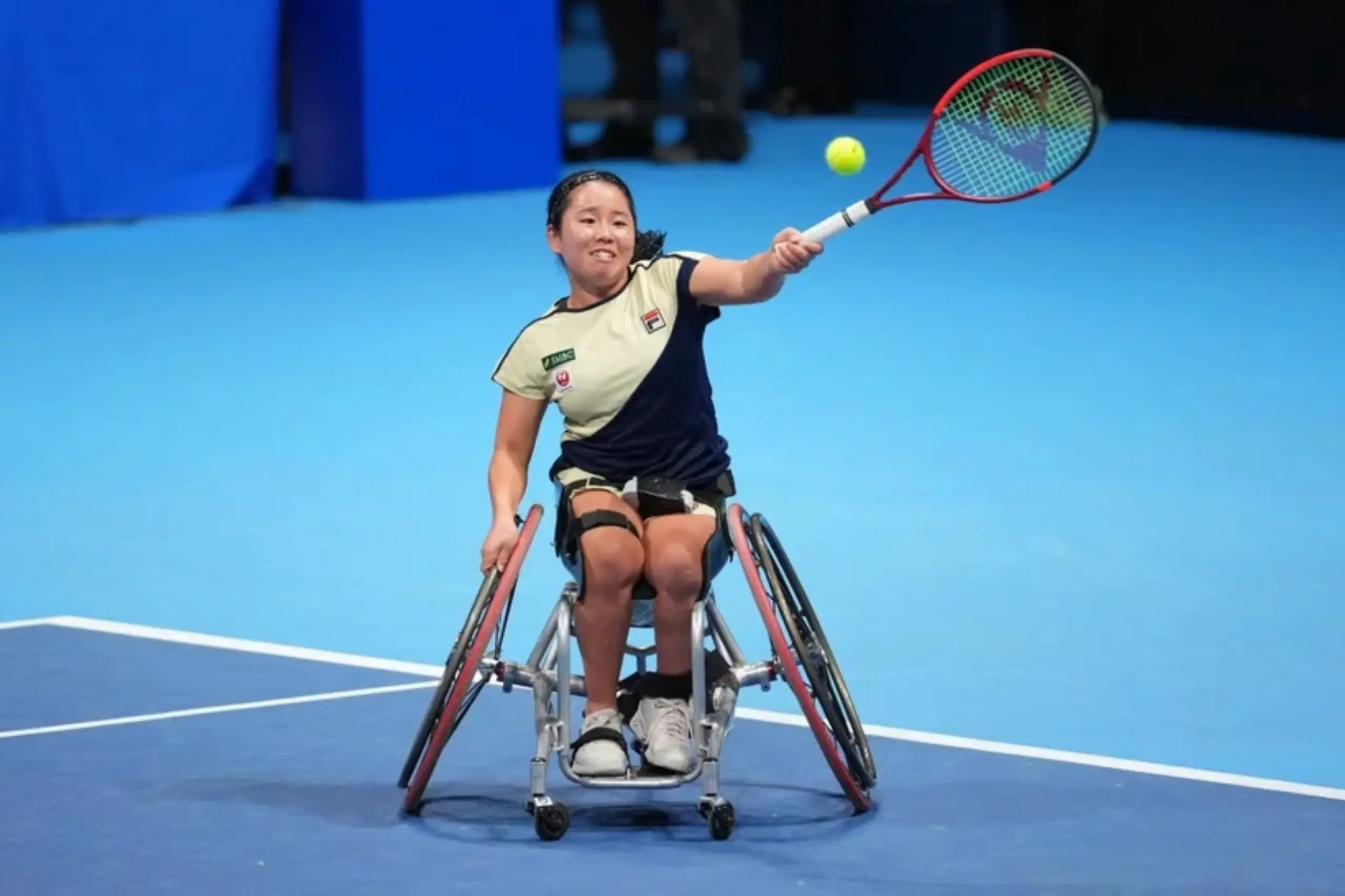
Wheelchair tennis witnesses a historic milestone in Abu Dhabi this weekend as the evergreen Jiske Griffioen prepares to face Yui Kamiji, the current world No.1, in Saturday’s final of the Mubadala Wheelchair Tennis Invitational presented by the WTA Foundation at the Mubadala Abu Dhabi Open.
The match marks the first time wheelchair tennis has been staged at a standalone WTA event in the UAE, underlining the tournament’s commitment to inclusivity and the global growth of the sport.
Griffioen advanced to the final following Thursday’s semi-final victory over María Angelica Bernal of Colombia, setting up a compelling clash between the 40-year-old Dutch veteran and Kamiji, who at 31 is nine years her junior and currently leads the women’s wheelchair tennis rankings.
A former world No.1 herself, Griffioen is one of the most accomplished players in the history of wheelchair tennis. During her career, she has won 20 Grand Slam titles (four singles and 16 doubles), claimed Paralympic gold, lifted seven Masters titles, and accumulated 59 singles titles and 106 doubles titles.
She held the world No.1 singles ranking for 106 weeks between 2015 and 2017 before retiring later that year, returning to competition in 2019.
Speaking about being part of the inaugural wheelchair invitational in Abu Dhabi, Griffioen said: ‘I’m so excited to be here. It’s so exciting for our Tour. We had shared stages with the Grand Slams previously, but this is the first time it’s a WTA event only and I think it’s really important that wheelchair tennis is represented there as well.
‘Everybody has been so welcoming. The courts are amazing. The crowd really likes it, so yeah, it’s been a really good week so far.’
Reflecting on the evolution of wheelchair tennis over the past two decades, she added: ‘It’s really funny because we have a lot of young players who don’t realise how we started 20 years ago.
‘They arrive with all these Grand Slams, and everything is amazing and there’s a lot of prize money, but when I grew up it wasn’t like that. We were playing small tournaments. There were no crowds. We were sharing a coach with 10 players.’
Griffioen credits the introduction of wheelchair tennis at the Grand Slams in 2002 as a pivotal moment for the sport.
‘The opportunity of a shared stage totally changed the wheelchair tennis tour, and it’s amazing to have witnessed that growth. When I was growing up, I could only dream of a Paralympic medal.
‘There was no dream for me as a junior player to win Roland Garros or Wimbledon, or to play on Court One at Wimbledon, or to play at a WTA event in Abu Dhabi – because it wasn’t there.’
Born with spina bifida, Griffioen initially represented the Netherlands in wheelchair basketball, competing at the Sydney 2000 Paralympics aged just 14, before choosing to focus on tennis.