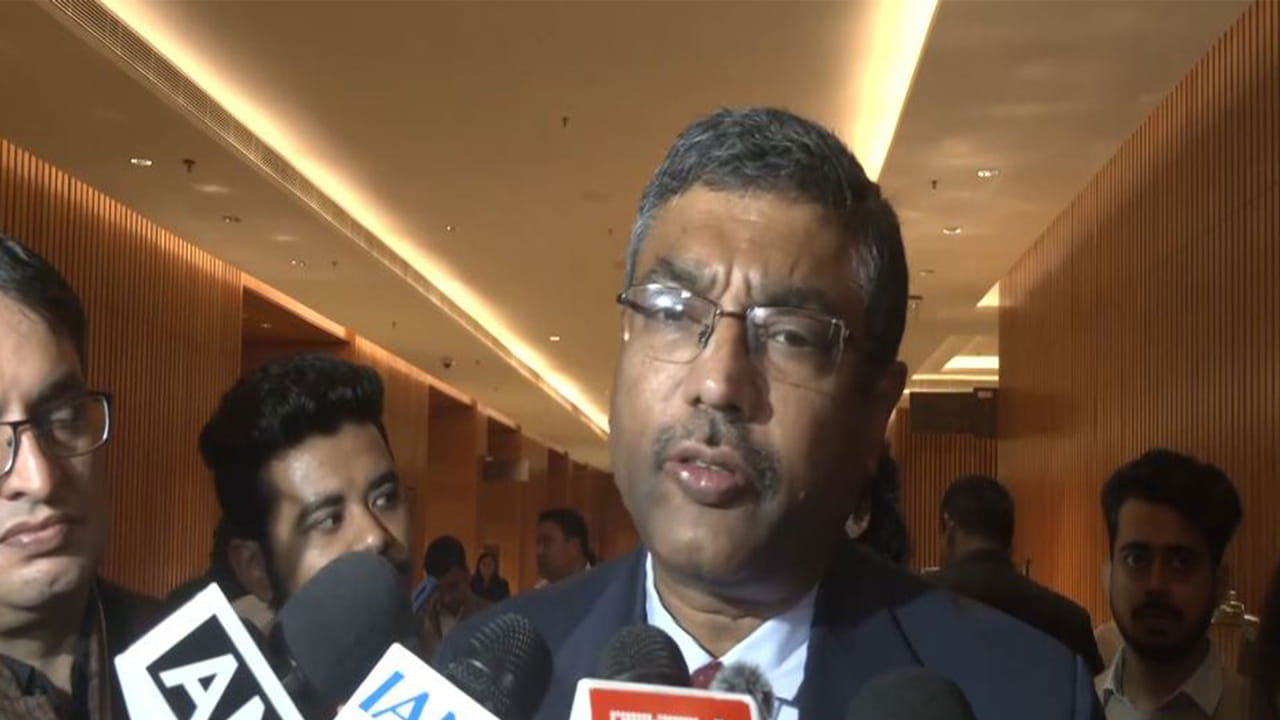
The government has found no misuse of IndiaAI Mission support given to Sarvam. MeitY Secretary S Krishnan confirmed that startup funds were used for indigenous model development while commercial offerings operate on a separate track.
New Delhi [India], November 25 (ANI): The government has found no misuse of assistance given to artificial intelligence startup Sarvam under the IndiaAI Mission in its commercial AI offerings, Ministry of Electronics and Information Technology (MeitY) Secretary S Krishnan said on Wednesday amid scrutiny over the firm hosting Chinese-developed AI models on its platform. Speaking to reporters, Krishnan stated that the government sees no violation in how Sarvam is running its commercial service alongside its state-backed model development. “Based on what Sarvam has told us, based on the experience that people have, we do not see any misuse of the support which the India AI mission has provided to Sarvam in the service that they are now offering.”
Krishnan noted that government support was targeted at building indigenous AI models, while Sarvam’s commercial services operate as a parallel track. “With the support that they received from the IndiaAI Mission, they first brought out a 105-billion-parameter model and a few other models. In addition, we are continuing to support them as they work towards a trillion-parameter model. That is the area for which we are supporting them,” he said. Backlash arose after Sarvam, one of the startups backed under the Rs 10,370-crore IndiaAI Mission aimed at strengthening domestic AI capacity and curbing reliance on foreign technology, began offering Chinese-developed AI models through its Token Factory platform. Launched earlier this month, Token Factory provides access to open-weight AI models from Chinese firms including DeepSeek, Alibaba, Moonshot AI, and Z.ai using compute infrastructure located within India.
Krishnan pushed back against claims of a contradiction between building frontier domestic models and running commercial offerings, arguing that AI startups need viable ways to earn revenue. “After all, AI companies also require a revenue model. They need a way in which they can monetise revenues. And many other such experiments have been tried,” he said. He added that several other startups had approached MeitY with comparable offerings and that government departments themselves use multi-model setups. “In fact, internally within the government also, we have some of these harness-based services which we are using,” Krishnan said, pointing to data protection benefits: “We are using open source open weight models because what it ensures is that the data does not leak out of the country.”
Earlier, Sarvam co-founder Pratyush Kumar clarified on X that the startup used subsidised access to graphics processing units (GPUs) under the IndiaAI Mission to train its indigenous Sarvam 105B model from scratch, whereas its commercial AI setup relies on privately funded hardware. “We serve multiple open-weight models on GPUs we have privately procured, without any government support,” Kumar wrote. Kumar added that roughly 20 startups received subsidised GPU access under the IndiaAI Mission, which includes a 40% discount on GPU compute costs, and underlined that India consumes a few trillion tokens each day while importing most of them. The debate highlights a practical tension shaping India’s AI ecosystem: while flagship initiatives like the IndiaAI Mission focus on sovereign compute infrastructure and homegrown foundation models, commercial AI startups face high compute and operating costs and often rely on open-weight models, including international ones, to build usable enterprise and developer products quickly. Running open-weight models domestically also allows Indian businesses and institutions to process data locally rather than routing sensitive workloads to external servers abroad. (ANI)