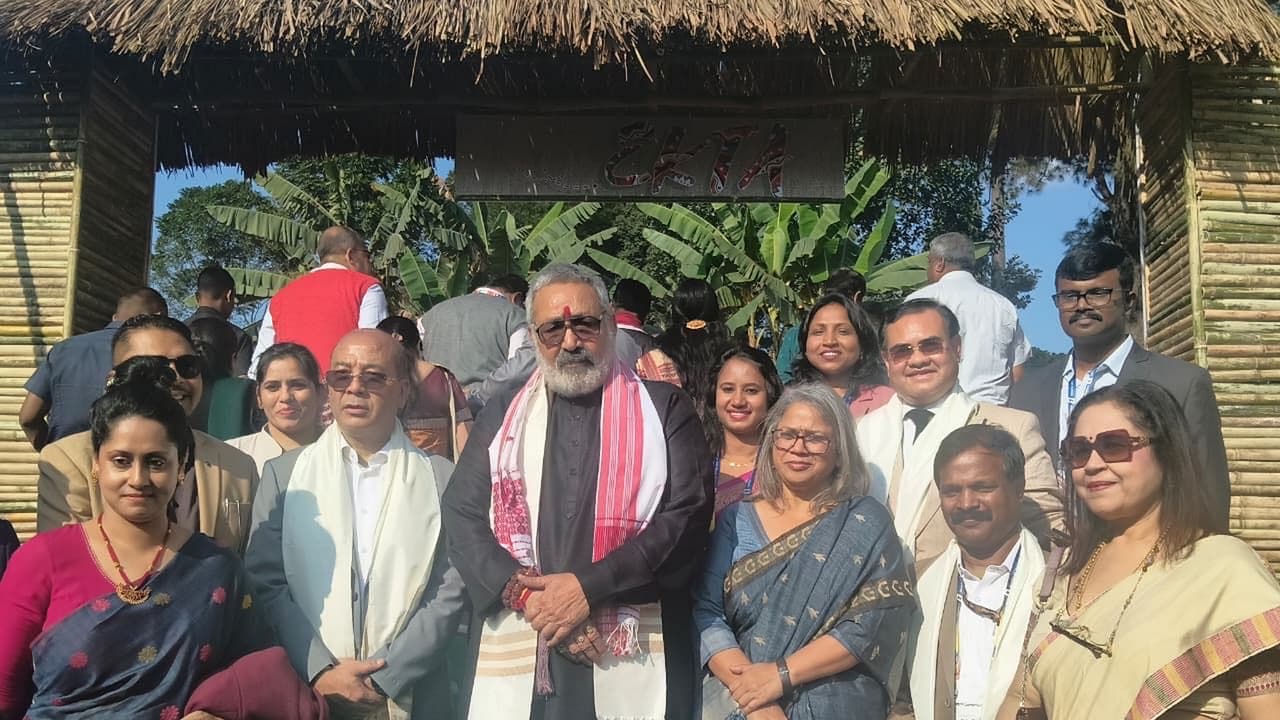
Union Minister Giriraj Singh inaugurated EKTA Meghalaya and the Integrated Textile & Tourism Centre in Nongpoh to strengthen the Northeast’s textile value chain. The initiative will boost Muga and Eri silk production and empower local artisans.
Union Minister of Textiles, Giriraj Singh, inaugurated EKTA Meghalaya (Exhibition cum Knowledge Sharing for Textiles Advantage) at Nongpoh, Ri Bhoi district of Meghalaya on Saturday. He also inaugurated the Integrated Textile & Tourism Centre (ITTC). The Union Minister was accompanied by Union Minister of State for Textiles, Pabitra Margherita, Minister of Textiles, Government of Meghalaya, Metbah Lyngdoh, MLA, Nongpoh Mayralborn Syiem, MLA, Umsning Dr. Celestine Lyngdoh, senior officials, artisans, weavers and local stakeholders.
PM’s Vision for Northeast’s Textile Heritage
Addressing the gathering, Union Minister Giriraj Singh said, “The Northeast is the pride of India’s textile heritage. It is the land of Muga, Eri and traditional weaving excellence. Under the leadership of Prime Minister Narendra Modi, we are committed to strengthening every link of the textile value chain in this region right from cocoon to global markets.”
The Minister highlighted that the ITTC will serve as an integrated platform for training, design development, silk processing, product diversification and tourism, enabling Meghalaya’s artisans to access national and international opportunities. He noted that the Government of India is implementing multiple schemes to support handloom clusters, improve raw material availability, modernise weaving technologies and promote natural fibres globally.
Boosting Farmers’ Income
The Minister announced new efforts to boost farmers’ income. “Today we discussed moving from two Muga crops to three, so farmers can double their income. One acre can yield four to five lakh rupees with best practices. The Central Silk Board and the State Sericulture Department will work together to make this a reality,” the Union Minister said.
Aiming for Global Silk Leadership
He emphasised the need to build an ecosystem that unlocks the region’s full potential, stating, “India is the only country producing different silks – Muga, Tasar, Mulberry and Eri. If Meghalaya and the North East scale up Muga and Eri, India can become a global leader, especially as other countries shift to synthetics.”
Key Initiatives Announced
Union Minister Giriraj Singh highlighted the Government’s commitment to building a strong textile and sericulture ecosystem in the Northeast. He announced the establishment of a new Weavers’ Service Centre (WSC) in Meghalaya.
New Weavers’ Service Centre for Meghalaya
“In Guwahati, the Weavers’ Service Centre is a vital hub offering technical and design support to weavers. Right now, we have only one such Centre in the region. I will now set up one in every state – starting from Meghalaya, once land is allotted by the state government,” he said. Emphasising the region’s comparative advantage, he stated, “I am fully confident that the North East can become a major buyer-seller hub. From Guwahati, it takes just one hour to reach natural silk production centres. This is a unique strength.”
‘Pachlakhia Didi’ Livelihood Model
Highlighting the Ministry’s livelihood-focused initiative, he said, “My goal is to connect every weaver to an income of fifty thousand rupees per month – this is our ‘Pachlakhia Didi’ model. We have prepared the roadmap, and we will implement it in Meghalaya with the State Government’s support.”
The Union Minister also interacted with master weavers and local producers, who expressed gratitude for the new facility, noting that the ITTC will help them access training, raw material support and better market opportunities.
Northeast Artisans on the Global Stage
Union Minister of State for Textiles, Pabitra Margherita, highlighted the significant presence of Northeast artisans on global platforms. He recalled, “At BharatTex recently, one of the largest textile events in the world, over two lakh industry stakeholders and 6,000 international buyers participated. On that same stage, a weaver from a remote village in Meghalaya presented their fabric with pride. This is the power of integration and India’s growth story under Prime Minister Narendra Modi ji.” He emphasised that 52% of India’s handlooms are located in the Northeast, making the region one of the strongest textile clusters in the country. He also informed that all textile ministers from across India will convene in Guwahati next month to deliberate on a Northeast-focused textile development agenda.
State Government Hails ‘Transformative’ Project
Minister of Textiles, Government of Meghalaya, Metbah Lyngdoh, expressed deep gratitude to the Ministry of Textiles for supporting the State’s aspirations. Describing the ITTC as a “historic and transformative project,” he said, “This Centre represents the coming together of tradition, skill and vision for Meghalaya’s cultural and economic future. It will empower artisans, revive our rich silk heritage, and position Nongpoh as a unique destination for textile tourism.” He highlighted that the ITTC, built under the North East Regional Textile Promotion Scheme, has been envisioned as an artisan empowerment hub, a living museum for Ryndia, Eri and Muga silk, a centre for training, design development and product innovation, and a textile-tourism destination that will directly benefit local communities.
ITTC: A ‘Symbol of Meghalaya’s Textile Renaissance’
Frederick Kharkongor, Principal Secretary, Textiles, Government of Meghalaya, expressed gratitude to the dignitaries and highlighted the significance of the new Integrated Textile & Tourism Centre (ITTC). Kharkongor, described the new facility as a symbol of Meghalaya’s textile renaissance. He said, “The Integrated Textile Tourism Centre – ITTC – is an acronym that tells its own story.”
Elaborating on its meaning, he added, “The Ts represent Textile, Trade and Tourism, and they also speak to Texture and Tradition. The C stand for Craft, Cuisine and Culture. Together, ITTC brings all these elements under one roof, creating a space that reflects the full spectrum of Meghalaya’s textile identity.”
Kharkongor highlighted that the Centre is envisioned not merely as a physical complex but as a creative ecosystem that connects people, culture and heritage. “This Centre aspires to bring together the threads of hands and hearts, harmony and heritage, and ultimately, skill and hope,” he said. He noted that the region surrounding Nongpoh is home to a thriving weaving and sericulture community. “For the weavers and artisans of the 62 villages in this area, who form the epicentre of our handloom and sericulture activity, the ITTC will stand as a beacon of opportunity and transformation,” he added.
Milestones: GI Tag and a ‘Game Changer’ Year
He also highlighted key milestones, including the recent GI recognition. “The year 2025 has been a game changer for Meghalaya textiles-from the GI tag for Ryndia to the unveiling of this iconic ITTC. Together, these achievements place our state firmly on the national textile map,” he added.
Central Silk Board Pledges Support
P. Sivakumar, Member Secretary, Central Silk Board, appreciated Meghalaya’s traditional silk sector, stating, “Muga and Eri are not just fibres, they are the cultural and economic strengths of this region. The ITTC will provide scientific, technical and commercial support to enhance silk production, ensure quality, and expand market outreach.” He reaffirmed the Central Silk Board’s commitment to supporting Meghalaya in seed production, rearing capacity, yarn quality enhancement and cluster development.
Showcasing Tradition and Modern Design
During the programme, artisans, weavers and trainees showcased live demonstrations on reeling, spinning, natural dyeing, loom operations and value-added processes. A special highlight of the programme was the showcase of traditional Ryndia textiles by leading Meghalaya designers Iba Mallai and Daniel Syiem. Their collections celebrated eco-friendly weaving traditions, natural dyeing methods, and the rich cultural narratives of local artisans.
EKTA Meghalaya: A Unified Exhibition
The Central Silk Board (CSB) under Ministry of Textiles in association with the Department of Textiles, Government of Meghalaya, placed exhibition stalls during EKTA Meghalaya (Exhibition cum Knowledge Sharing for Textiles Advantage) at the Centre Nongpoh. EKTA Meghalaya brings together Silk, Handloom, Handicrafts, Jute, and Technical Textiles on one platform, promoting knowledge sharing, innovation, market linkages, and inter-state collaboration.
The event was attended by senior officials from the Ministry of Textiles, Government of Meghalaya, Central Silk Board, local industry leaders, artisans, students and community representatives. (ANI)
(Except for the headline, this story has not been edited by Asianet Newsable English staff and is published from a syndicated feed.)