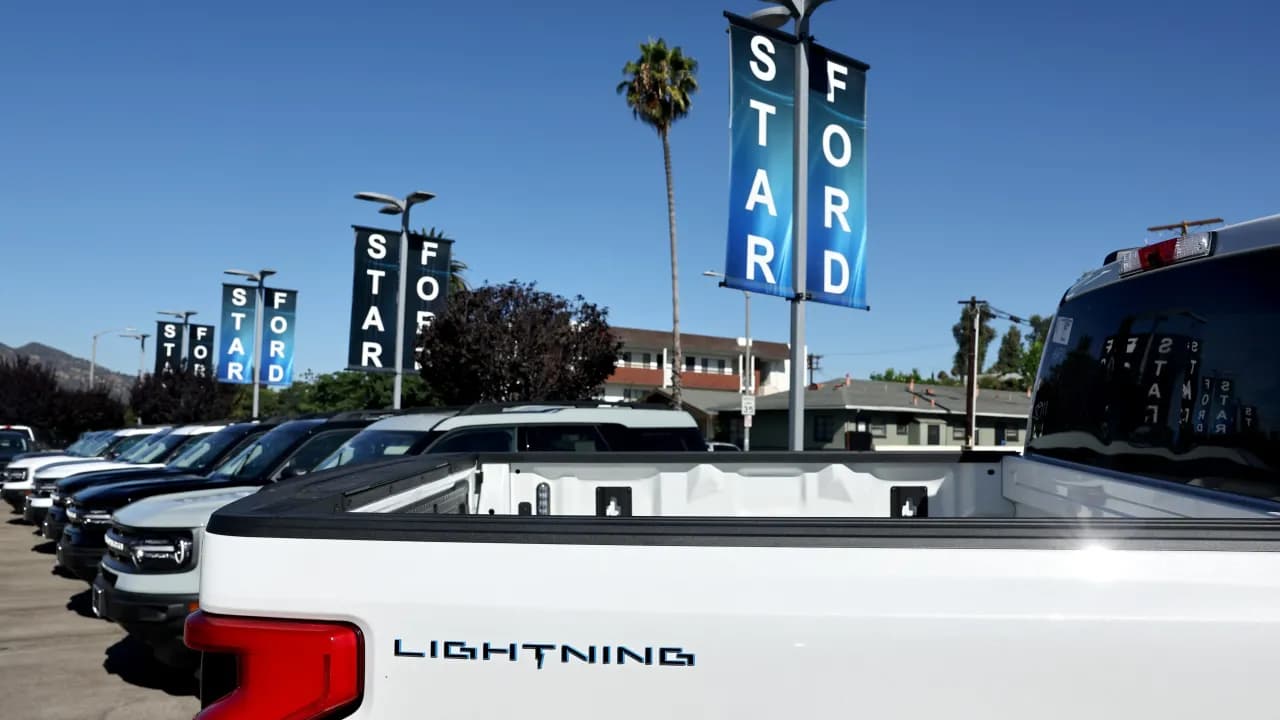
While a majority of the $19.5 billion charges would be incurred in the fourth quarter, the remaining will be incurred in 2026 and 2027, Ford said.
- Ford said that it will stop making the F-150 Lightning as a battery electric pickup truck and instead make an extended range version of it.
- The company also launched a new energy storage business to feed the growing demand for energy from data centers and boost revenue from its underutilized EV battery capacity.
- The company also raised its adjusted pretax earnings outlook to about $7 billion in 2025, up from its previous forecast of $6 billion to $6.5 billion.
Ford Motor’s (F) decision to pull back on electric vehicles and take a $19.5 billion charge is “good news for Tesla,” according to Deepwater Management managing partner Gene Munster, who said the retreat by legacy automakers strengthens the competitive position of the pure-play EV maker.
Munster added in a post on X that it is “hard to see” how a large autonomy business can be built on hybrid vehicles.
Ford Pulls Back On Select EV Models
Dearborn-based automaker Ford Motor Co said on Monday that it expects to incur $19.5 billion in EV-related charges as it kills several EV models to stem losses from the segment.
While a majority of the charges would be incurred in the fourth quarter, the remaining will be incurred in 2026 and 2027, the company said.
The company said that it will stop making the F-150 Lightning as a battery electric pickup truck and instead make an extended range version of it, which is essentially an electric car that uses an electric motor for all propulsion but includes a small gasoline engine that acts as a generator to recharge the battery. The new generation Lightning truck will be assembled at the Rouge Electric Vehicle Center in Dearborn, Michigan.
“Ford no longer plans to produce select larger electric vehicles where the business case has eroded due to lower-than-expected demand, high costs and regulatory changes,” the company said.
Pivot Into Hybrids And Gas Guzzlers
CEO Jim Farley noted that the move is centered on customer demand. “The operating reality has changed, and we are redeploying capital into higher-return growth opportunities: Ford Pro, our market-leading trucks and vans, hybrids and high margin opportunities like our new battery energy storage business.”
Ford expects approximately half of its global volume will be hybrids, extended-range EVs and fully electric vehicles by 2030, up from 17% in 2025. For the North American market, it now intends to make smaller, and more affordable electric vehicles based on its universal EV platform.
The first vehicle from the platform will be a midsize pickup truck assembled at Louisville Assembly Plant starting in 2027. The company also replaced a planned electric commercial van for North America with a new, affordable commercial van with both gas and hybrid models that will be produced out of its Ohio assembly plant. The company now aims to reach profitability for its EV business called Model e by 2029.
New Energy Storage Business To Stoke Revenue From Existing EV Battery Capacity
The company also launched a new energy storage business to feed the growing demand for energy from data centers and boost revenue from its underutilized EV battery capacity. The company intends to repurpose its existing U.S. battery manufacturing capacity in Glendale, Kentucky for the purpose and convert it to manufacture 5 MWh+ advanced battery energy storage systems. The company also plans to invest roughly $2 billion in the next two years to scale the business and deploy at least 20 GWh annually by late 2027.
Last week, the company disposed of a joint venture with South Korea’s SK On, as a result of which its unit now owns and operates the Kentucky battery plants.
Ford said that it will also utilize BlueOval Battery Park Michigan in Marshall, Michigan, to produce smaller Amp-hour cells for use in residential energy storage solutions.
Fresh Outlook
The company also raised its adjusted pretax earnings outlook to about $7 billion in 2025, up from its previous forecast of $6 billion to $6.5 billion.
The company also said that it plans to hire thousands of people across America to support the many actions planned.
Waning Government Support
The hard pivot into gas and hybrid vehicles comes amid waning government support for EV vehicles. In November, Ford’s EV sales fell about 61% after the Trump administration removed federal tax credit on the purchase of EVs, effectively hiking the end price for consumers.
Earlier this year, Ford said it expected to lose roughly $5 billion to $5.5 billion on its EV business in 2025, roughly the same as in 2024.
Ford’s rival General Motors took a $1.6 billion charge in October after it pulled back on its EV capacity. The company also signaled that more write-downs are in store.
How Did Stocktwits Users React?
On Stocktwits, real sentiment around Ford stock fell from ‘neutral’ to ‘bearish’ territory over the past 24 hours, while message volume rose from ‘normal’ to ‘high’ levels.
A Stocktwits user now sees further write downs from GM.
Another echoed Munster’s sentiment, highlighting that the loss of EV credits is hurting Tesla’s many competitors.
F stock is up by 38% this year and by about 37% over the past 12 months.
For updates and corrections, email newsroom[at]stocktwits[dot]com<