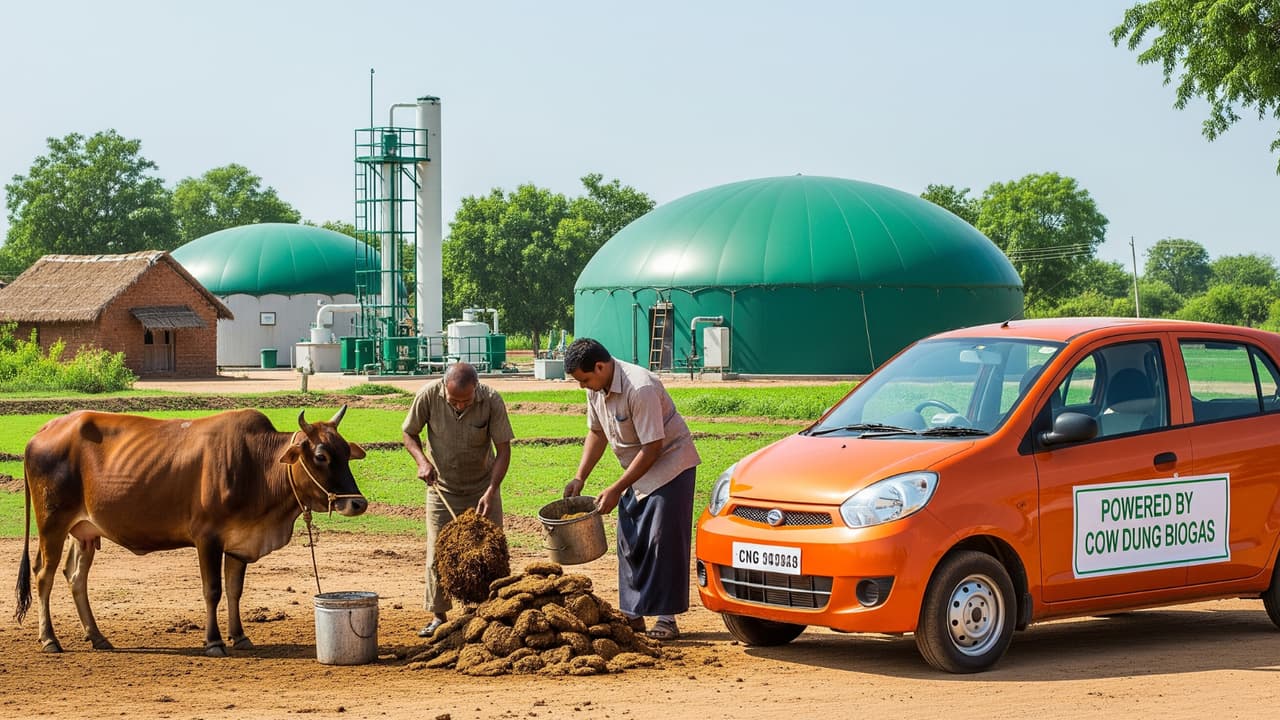
Due to the vision of Chief Minister Yogi Adityanath, the cow-based economy in Uttar Pradesh is getting new strength. Compressed biogas produced from cow dung will reduce dependence on oil and LPG, increase the income of cowherds and make villages self-reliant.
Now in Uttar Pradesh, cow is not just a symbol of faith and tradition but is going to become the pivot of a strong economy. Under the vision of Chief Minister Yogi Adityanath, such an energy model is taking shape in the state, in which compressed biogas (CBG) made from cow dung will not only reduce the dependence on petroleum products, but will also open the way for permanent income for thousands of cowherds. UP is rapidly gaining its place among the leading states of the country in the field of renewable energy.
Solid strategy to reduce dependence on oil and LPG
According to the plan of the state government, biogas will be prepared from cow dung on a large scale and converted into compressed biogas. It can be used from cooking gas to vehicle fuel. Scientific assessments of experts show that if methane from the dung of one lakh cows is exploited in the state, it is possible to save about Rs 500 crore in petroleum products. This savings will directly help in reducing dependence on imports of crude oil and LPG.
From the year 2022 till now, more than 26 CBG plants have been installed in the state under UP NEDA. Production from these plants has started in districts like Lucknow, Gorakhpur, Mathura, Muzaffarnagar, Meerut, Bulandshahr, Barabanki, Badaun, Bareilly and Mirzapur. Apart from this, more than 21 new CBG projects are under construction in different parts of the state, which will further increase the capacity of energy production in the coming time.
Also read: Voice of development will rise from Ramgarhtal, powerful message from CM Yogi in Gorakhpur Mahotsav
Plan to establish CBG as alternative fuel
According to Go Seva Aayog Chairman Shyam Bihari Gupta, work is underway on a phased action plan to establish CBG as an alternative fuel. Preliminary technical assessments show that on an average about 10 kg of dung is obtained per day from an indigenous cow. Biogas containing methane can be made from this dung.
According to Dr. Anurag Srivastava, OSD of Go Seva Aayog, after purification, this gas becomes compressed biogas, which can be used as fuel in domestic kitchens and vehicles. This will reduce pressure on traditional sources of energy and promote clean fuel.
New way to increase the income of cattle herders
Cow herders are going to get the biggest benefit of this model. Cow dung, which was earlier considered limited only to agriculture or cow sheds, is now becoming a source of income. Experiments like Barabanki’s CBG plant and Mathura’s Shri Mataji Gaushala, operated with private participation, are proof that this model can be successful on the ground.
Big step towards making villages self-reliant
This cycle of increasing agricultural productivity through cow dung, energy through bio-fertilizer and bio-fertilizer can change the economic picture of villages. This will not only reduce the costs of farmers, but will also increase production. Besides, the state will get strength in the direction of energy security.
This vision of Chief Minister Yogi Adityanath clearly indicates that in the coming times, Uttar Pradesh will emerge as a strong model of renewable energy, rural employment and the concept of self-reliant India. Cow, which has been a part of rural life for centuries, is now going to give a new direction to the economy of the state.
Also read: Mahakumbh 2025: 66 crore devotees, 60 lakh cyber attacks and ICCC’s historic success