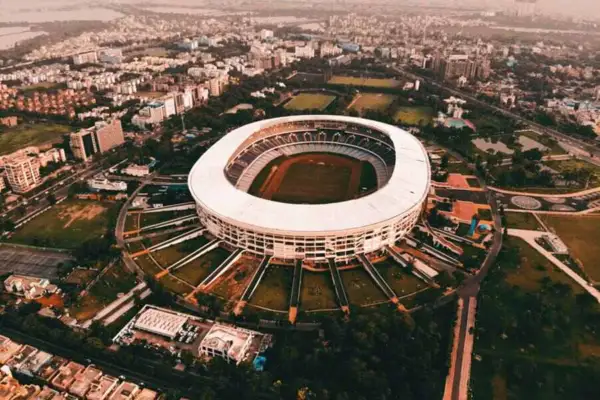
The Salt Lake Stadium pitch is close to being ready for India’s international friendly against Brazil on October 3 after nearly a month of restoration work supervised by Brazilian turf expert Ivan Nascimento.
The five-time World Cup winners will face India at the Vivekananda Yuba Bharati Krirangan before the Blue Tigers take on Uruguay at the same venue on October 6.
Concern over the playing surface arose after a Brazilian Football Confederation delegation inspected the stadium following the announcement of the Brazil fixture. The All India Football Federation then asked the CBF to send an expert to help prepare the pitch.
Nascimento, who arrived from Brasilia and worked alongside the local ground staff, said the surface was uneven and the grass had grown too tall when the restoration began.
“Our main goal was to regularise the processes and the soil. We found some unevenness in the soil, with waves on the surface, and the grass was also very tall,” Nascimento told Sportstar.
“So, we started with the agronomic work and then moved on to coordinating the operations so that we could transform this field into a standard international playing field.”
The pitch was converted from artificial turf to a natural Riviera Bermuda grass surface ahead of the 2017 FIFA Under-17 World Cup. Regular Indian Super League seasons and other tournaments have since taken a toll on it.
“The main changes we had to make were to correct the soil level and make the necessary agronomic adjustments, particularly with the fertilisation,” Nascimento said.
“After the initial analysis, we were able to draw up a plan for what needed to be done over the following months. My role then involved coordinating the daily operations, observing and understanding how the field responded to each intervention.
“In this way, we could make accurate decisions to reach the final goal: a healthy field that allows the players to perform without getting injured and provides a good spectacle for television.”
The restoration involved levelling the surface, aerating the soil, repairing hardened areas and changing the mowing pattern.
“The main interventions were related to levelling. We needed to carry out drilling, which is aeration, to allow air to enter the soil. After that, we were able to use a roller and transform the uneven surface into a much flatter field,” Nascimento said.
“Then we did very specific work on the areas where the playing lines would be painted. There was a very large deposit of paint, which was making the soil extremely hard. After correcting that, we started the mowing process.”
Nascimento said the grass was mown in the opposite direction from the previous pattern. The team also fertilised the pitch and introduced measures to control fungus and insects.
Once the grass had been restored, work began on creating the alternating light and dark green stripes visible across the playing surface.
“We came from Brazil with two teams, an agronomic team that included me and a team from the stadium department,” Nascimento said.
“We adjusted the operation day by day, but we also had the support of the local team that already takes care of the lawn and the pitch, which has been fantastic.”
Nascimento is accustomed to restoring football pitches within tight schedules. His company, Arenas, works at the Mané Garrincha Stadium in Brasilia, where concerts are regularly held between football matches.
“In the gaps between the matches, we host a number of international concerts, which really damages the turf,” he told Sportstar.
“As a result, we are constantly changing, replacing and restoring the grass several times a year. In fact, this November, I am replanting the entire field.”
Both Brazil and India are scheduled to train at the Salt Lake Stadium on the eve of their match.
“According to the protocol, there will be no separate training pitch. Brazil will be training on the main pitch the day before the match. Brazil will train from 4pm to 5pm, and then India will train from 6pm to 7pm,” Nascimento said.
“So, we have a field that will accommodate both teams’ training sessions. We will prepare it for the match and also for the subsequent game against Uruguay on October 6.”
Nascimento said the work had brought the pitch close to the required standard, although some improvements were still needed.
“Today, we don’t have a 100 per cent field, but I would say we have reached something close to 90 per cent, with acceptable levelling, good colour and important grass density,” he said.