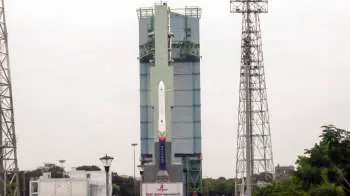
In a historic milestone for India and its space sector, Vikram-1, which is the country’s first privately developed orbital-class rocket, was successfully launched by Skyroot Aerospace from the Satish Dhawan Space Centre (SDSC-SHAR) in Andhra Pradesh’s Sriharikota on Saturday.
Dubbed as ‘Mission Aagaman’ (meaning arrival), it was described as a “grand success” and Prime Minister Narendra Modi termed it a defining moment in India’s space journey.
“Spoke to the team of Skyroot Aerospace and congratulated them on the successful launch of Vikram-1,” (formerly Twitter). “The growing participation of our private sector is opening new frontiers and accelerating innovation. This achievement will encourage countless youngsters to dream bigger and innovate fearlessly.”
As India celebrates the successful launch of Vikram-1, here’s a look at the country’s space achievements:
Mars, the Moon, the Sun, and the ocean floor
India became the first Asian nation to place a spacecraft in Mars’ orbit in 2014, and is notable for its low cost relative to comparable missions by the US, Russia and the European Union.
The lunar programme, Chandrayaan, included an orbiter in 2008, a failed landing attempt in 2019, and a successful 2023 mission that deployed a rover, making India the fourth country to land an unmanned craft on the Moon. A fourth Chandrayaan mission set for 2027 is expected to bring back Moon samples, and a Venus orbit mission is slated for 2028.
An ongoing solar mission, Aditya, is observing the Sun’s outermost layers and space weather.
ISRO’s technology is also being used to develop the Matsya submarine. The Matsya submarine project aims to carry scientists six kilometres below the surface by 2027 to access deep-ocean mineral resources, including rare earths, according to Union Science and Technology Minister Jitendra Singh.
India’s satellite economy
India’s satellite programme dates to 1975, when its first satellite was launched on a Soviet rocket. Since then, ISRO has launched more than 430 foreign satellites, generating over USD 600 million, and more than 144 domestic satellites.
The country is expanding its launch facility at Sriharikota and building a second spaceport at Kulasekarapattinam in Tamil Nadu. The space projects will grow to USD 44 billion by 2033 and USD 100 billion by 2040, according to New Delhi’s projection.
Defence space and civil space sectors are interlinked
India’s civil space and defence sectors are connected, with several companies supplying both. Rocket, propulsion, satellite and guidance technologies developed for ISRO also support the country’s missile and military drone programmes. ISRO has cited “active coordination” with the Defence Research and Development Organisation and maintains close ties to the BrahMos missile programme, a joint India-Russia venture.
India’s first crewed spaceflight mission – Gaganyaan
India is also preparing for its first crewed spaceflight, Gaganyaan, with the first of three planned uncrewed test flights expected in late 2026. The mission aims to send three Indian astronauts into a 400-kilometre orbit for three days.
As part of preparations, Indian Air Force pilot Shubhanshu Shukla joined the SpaceX Dragon flight to the International Space Station in 2025, becoming the first Indian to reach the International Space Station.