Indian boxing has witnessed several significant moments over the years, and August 1 in Glasgow is certain to rank among the finest. In front of a raucous crowd at the SEC Centre, the Indian pugilists won an astonishing seven gold medals – 10 overall – at the Commonwealth Games, an achievement that took everyone by surprise, including the federation, the coaches and support staff.
Leading the charge on that magical night were the women who captured a whopping five golds (Sakshi Chaudhary, Preeti Panwar, Jaismine Lamboria, Priya Ghanghas, Arundhati Choudhary) and a silver (Lovlina Borgohain). Once again, Indian women had outshone their male counterparts on the big stage, showing how far they’ve come in a sport that fully opened its doors competitively for them just about a decade and a half ago.
It’s not just this Commonwealth Games where the women have outperformed the men. At the 2022 edition in Birmingham, they won three medals as compared to four by men, but they were better on the gold count with Nitu Ghanghas and Nikhat Zareen triumphing as compared to just Amit Panghal standing on top of the podium for the men. One might argue that winning CWG medals is a bit easier as compared to other competitions, as some of the superpowers of the sport like Kazakhstan, Uzbekistan, Cuba and Russia are missing in action. But Indian women have been excelling even at Asian Games, Olympic Games, as well as World Championships – all three being marquee competitions.
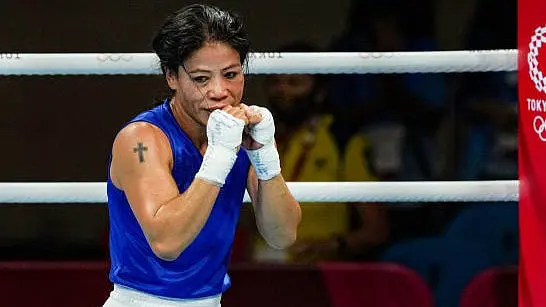
Let’s first take the Olympics – the pinnacle of the sport. While Vijender Singh did break the glass ceiling by winning the sport’s maiden medal for the country with a bronze in Beijing 2008, the legendary MC Mary Kom brought about a revolution with a medal of the same hue four years later in London when women’s boxing was introduced at the quadrennial extravaganza. Then Lovlina won a bronze in Tokyo 2020 to ensure the women led 2-1.
Then comes the Asian Games, a competition as tough as the Olympics because of the ‘stan’ nations. Women (overall) only entered the fray from 2010, but since then the Indians have carved a niche for themselves. On their debut, they matched the men’s tally of 2 medals, but four years later in Incheon, they won two medals – one more than men. Indians drew a blank together in 2018, but in Hangzhou three years ago, women bagged three medals as compared to just one by men.
Finally, the World Championships. While the men have won 10 medals – 9 bronze and a silver – Mary Kom alone has bagged a staggering eight medals, including a mind-boggling five consecutive golds. In total, the women have scaled the podium a jaw-dropping 43 times as compared to just 10 by the men. Such has been their success – phenomenal in fact – former Indian boxer Akhil Kumar, in an interview with PTI, suggested the federation and ministry should prioritise women’s boxing as they have better chances of winning a medal than men at the Los Angeles Olympics in two years’ time.
So what has brought about this massive strike rate in women, in a sport that many parents once dreaded their daughters pursuing it, considering the brutal nature of it where maximum damage occurs to the face? Chhote Lal Yadav, the former coach of Mary Kom who now works with Jaismine, Sakshi, Arundhati and Preeti at the world-class Army Sports Institute in Pune, felt equal opportunities given to women nowadays have played a major role in their staggering rise.
“The ASI in Pune is one of the best facilities in the world. Our girls now have a better head start as compared to a decade ago. We all have heard about the struggles of Mary Kom during her earlier years, but now an aspiring woman boxer, once she becomes a part of the programme, has access to everything. Right from training to physios to mind coaches to nutrition, nothing is lacking for them,” the respected coach told DHoS.
“Women have also become more aspirational now, and they don’t fear anything. Let alone boxing, see wrestling and weightlifting. It’s no longer a male domain. Speaking of boxing, many of these girls have seen Mary Kom attain cult status, and they want to replicate it. The BFI has done some excellent work at the grassroots level. The talent pool is much stronger now, thanks to the various programmes being carried out. At the national level, there’s immense competition at different weight categories. A key game-changer has been the Khelo India games at the youth level that provide financial incentives.”
Santiago Nieva, the head coach of the women’s national team who previously served as the High Performance Director from 2017-2022, feels Mary Kom’s early success paved the way for a generation of boxers to follow in her footsteps. “Success breeds success. Early on, we had role models in women’s boxing like Mary Kom and Sarita Devi. Mary Kom winning the Olympic medal will always be a defining moment for women’s boxing. It showed them if one is determined and works hard, anything is possible. Then came Sarita Devi. Thankfully, the BFI invested heavily in women’s boxing.
“In many other countries, there are fewer female boxers, or they don’t invest as much in women’s boxing. So, in that sense, there are more male boxers there. So, there are more boxers to fight for one medal in men’s boxing. Just by statistics, it makes it harder to get a medal in men’s boxing. Fortunately, in India, we support equally both men’s and women’s boxing. All that investment is paying off beautifully now.”
The 24-year-old Jaismine, one of the gold medal winners at the CWG and a bright future prospect, feels parents’ mentality has completely changed now. “Women’s boxing has grown by leaps and bounds in the country. The girls are achieving a lot of things. Unlike old times, women get good support now. Be it from family, federation, government, or the Army in my case… nothing is lacking for us. The whole ecosystem has changed. That is why women are able to do better. I see a bright future for women’s boxing in the country.”
CA Kuttappa, the head coach of the men’s team, feels the change started in 2006 and is confident of women doing well at the upcoming Asian Games and the Olympics in two years’ time. “At the 2006 World Championships, Indian women boxers won six medals. Since then, they have been extremely successful. The talent pool has also increased. If they keep up their form, I’m confident we could have one of the most successful Asian Games ever.”